CSXT to replace Mobile, Ala., swing bridge
Written by jrood


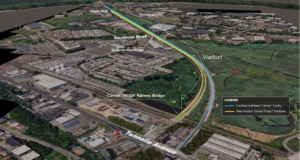
CSX Transportation Inc. awarded a $60-million contract to Scott Bridge Company of Opelika, Ala., for the alteration of the 14-Mile Bridge over the Mobile River. The total project cost is estimated at $72 million, which includes the construction contract to the Scott Bridge Company. The project is being funded largely by the federal government (approximately 94 percent) under the Truman-Hobbs Act, which is administered by the U.S. Coast Guard.
The federal portion of
the project results from appropriations under the American Recovery and
Reinvestment Act of 2009 and previous year bridge alteration appropriations.
CSXT will pay approximately six percent of the project cost, which includes
design improvements and communications and signals work.
The bridge alteration
project serves to more than double the capacity for commercial and pleasure
vessels using the waterway. The existing 14-Mile Bridge was constructed in
1925. It operates as a swing span, pivoting to allow barges and other vessels
to pass, and provides a 146-foot channel horizontal clearance for vessels.
The proposed alteration
replaces the existing swing span with a vertical lift span to provide an improved
channel horizontal clearance of 300 feet. The lift span will rise 60 feet,
providing plenty of vertical clearance for vessels that routinely use the
waterway.
"We are looking
forward to working closely with the Coast Guard and Scott Bridge on this important
transportation project," said John West, vice president-engineering, for
CSXT. "This is the result of great teamwork among many agencies to design
this modern span, and it will improve the efficiency of both marine and rail
traffic."
Site work is already
under way, with construction expected to start within two months. The bridge
alteration is scheduled to be completed in two years, with minimal impact on rail
and river traffic. The bridge is named for its location approximately 14 miles
north of Mobile.
Several years ago, the
Coast Guard determined that the current bridge was an unreasonable obstruction
to navigation, impeding increased marine traffic, and began working with CSXT
to design a new, wider navigation span.
RELATED ARTICLES