Dignitaries get close up look at new Montana rail line, mine
Written by jrood


After an investment of $408 million and a year of rapid construction, the first coal train will leave the Signal Peak Energy Mine near Roundup, Mont., next week, carrying the first load of low-sulfur Montana coal east to an Ohio utility, the Billings Gazette reports. A new railroad junction near Broadview and the mine site south of Roundup were officially dedicated Sept. 2 by top executives from BNSF; FirstEnergy, an Ohio utility; the Boich Group of Ohio; Signal Peak Energy; and a corral of Montana politicians, including Gov. Brian Schweitzer.
In the early 1990s,
efforts began anew to reopen the mine, then owned by the Bull Mountain Coal Co.
But the attempts were unsuccessful and a string of lawsuits followed.
BNSF Chairman and Chief
Executive Matt Rose, who traveled to Montana for Wednesday’s ribbon-cutting
ceremonies, said that after many years of talk, "nothing ever
happened."
But in the spring of 2008,
when the Boich Group of Ohio and an Ohio utility, FirstEnergy, teamed up to buy
the mine, Rose said he became convinced they were going to be successful. And
other key players are taking a fresh look at this Montana mine as well, he
said.
"It really does make
people start to reconsider how the quality coal can be used in their
portfolio," Rose said. "Coal will remain a very large piece of our
energy future."
Coal currently produces
52 percent of the electricity consumed in the U.S.
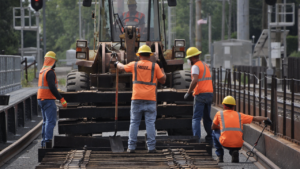
The rail spur ties into
the BNSF main line three miles south of Broadview at a crossing that was named
"Walter" on Wednesday in honor of the world’s oldest man,
112-year-old Walter Breuning of Great Falls. For half a century, the Montanan
worked for BNSF’s predecessor, the Great Northern Railway.
The Boich Group and
FirstEnergy are 50/50 owners in the Signal Peak project. The 36-mile rail spur
cost $105 million.
In one year, the mine
site progressed from a few older buildings and little external infrastructure
to a large industrial complex. The mine site has a new office, warehouse and
shop; a wash plant capable of cleaning 2,000 tons of coal an hour; two giant
storage silos; an extensive conveyor system; and the railroad spur.
"It’s not just the
rail, there was a whole infrastructure built," said Signal Peak Energy
President John DeMichiei.
The mine employs 190
people and, along with the railroad, is expected to pay $28 million per year in
federal and state taxes. The first 120- to-140-car train is expected to leave
the mine for Ohio on Sept. 9.
RELATED ARTICLES