CP acquires Steelcare Inc.
Canadian Pacific has acquired Steelcare Inc., Canada’s largest steel transload facility, which is located in Hamilton, Ontario.
Canadian Pacific has acquired Steelcare Inc., Canada’s largest steel transload facility, which is located in Hamilton, Ontario.
The U.S. Department of Transportation (USDOT) recently unveiled its Build America Transportation Investment Center (BATIC), which will serve as the single point of contact and coordination for states, municipalities and project sponsors looking to utilize federal transportation expertise, apply for federal transportation credit programs and explore ways to access private capital in public-private partnerships.
The U.S. Department of Transportation Pipeline and Hazardous Materials Safety Administration (PHMSA) is awarding grants totaling $5.9 million to provide hazardous materials training for volunteer or remote emergency responders. The Assistance for Local Emergency Response Training (ALERT) grants will go to three non-profit organizations that will provide training for incidents involving shipments of crude oil, ethanol and other flammable liquids by rail.
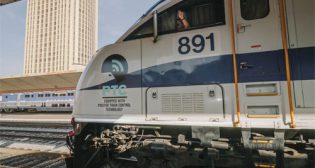
The U.S. House of Representatives Transportation and Infrastructure Committee leadership introduced legislation to extend the deadline for U.S. railroads to implement Positive Train Control (PTC).
The North Carolina Railroad (NCRR) is partnering with the town of Morrisville and will invest $6.9 million to construct a new railroad bridge over Crabtree Creek in Morrisville, N.C., replacing a structure built in 1927.
Norfolk Southern‘s yard in Memphis, Tenn., has a new name and it is “Harris Yard,” in honor of Deborah Harris Butler, the railroad’s executive vice president planning and chief information officer, who is retiring Oct. 1, 2015.
Charles Moorman is completing his service as executive chairman of the Board of Directors of Norfolk Southern. Effective Oct. 1, 2015, Moorman will continue to serve as a director and senior advisor to the President and Chief Executive Officer James Squires until Dec. 31, 2015, when he will retire from both roles.
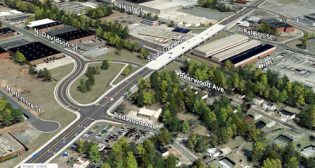
The North Carolina Department of Transportation (NCDOT) has awarded a contract for the Sugar Creek Road grade separation project, which is designed to improve railroad capacity, efficiency and safety along Sugar Creek Road in Charlotte, N.C.
The White House Office of Management and Budget, Council on Environmental Quality and U.S. Department of Transportation says the Obama Administration will take steps to accelerate critical infrastructure projects, including an enhanced Federal Infrastructure Permitting Dashboard, new guidance to federal agencies establishing metrics for the permitting and environmental review of infrastructure projects.
Canadian Pacific completed the sale of more than 280 miles of track from Schenectady, N.Y., to Sunbury, Pa., to Norfolk Southern.

Laura Mohr joined HNTB Corporation as vice president and rail and transit group director in one of the firm’s Los Angeles offices.

SNC-Lavalin has named Neil Bruce president and chief executive officer and a member of the board of directors, succeeding Robert Card, who will retire. Bruce will begin in his new role October 5, 2015.
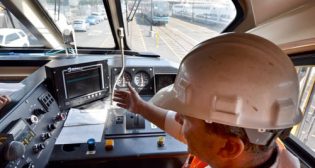
The Government Accountability Office (GAO) released a report reviewing the process of Positive Train Control implementation. Bottom line: Most railroads will not meet the deadline.
A study regarding a freight bypass rail line between the Canadian Pacific Line (Milton GO Rail corridor) west of Trafalgar Road in Milton and the Canadian National bypass Line at Bramalea has been endorsed by the Mississauga City Council.
The N.C. Department of Transportation (NCDOT) awarded a $10.2-million grading contract to C.M. Lindsay & Sons, Inc., to create a new 2.4-mile single-track railroad connection in Robeson County.
CSX made a number of senior management changes, effective immediately, including the resignation of Oscar Munoz, who has been named president and chief executive of United Continental Holdings, Inc.
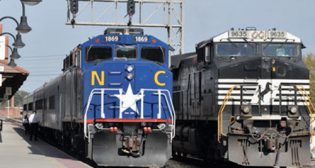
The North Carolina Board of Transportation adopted the 2015 Comprehensive State Rail Plan at its meeting on August 5, 2015. The Rail Plan was created to identify near- and long-term freight, passenger and safety projects, in addition to other rail initiatives that will help better serve the state’s communities, businesses and industries.
Gary Smith has been named rail sector lead for Stantec’s freight rail team, accountable for growing Stantec’s freight and commuter rail services throughout Alberta, British Columbia, Saskatchewan and Manitoba.
Union Pacific promoted Wes Lujan to vice president public affairs for the western region and Liisa Stark to assistant vice president public affairs for Illinois, Minnesota and Wisconsin; both appointments are effective October 1.
The Federal Railroad Administration (FRA) is soliciting applications for $10 million in competitive grant funding available to states to improve highway-rail grade crossings and track along routes that transport energy products, such as crude oil and ethanol.
The guidelines for the grant applications set by the FRA encourage states to include innovative solutions to improve safety, especially at highway-rail grade crossings. The funding is part of the Railroad Safety grants for the Safe Transportation of Energy Products (STEP) by Rail Program.
“The U.S. Department of Transportation has made increasing safety at highway-rail grade crossings, especially along routes transporting energy products, one of its top priorities,” said U.S. Transportation Secretary Anthony Foxx. “This money allows the department to support innovative ideas and solutions developed at the local level and I encourage states to apply for this funding.”
Highway-rail grade crossings collisions are the second-leading cause of all railroad-related fatalities. Last year, 269 individuals died in these collisions. While the number of fatalities has decreased for the last several decades, this number increased last year for the first time this decade.
FRA notes that highway-rail grade crossing accidents are frequently the result of a driver’s lack of awareness of a crossing or an oncoming train or a driver’s attempt to “beat the train.” Earlier this year, FRA ramped up its campaign to prevent collisions and save lives at highway-rail grade crossings through greater education, stronger enforcement and smarter engineering. To accomplish this, FRA developed key partnerships and has: worked with Google and other technology companies to integrate FRA’s grade-crossing location data to provide audio and visual alerts when using turn-by-turn navigation applications; partnered with local law enforcement agencies to increase enforcement at railroad crossings and supported research on grade crossing technology.
“Most of these deaths are completely preventable and that is why the Federal Railroad Administration has redoubled its efforts to reverse last year’s upward trend. These funds will allow states to take innovative ideas and make them a reality to increase safety and decrease fatalities,” said FRA Acting Administrator Sarah Feinberg.
Through the GROW AMERICA Act, the U.S. Department of Transportation (USDOT) has proposed creating new grant program that would make $250 million available to local communities for highway-rail grade crossings, as well as other critical rail infrastructure projects. In addition, USDOT has proposed continuing Federal Highway Administration’s $220-million per-year dedicated grant program for highway-rail grade-crossing projects.
Earlier this year, USDOT released its rule that raises the bar on the safety of transporting crude oil by rail. The rule requires stronger tank cars and 21st century electronically controlled pneumatic brakes that activate simultaneously on all tank cars, reduce the distance and time needed for a train to stop and keep more tank cars on the track if a train does derail. USDOT has also required that railroads transporting crude oil notify State Emergency Response Commissions of the movement of crude oil through individual states.