A true shortline, GRD, develops a plan for growth to secure its future.
All photos courtesy Gardenale Railroad, Inc.
Shortline can be a misnomer for a lot of railroads that run routes that number in the hundreds of miles. However, the term “shortline” could not be a better fit for Gardendale Railroad, Inc., a wholly-owned subsidiary of Ironhorse Resources, Inc., which measures its length in feet rather than miles. But a short distance doesn’t mean maintenance and engineering challenges are diminished. The railroad began its customer, railcar, employment and locomotive counts at zero and in the past year and a half has grown to nine customers, more than 25,000 loaded railcars annually and grown from 1,600 feet of track to 63,915 feet of railroad and industry track. The site now employs more than 120 full-time positions between railroad and industry jobs.
GRD dates its history to 1990 when Crystal City Railroad, Inc., a wholly-owned subsidiary of Ironhorse Resources, Inc., purchased a 50-mile stretch of rail line from the Missouri Pacific Railroad. In 1995, the major 1,000-railcar/year customer discontinued shipping and 49 miles of the 50-mile branch line were abandoned. Ironhorse Resources discontinued operations at this location at the same time, but maintained ownership of approximately 1,600 feet of the connecting interchange track and 6,200 feet of a 100-foot wide railroad right-of-way.
In 2010, after being dormant for 15 years, the 6,200 feet right-of-way was reopened for business and the line was re-branded as GRD when market interest in the Eagle Ford Shale drilling play gained momentum. Once the need for the line was reestablished, the next task was to return the infrastructure back to working condition, which meant dealing with the effects of time, such as ties that more closely resembled felled trees, as well as the effects of man, such as removing a deer blind that had been erected too close to the railroad.
“As a result of abandoning 49 of the 50-mile branch line, we only had 1,600 feet of 90-lb. rail remaining,” said Matt Cundiff, vice president Southern Region at Ironhorse Resources, Inc. “In 2010, this 1,600 feet was barely in excepted condition. To bring on our first customer (through agency agreement with UP), we installed ties and spent about $30,000 to initially bring the line ‘back to life’.”
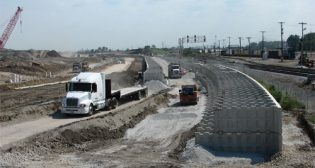
The entirety of GRD’s infrastructure is 100 percent new build. According to Cundiff, based on volume demand, GRD scheduled a complete replacement and upgrade of the original 1,600 feet, which is now all newly constructed 112-lb. rail, 7×9 tie track. Cundiff points to two contractors that helped the project including Central State Resources, Inc., which did all the rail engineering and the majority of the dirt work (sub grade and sub base) at the facility and TracWorks Inc., which built the majority of the track throughout the rail park.
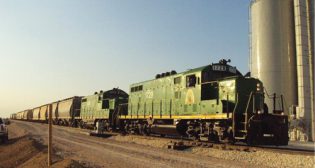
“The biggest issue with our original ‘interchange’ track was that there really wasn’t even a need for us to send a locomotive. We were a ‘railroad,’ but the track resembled an industry siding that needed direct Class 1 service,” said Cundiff. “As a result, [we asked ourselves] ‘How do we re-establish service and still make a return on our asset?’ Through many brainstorming sessions, it was decided that we establish an ‘Agency Agreement’ with the Union Pacific until we build adequate trackage and start using our own power to interchange cars and switch customers. This Agreement allowed UP to interchange cars to GRD directly to the 1,600 feet of track. Then, UP acted as GRD’s agent for creating the outbound train when the cars were released by our customer.”
While developing the agreement with UP, GRD also began working on a land acquisition strategy and designing a phased growth interchange yard. According to Cundiff, in September 2010, GRD obtained an 80-year lease on an adjacent 100-plus acre ranch and in January 2011, GRD obtained a Phase 2 site of more than 150 acres.
“This project would not have happened without the support of Union Pacific Railroad making timely marketing decisions to promote business, Union Pacific’s operation department willing to work as an Agent for GRD on a temporary timeframe and UP scheduling continued mainline improvements to support this extreme growth,” said Cundiff.
In order to establish long-term interchange service with UP, GRD needed to finalize an acceptable interchange design. Due to a limited 6,200-foot ROW and a need for a switching lead, Cundiff says a preferred 8,000-foot interchange track was not attainable.
“After many design evolutions and discussions, GRD and UP finalized the MOU in December 2010 that allowed for a ‘double-over’ of inbound and outbound train movements. The resulting design for the phased interchange yard allowed for growth to support multiple inbound unit trains, multiple outbound trains and simultaneously handle manifest trains,” said Cundiff.
However, Cundiff notes that the interchange yard design and acceptance process also presented some significant challenges.
“Our corporate strategy is NOT to invest in any solution that does not allow unit train handling solutions. (If a Class 1 railroad prefers to handle a 100-plus car train, that is the solution we need to invest in.) With only a 6,200-foot long, 100-foot wide corridor, how do you create a unit train handling solution with a switching lead that allows growth and flexibility to service new customers?
“We simultaneously worked in-house on conceptual designs and further employed Central State Resources, Inc., to provide the final rail engineering for the site. After a multitude of designs, we finalized our Memorandum of Understanding with Union Pacific,” said Cundiff. “The result provided an expandable solution that provides for an open-runaround track and multiple 3,300-foot long tracks. This allows an inbound movement to ‘double-over’ and allows the Union Pacific locomotives to run-around the placed inbound interchanges.
“Our design evolution has shown that with our physical footprint constraints, a yard and ladder track design concept allowed for the most efficient use of our available acreage. We began our yard design process around September of 2010 and had our MOU and final design acceptance with UP by December 2010,” said Cundiff.
GRD is also planning for the future and a Phase 3 development with the acquisition of an option to purchase an additional 220 acres. The original Phase 1 and Phase 2 developments are almost sold out to various customers needing to move everything from frac sand to barite and bentonite, hydrochloric acid, line pipe, crude and natural gas liquids.
From the initial 1,600 feet of interchange track and 6,200 feet of ROW, GRD has constructed more than 63,000 feet of new track and an additional 50,000 feet of track is under construction and expected to be active before July 2012.
With all new infrastructure, maintenance is important to GRD, but growth is key to its survival.
“The track maintenance will be minimal for the first few years. We will conduct weekly track inspections and anticipate minor maintenance during this time. Our plans are to maintain the track to Class 3 standards,” said Cundiff. “Currently, we have developed and built infrastructure to handle our current nine customers. We anticipate handling more than 25,000 car loads per year. If we expand into Phase 3 of this project (approximately 220 acres and potentially five additional customers), we would expect an additional capital improvement of $6 million to support that expansion.”