Cost of NSU’s light-rail demands pegged at $10 million
Written by jrood


Changes to the light-rail line pushed by Norfolk State University officials and agreed to by city leaders will cost city taxpayers $10 million, The Virginian-Pilot reports. These costs are not new. They are included in the $338-million light-rail price tag, but after three years of negotiations, NSU, HRT and the city are nearing an agreement for the changes. They include moving a passenger station farther from campus and redesigning the storage and maintenance building.
While the work doesn’t include
buying the university president’s house as requested, it includes extensive
landscaping to screen the pool area from the view of light-rail riders.
For some city leaders,
the negotiations still sting.
"I think we were held
hostage by the NSU president," said Councilman Barclay Winn, who sits on the
Hampton Roads Transit governing board. "I think it’s a terrible waste of money."
Mayor Paul Fraim said he
believes the costs are even higher considering delays the changes caused in the
construction of the entire 7.4-mile line.
"The addition of $10
million to the cost is significant and, in my opinion, to some degree
unnecessary," he said. "It should have been avoidable."
The city is ultimately
responsible for cost overruns, with the first payment toward them due in
January. The changes for the most part are under way or already completed. HRT’s
board recently authorized CEO and President Philip Shucet to sign the legal
document.
"Frankly, the issues were
worked out before I got here," said Shucet, who became HRT’s leader in February
after Michael Townes was forced to resign primarily because of $106 million in
cost overruns. "I’m not renegotiating it. It’s now just the legal wrappings
around the terms and conditions that have already been worked out."
Norfolk’s starter
light-rail line, scheduled to open in May, runs directly adjacent to the NSU
campus. Because of its proximity, considerations such as land swaps, easements
and drainage improvements were necessary. A set of conditions was originally agreed
to by NSU President Marie McDemmond. But the most recent president, Carolyn
Meyers, who resigned in June, wanted changes.
"Completing the project
has been a challenge for everybody," HRT spokesman Tom Holden said. NSU’s
changes required redesign work and contractor delays and ultimately contributed
to delaying opening the system, he said.
Because of safety
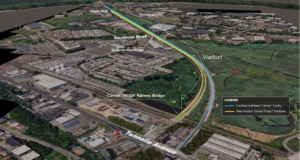
concerns, NSU wanted the station moved across Brambleton Avenue, away from the
campus. That change alone cost nearly $7 million. The work is complete.
The new location, on the
west side of Brambleton, was more expensive because it extends over the road,
requiring heavier-duty material and complicated construction. The station could
not be moved beyond Brambleton because of a bend in the track.
NSU also wanted the
vehicle storage and maintenance building redesigned and wrapped in brick to
better blend with the campus. That change cost $3 million and the facility will
be finished by March.
The college asked that
the city buy the president’s house because rail passengers would be able to see
into the backyard and pool. The city instead will spend $15,000 to landscape
the yard with trees for privacy. If NSU officials are not
satisfied, the city will install a retractable pool enclosure.
"It’s really not a
request that’s totally unreasonable," said Assistant City Manager Stanley A.
Stein. "If you look at where light rail rises up onto a bridge structure to go
over Brambleton Avenue, the cars are high up in the air, and yeah, you do get a
good vantage into her backyard."
NSU issued a statement
saying it is satisfied with the compromise.
What about shielding
other residents from light rail? Stein said there’s $850,000 in the budget for
landscaping. Plantings have been done between the Stonebridge neighborhood just
east of the NSU campus and the rail line. However, at Ingleside, a community
that has begged for screening, Stein said there’s not enough land to do similar
work.
The legal agreement also
covers the development of a park-and-ride lot at Ballentine Boulevard.
Norfolk’s share of the
$338-million project is now about $77 million. Officials are hopeful that the
project will come in $10 million under budget, which would reduce the city’s
obligation.
RELATED ARTICLES