Demolition reveals 1870s elevated tracks
Written by jrood


When the strip mall along Davenport, Iowa's East River Drive and west of Mound Street came down in March, a new view opened up, and many people noticed for the first time the tall wooden railroad trestle behind the property, the Quad Cities Times reports. The trestle is the only one like it in the Quad-Cities - possibly the only one like it in Iowa or Illinois - and is listed on the National Register of Historic Places as a "contributing structure" within the Village of East Davenport's historic designation.
"It is a really,
really cool structure," city planner Darrin Nordahl said.
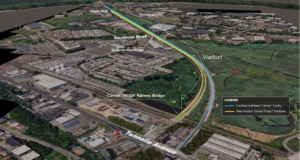
Beginning at ground level
next to the Iowa American Water Co. to the south, this engineering marvel rises
quickly and slants across River Drive via a rusty steel bridge, then continues
northeasterly through the Village, rising to a height of 37 feet (27-foot logs
atop a 10-foot earthen berm) in the block behind the former 1950s strip mall.
From there, the tracks
run over a high earthen embankment east of Aunt Rhodie’s landscaping, become
airborne again with bridges over 11th and 12th streets, then dip down, running
beneath 13th Street and going airborne for a fourth time across the elevated
bridge above Kirkwood Boulevard. The tracks snake all the way to Eldridge,
Iowa, where they dead-end near North Scott High School and the former
right-of-way becomes a paved bike path for about a half-mile.
Although the tracks
handle only two trains a week now, they could be getting much more business in
the near future as a 2.8-mile spur is built into Davenport’s Eastern Iowa
Industrial Center near Interstate 80 and businesses load commodities that would
then travel on the rails south to the Mississippi River.
That the trestle has
survived with most of its original 1870s timbers and historic appearance intact
is thanks to the resolution of a controversy that erupted in the mid-1980s when
a River Drive road-straightening project threatened to change the trestle’s timeworn
character. (RT&S Editr’s note CP points out, "That is certainly not the case. The original bridge at that location was circa 1870, but as is typical of timber trestles, piles, caps, stringers and deck have been replaced many times over the years. The bridge has a central steel span supported on timber pile clusters and is flanked by timber trestles. I imagine the "form" of the bridge has remained fairly consistent over the years, but materials have certainly been updated and replaced."
Here is more information
about this one-of-a-kind structure, then and now.
Q: When was it built?
A: In the 1870s, by John
Hornby, who was a mill owner and builder, according to research by Karen
Anderson, the executive director of the Scott County Historic Preservation
Society. In 1879, the completed rail line was sold to the Chicago-Milwaukee-St.
Paul railway, she said.
Originally the tracks
went all the way to DeWitt, Iowa.
Q: How unusual is the
trestle?
A: That’s difficult to
answer, but it is believed to be quite unusual for several reasons: It remains
mostly timber construction rather than more modern steel, it is fairly tall at
its highest point and it is fairly long.
Barry Bennett, inventory
coordinator with Iowa State Historic Preservation Office in Des Moines, said
the only other historic bridge with a log foundation that he is aware of is in
Waterloo, but that span has been converted to bike trail use, has chain-link
fencing on its sides and is only 14 feet high. That is not to say there aren’t
other trestles like this one, but he doesn’t know of any.
Andrew Heckenkamp,
National Register coordinator with the Illinois Historic Preservation Agency,
said that, off the top of his head, he doesn’t know of any such structures, but
added that they commonly "aren’t on our radar screen." Without
extensive research through paper files, "it might be impossible to
know," he said.
Q: Who owns the
trestle/tracks now?
A: The Canadian Pacific
Railway, and the tracks are part of the Eldridge Branch Line. The Canadian Pacific
runs two trains on the line each week, going to Leiner-Davis Gelatin, 7001 N.
Brady St., said T.J. Nelson, Canadian Pacific’s manager for public
affairs/research. There also are spurs going to Probuild (formerly UBC Lumber),
the Deere Davenport Works, and the former Roll & Hold and Caterpillar
plants, but Leiner-Davis is the only active customer.
Q: What’s this about a
new spur at the Eastern Iowa Industrial Center?
A: Land acquisition is
expected to be complete by the end of this year, so the project can be bid by
the Iowa Department of Transportation in the spring, with the line to be
operational in the spring of 2012, said Pam Miner, the city’s community
planning and economic development director.
About $4.9 million in
federal, state and local funds have been allocated for the project, she said. The
city also has received $2 million from the state of Iowa and $6.8 million from
the federal Economic Development Administration to put toward the construction
of a facility where area businesses could load commodities that would then
travel on the tracks south to the Mississippi River.
Q: What was the
road-straightening controversy about?
A: Historic
preservationists were worried that a project to straighten a severe S-curve on
East River Drive (U.S. 61) would replace the bridge over the four-lane street
with an out-of-place modern structure and that the tall logs making up the
trestle to the north would be taken away and replaced with an earthen
embankment. Ultimately, the trestle’s historic appearance was retained and the
wooden bridge over River Drive was replaced with a steel bridge designed to
look old, said Doug Rick, area engineer for the Iowa Department of
Transportation. The new bridge has trusses on the side and is made of Core-Ten
steel that rusts to an old patina. It is 230 feet long – 125 feet longer than
the bridge it replaced – so a pier was built in the middle of River Drive for
strength.
RELATED ARTICLES