Feds may fund study of Texas/New Mexico commuter rail route
Written by jrood


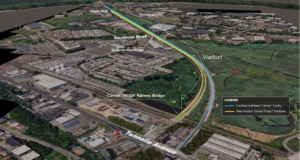
It has to start with small steps by city leaders in Las Cruces and El Paso, but the goal is to someday provide commuter rail service between the cities, the Sun-News reports. Officials met the week of July 19 with representatives of BNSF and Las Cruces Mayor Ken Miyagishima came away with two definite opinions: The cost to start commuter rail service won't come cheap and he's excited the service has the potential to become a reality.
Miyagishima’s optimism was
bolstered by an announcement from U.S. Sens. Jeff Bingaman and Tom Udall that a
$1-million earmark was approved by the Senate Appropriations Committee that
could pay for a study to determine the feasibility of commuter rail service and
other transit alternatives. The proposed appropriation is part of the U.S.
government’s 2011 fiscal year Transportation, Housing and Urban Development
appropriations bill. Jude McCartin, spokeswoman for Bingaman, said the proposed
legislation is expected to be considered soon by the full Senate.
BNSF representatives told
Miyagishima and El Paso officials that some infrastructure improvements would
have to be made to accommodate commuter rail service. Currently, BNSF operates
a non-signalized main track between the two cities that has a maximum speed of
49 mph. A second track would have to be built because trains use the main track
fairly frequently. Daily, BNSF serves more than 100 customers between El Paso
and Las Cruces and some of those trains often include as many as 100 cars.
For commuter rail service,
the speed of the track between Las Cruces and El Paso would have to be
increased to 79 mph, and road crossings would have to be improved to allow for
trains traveling that fast. Another crucial consideration is that a minimum of
26.6 miles of a second main track would have to be constructed. Also, three
universal crossovers, and dual-control and electric lock switches would have to
be installed at various locations.
BNSF representatives also
offered some proposed commuter operations. Those recommendations included:
train sets of a locomotive and three passenger cars, similar to Rail Runner,
and allowing trains to dwell in El Paso and Las Cruces for 20 minutes for
disembarking and embarking passengers.
Two morning and afternoon
departure and arrival times were also suggested. Trips between the two cities
would take 38 minutes.
But beyond those
recommendations, BNSF representatives were hesitant to commit to anything.
"It would be premature
at this time to make any firm commitments," said Joe Faust, BNSF director
of public affairs. "The project is still in the exploratory stage."
Faust added the results of
the study would be important.
"It is in the best
interests of BNSF and all others concerned to wait for the study to be
completed," he said. "After the study has been completed, we will
review the findings that will put us in an appropriate position to determine
what further participation we might have in the project."
RELATED ARTICLES