‘Not in my rail yard,’ carrier says
Written by jrood


February 14, 2001 Triangle Transit still likes the idea, but there aren't many cheerleaders left for a proposal to run high-speed passenger trains through the Norfolk Southern freight yard along the west side of Capital Boulevard, the Raleigh, N.C., News and Observer reports. Norfolk Southern blasted that notion last week in a 17-page letter to the state Department of Transportation.
Raleigh city leaders
originally floated the Norfolk Southern option two years ago – but lately
they’ve had second thoughts. The city’s formal comment on DOT’s high-speed rail
project was a 34-page package of mixed messages.
John V. Edwards, Norfolk
Southern’s passenger policy director, warned that DOT should be prepared to
cover at least $100 million in damages to the railroad – for lost freight
business and increased operating costs, and for the expense of pushing freight
rails, offices and other facilities out of the way for new passenger tracks.
"We’re starting to
get a feel for just how expensive it would be to replicate all the facilities
that are going to be adversely affected for Norfolk Southern," Edwards
said in an interview.
DOT published a draft
environmental impact statement in June evaluating the Norfolk Southern path as
one of two possible routes through downtown Raleigh for trains that will travel
as fast as 110 mph on parts of a planned 162-mile track from here to Richmond,
Va. Edwards submitted his letter to DOT as a three-month public comment period
ended Friday.
Raleigh Mayor Charles
Meeker asked DOT in 2008 to consider the Norfolk Southern alternative after
local planning and business officials cited concerns about the only option then
on the table.
To accommodate the
Southeast High Speed Rail Corridor, DOT was going to route the new trains along
Capital Boulevard’s east side, through DOT and CSX Transportation rail yards. City
leaders worried that the CSXT alternative would close key streets and disrupt
traffic and commerce connections between downtown and Glenwood South and that
it would complicate Raleigh’s planned Union Station for trains and transit.
Triangle Transit, a
three-county public agency planning a regional rail transit network, owns a
long strip of land along the CSXT corridor and hopes to add tracks for
electric-powered light-rail cars.
It could be difficult to
make room there for high-speed intercity trains as well. So, in a letter to
DOT, Triangle Transit General Manager David King endorsed the proposal to run
those trains through the Norfolk Southern corridor on the other side of
Capital. King added that while this option "has technical advantages over
the others for a future regional rail operation in this vicinity,"
Triangle Transit would shape its own plans to accommodate whatever DOT decides
for its fast-train route.
CSXT has remained silent
in the public debate, and it was not clear last week whether the railroad would
submit a formal comment on the DOT project. Telephone and e-mail messages to
CSXT and DOT officials were not returned.
The city’s comments, signed
by Meeker, included lengthy endorsements of the Norfolk Southern route from
city planners and a citizens task force on passenger rail issues. Both
documents cited disadvantages with the CSX route. But Meeker and the City
Council did not endorse anything. The council’s letter offered a dozen points,
most of them Meeker’s, asking DOT to address shortcomings in all the
alternatives.
The council asked DOT to
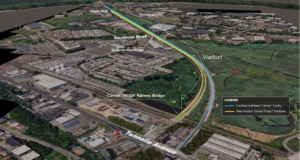
consider "hybrid" route options suggested in recent weeks by groups
of citizens. There are two similar proposals to build a bridge across Capital
Boulevard for new trains that would pass from the Norfolk Southern to the CSXT
tracks, possibly avoiding the worst problems on both sides.
Tucked into the city’s
submission to DOT was a letter in which council member Thomas Crowder proposed
a partnership of more than a dozen federal, state and local agencies to
redevelop Capital Boulevard itself. Crowder envisioned a long valley
transformed with new streets and dense housing, a greenway and a long viaduct that
would carry both DOT and Triangle Transit’s trains above the boulevard.
Much of Norfolk Southern’s
critique focused on damage to the Five Points neighborhood, which Edwards said
had been overlooked or minimized in DOT’s environmental study. Although DOT
said no Five Points homes would be taken for the project, Edwards’ letter
counted 18 houses within 100 feet of the project and predicted that many of
them would be significantly damaged.
"They’ve got to
realize their environmental process was lacking," Edwards said.
DOT officials have said
they will consider the new hybrid route proposals and evaluate other comments
before choosing their preferred route late this year or early in 2011.
RELATED ARTICLES