Small North Carolina towns fret rail crossing closing plans
Written by jrood


The railroad spawned a string of towns north of Raleigh, N.C., in the 19th century, and now it threatens to cut them in half, the News Observer reports. Many residents worry that Youngsville, Franklinton, Henderson and Norlina will see little benefit from a plan to run passenger trains between Raleigh and Richmond, Va., at speeds up to 110 mph. The $2.3-billion project is part of a planned high-speed rail corridor that would cut nearly two hours from train trips between North Carolina and the Northeast.
"I think high-speed
rail is going to be a boon to North Carolina – but not to all the little towns
it’s going to go through," said Karen Wright, 57, a retired Franklinton
schoolteacher who taught North Carolina history for 30 years. "It’s not
even going to stop here."
Franklinton was founded in
1839 as Franklin Depot. Youngsville, originally called Pacific, was renamed for
a man who built a rail stop there. Up and down the CSX transportation rail
corridor today are towns whose east and west sides are stitched together by
streets that crisscross the tracks.
Citing safety concerns,
state agencies in North Carolina and Virginia want to close every at-grade rail
crossing between Raleigh and Richmond. A few would be replaced with bridges and
underpasses to carry streets over and under the tracks. The rest would become
dead ends, choking the cross-town flow.
"You’re coming into
Youngsville, and you’re going to take away two of our three crossovers,"
Youngsville Mayor Samuel K. Hardwick, Jr., said at a public hearing in
Franklinton on the Southeast High Speed Rail Corridor plan. "We can’t
allow that to happen. We have to have the ability to cross back and
forth."
Elic A. Senter, Franklinton’s
mayor, warns that every police and emergency trip to the east side of town will
be delayed if Mason and College streets are closed, as proposed. Franklinton,
with 2,500 residents, might have to build new substations to provide adequate
response times on both sides of the tracks, he said.
"This is something we
never asked for in the first place," Senter said to booming applause in
the Franklinton High School gymnasium, home of the fighting Red Rams. "The
town of Franklinton will get absolutely no benefit from this rail."
Henderson – the biggest
North Carolina city on the rail route north of Wake Forest, with 16,300
residents – would benefit as the site of a proposed passenger station. Two of
the eight daily passenger trains would stop there. But Henderson officials
protested DOT’s proposal to close 12 of the 17 rail crossings in and near the
city. They said Chavasse Avenue, marked for closing, should be converted
instead to an underpass. Other communities are lobbying for similar changes.
"I don’t think we
heard anything unexpected," said Pat Simmons, head of the DOT rail
division, after an estimated 2,200 people attended four hearings in North
Carolina and four in Virginia. "We also received input about how things
might be adjusted or improved."
The little towns north of North
Carolina’s capital aren’t alone in their concern. The plan has also caused
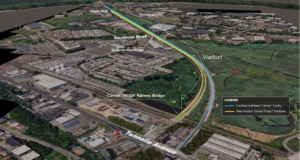
angst in Raleigh, where two routes through the city are under consideration. A
citizen task force last week endorsed the Norfolk Southern corridor on the west
side of Capital Boulevard as the preferred path. Norfolk Southern has lobbied
against the option, contending it will disrupt its freight yard, hurt its
customers and residents of the nearby Five Points neighborhood.
The Raleigh City Council is
to consider the task force’s recommendation. The task force has recommended
that the DOT take steps to ease the effects of closing rail crossings.
Simmons disagreed with
critics who said the little railroad towns would be cut in half. He pointed out
that plans call for nearly 100 new bridges and underpasses between Raleigh and
Richmond, with 80 miles of road construction.
"Most of the places
where we’re going have grown up around a railroad historically," Simmons
said. "We are expanding the use of that facility and improving the road
network."
RELATED ARTICLES