CN, CPKC Lock Out Employees, Move Toward Network Shut Downs
Written by Marybeth Luczak, Executive Editor, Railway Age


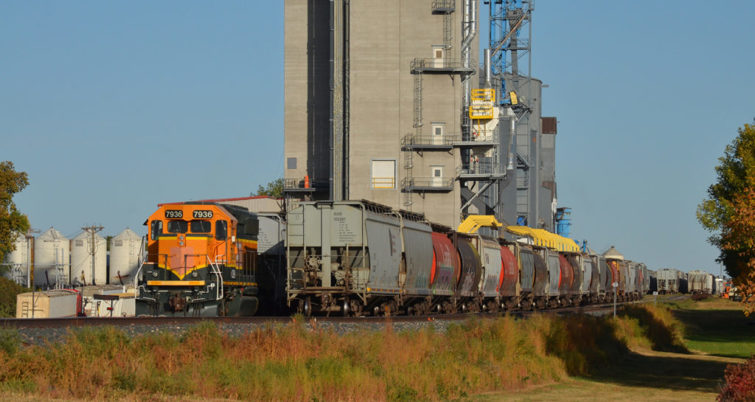
U.S. agriculture that could be impacted by a Canadian rail shutdown includes soybeans that are loaded into unit trains in Garrison, N.D., and ferried across southern Canada before hand-off to UP at Eastport, Idaho, for final delivery to an export terminal in Kalama, Wash. Bruce Kelly photo.
ATLANTA –– Although labor issues are not on our beat, we would be remiss in not reporting the situation that's taking place in Canada right now. Marybeth Luczak, Executive Editor of Railway Age, filed this report today.
Without agreements or binding arbitration, CN and Canadian Pacific Kansas City (CPKC) on Aug. 22 formally locked out Canadian employees represented by the Teamsters Canada Rail Conference (TCRC) and finalized network shutdowns.
CN and CPKC have been in separate negotiations at intervals with the TCRC, which represents approximately 10,000 engineers and conductors combined for the railroads, and with the assistance of federal conciliators.
CN in a statement said it formally locked out employees who are TCRC members as of Aug. 22 at 12:01 a.m. ET, after the union did not respond to another offer by the railroad in a final attempt to avoid a labor disruption. According to CN, this offer “improved wages and would have seen employees work less days in a month by aligning hours of service in the collective agreement with federally mandated rest provisions.” Additionally, it “proposed a pilot project for hourly rates and scheduled shifts on a portion of the network as CN continues to believe this is a better and more predictable framework for our employees.” The railroad noted that over the past nine months, it has “negotiated in good faith,” proposing “serious offers, with better pay, improved rest, and more predictable schedules.” However, the Teamsters ”have not shown any urgency or desire to reach a deal that is good for employees, the company and the economy,” according to the railroad, which urged the union ”to engage in these negotiations with the urgency and importance that this situation requires.”
CPKC in an Aug. 22 statement said that it locked out 3,200 locomotive engineers, conductors, and train and yard workers who are members of the TCRC–Train and Engine (T&E) division effective 12:01 a.m. ET, and approximately 80 rail traffic controllers who are members of the TCRC–Rail Traffic Controller (RCTC) division effective 12:01 a.m. MT. “Throughout nearly a year of negotiations, CPKC has remained committed to doing its part to avoid this work stoppage,” the railroad said. “CPKC has bargained in good faith, but despite our best efforts, it is clear that a negotiated outcome with the TCRC is not within reach. The TCRC leadership continues to make unrealistic demands that would fundamentally impair the railway’s ability to serve our customers with a reliable and cost-competitive transportation service. At this time, the responsible path forward for the union, the company, our customers, the Canadian economy and North American supply chains and the public interest is for TCRC and CPKC to engage in binding arbitration to resolve all outstanding disputes. Binding arbitration is an effective, reasonable and fair process that ultimately has been used many times in the past to resolve disputes with this union. CPKC reiterates its standing offer to resolve this matter through binding arbitration. Acceptance of that offer by the TCRC would immediately end this work stoppage and mitigate further harm and disruption to supply chains and our economy.” CPKC said that it “fully understand[s] and appreciate[s] what this work stoppage means for Canadians and our economy,” and is acting “to protect Canada’s supply chains, and all stakeholders, from further uncertainty and the more widespread disruption that would be created should this dispute drag out further resulting in a potential work stoppage occurring during the fall peak shipping period.“
For the TCRC–T&E division, CPKC said it has focused on negotiating a three-year “status-quo contract renewal with competitive wage increases that are consistent with recent settlements with other railway unions“ and that the proposal has no work rule changes. According to the railroad, it presented “an enhanced final offer to avoid a work stoppage that includes: enhanced wages that exceed inflation, an engineers’ guaranteed extra board, increased shift differentials, and resetting rest only at the home terminal, among other items that the TCRC negotiating committee requested.“ The only item the railroad said it wants to negotiate “remains reasonable adjustments to the timing of held-away from home pay that resets the negotiated buffers that existed before Transport Canada implemented work rest rule changes last year, that by default eliminated the buffer.“ CPKC said the status quo-style offer “fully complies with new regulatory requirements for rest and does not in any way compromise safety.“
For the TCRC-RCTC division, CPKC said it has proposed a renewed agreement with the rail traffic controllers that would deliver competitive wage increases.
CPKC said that working with customers, it has executed a “safe and structured shutdown“ of its train operations across Canada, which will enable it to “safely and efficiently resume full rail operations across the entire network once the work stoppage ends.“
The TCRC in a statement said that despite months of “good faith negotiations,“ the parties remain “far apart.“ Over the past several days, the union said it has “put forward multiple offers, none of which were seriously considered by either company,“ and the “main obstacles to reaching an agreement remain the companies’ demands, not union proposals.“ The Teamsters “remain at the bargaining table with both companies,“ despite the lockout, according to the union.
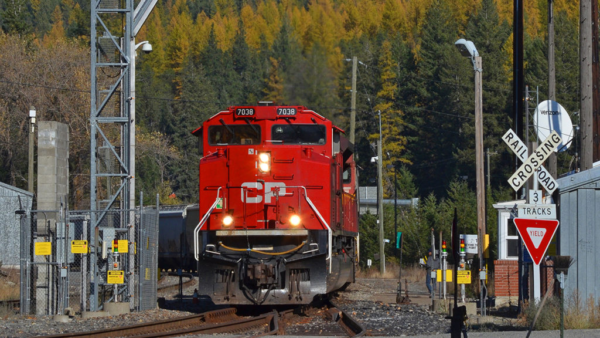
CPKC power leads a grain train through the customs checkpoint on the U.S./Canada border at Eastport, Idaho, in October 2023. From here, UP will take it to an export terminal in western Washington State. This joint CPKC/UP routing handles a large amount of soybeans, corn, and wheat that originates in North Dakota and other Midwestern states. Bruce Kelly photo.
“All rail traffic in Canada and all shipments crossing the U.S. border have stopped,“ reported the Associated Press on Aug. 22, “although CPKC and CN’s trains will continue to operate in the U.S. and Mexico. Billions of dollars of goods each month move between Canada and the U.S. via rail, according to the U.S. Department of Transportation.“
Ahead of the work stoppage, traffic embargoes were issued by both Canadian Class I carriers and U.S. Class I’s CSX, Norfolk Southern, BNSF and Union Pacific for traffic that interchanges with them.
“‘If rail traffic grinds to a halt, businesses and families across the country will feel the impact,’” National Association of Manufacturers President and CEO Jay Timmons said in a statement to the Associated Press. “Manufacturing workers, their communities and consumers of all sorts of products will be left reeling from supply chain disruptions.”
Additionally, more than 32,000 Canadian rail commuters will be affected, according to an Aug. 22 report by The Canadian Press. “Transit authorities have said select commuter lines that run on Canadian Pacific [Kansas City] tracks in Toronto, Montreal and Vancouver will be suspended should dispatchers walk off the job,” the media outlet reported. “The commuter lines affected by the work stoppage are TransLink’s West Coast Express in the Vancouver area, Metrolinx’s Milton line and the Lakeshore line’s Hamilton GO station in the Greater Toronto Area, and Exo’s Candiac, Saint-Jérôme and Vaudreuil/Hudson lines in the Montreal area, among others.” Additionally, it said, VIA Rail Canada would suspend trains 185 and 186 on its Sudbury–White River service without alternative transportation in the event of a CPKC work stoppage.
Industries Urge Action
Union Pacific (UP) CEO Jim Vena, a 40-plus-year U.S. and Canadian railroad veteran, in an Aug. 19 letter urged Canadian Minister of Labor Steven MacKinnon to intervene to prevent a work stoppage. In the letter, obtained by Railway Age, Vena said he was requesting “urgent intervention to avoid freight rail service disruption in Canada, which would have devastating consequences for the Canadian and U.S. economies.” He continued: “North American railways are highly integrated—a Canadian rail shutdown would directly impact cross-border traffic, causing a significant ripple effect in the U.S.
“About a third of the traffic moved by Canadian railways crosses the Canada-U.S. border, impacting Union Pacific and our customers. For Union Pacific specifically, in the event of a shutdown, more than 2,500 cars per day would not move across the border. Some of these impacts have already begun. While some Canadian port traffic is shifting to the U.S., any strike or lockout will have a negative impact on the entire rail industry. For every one day of disruption, you can expect at least 3-5 days of recovery – perhaps even more, given two Canadian railways are impacted.
“I spent most of my life and career in Canada, including 40 years working at the CN where I started as a unionized employee, so I deeply understand both the Canadian and U.S. rail systems. I am in a unique position to share my thoughts and perspectives on these dynamics with you, if you believe I can be helpful.
“Ultimately, I must reiterate how imperative it is that you intervene to prevent a work stoppage. The impacts of a prolonged shutdown will have devastating consequences on the North American economy, with significant cascading effects. Along with supply chain delays and shortages, mines, grain elevators, factories, mills and other industries will incur increased costs when they lose their rail service. They will be forced to shut down or find costly, last-minute temporary alternatives—and in many cases, there are no alternatives to rail. Consumers and workers across multiple industries in both Canada and the U.S. will be severely impacted. Specifically, cross-border commodities such as chemicals, lumber products, automobiles, auto parts, agricultural products and other customer goods will be impacted.
“Thank you for considering the serious impacts at hand and the urgent need to act using any and all available resources. Do not hesitate to call me personally if my perspective can be of assistance as you intervene to avoid a work stoppage.”
According to an Aug. 19 Reuters report, “[r]oughly 30% of freight rail operations in Canada cross the northern border annually, the Association of American Railroads said … In the first half of the year, rail transport accounted for about 14% of the total bilateral trade of $382.4 billion between the U.S. Canada, according to the U.S. Department of Transportation.”
The Canadian Federation of Independent Business (CFIB) also called “on all parties to reach an immediate agreement to prevent a work stoppage. Any disruptions to railway operations could be devastating for small businesses, their employees and communities,” said Jasmin Guenette, Vice President, National Affairs. “Many small businesses rely on rail services to send and receive goods, products and essential materials. The longer the work stoppage goes on, the costlier it becomes for small firms who may lose sales and contracts if goods are not delivered or received on time. These shutdowns will also disrupt public transit and commuting to big cities such as Toronto or Montreal and lead to increased business costs and supply chain disruptions. Although the decision by the Canada Industrial Relations Board (CIRB) prohibited the maintenance of certain activities during a work stoppage, politicians still have the power to change labour laws. CFIB continues to call on the government to make ports and rails an essential service, so they remain fully operational at all times.”
According to the Aug. 22 report by The Canadian Press, business groups “pleaded for Ottawa to step in and prevent the work stoppage that would upend supply chains—while Prime Minister [Justin Trudeau] stressed a deal at the table is the best outcome.”
“Under article 107 of the federal labor code, Labour Minister Steven MacKinnon has broad powers and can order the sides to enter binding arbitration,” Reuters reported Aug. 19. “In 2023, his predecessor, Seamus O‘Regan, issued such an order to end a dockworkers strike in British Columbia. In that case, unlike the current rail dispute, the sides had largely agreed on the outlines of a deal.”
Alternatively, business groups “suggested the government recall Parliament and pass back-to-work legislation — a step taken by a previous Conservative government during a rail strike in 2012, and a move it threatened to make in 2015,” according to The Canadian Press.
On Aug. 19, Steven MacKinnon‘s office announced that he would “be in Montreal tomorrow [Tuesday, Aug. 20] and Calgary on Wednesday [Aug. 21] to meet with the parties and federal mediators and urge CN Rail, CPKC and Teamsters to fulfill their responsibility to Canadians, reach agreements at the bargaining table, and prevent a full work stoppage,” according to a CBC News report. In a statement earlier on Aug. 19 (see below), the Minister encouraged the parties to reach a deal.
However, the meetings with MacKinnon did not end in deals or binding arbitration, which would end a work stoppage (see MacKinnon’s post on social media platform X, below).
MacKinnon on Aug. 9 received from CN a request to order binding arbitration, but MacKinnon rejected it.
“After careful consideration of this request by Canadian National Railways Company, I have decided not to proceed with a section 107 referral,” MacKinnon wrote in a Aug. 14 letter released by the TCRC. “Consistent with our discussion on August 5, 2024, I would like to clarify that it is your shared responsibility—Canadian National Railways Company and the Teamsters Canada Rail Conference—to negotiate in good faith and work diligently towards a new collective agreement. To support this process, mediators from the Federal Mediation and Conciliation Service remain available to work with you to facilitate productive negotiations and help bridge any gaps. I trust that with continued effort, an agreement can be achieved promptly. The Government firmly believes in the collective bargaining process and trusts that mutually beneficial agreements are within reach at the bargaining table.”
In an Aug. 15 media statement, CN spokesperson Jonathan Abecassis said that “[w]hile we are disappointed the minister is choosing not use section 107 of the Canada Labour Code at this time, we hope TCRC will listen to the minister’s strong message that they must get serious and engage meaningfully at the negotiating table. The minister must reconsider his decision if they don‘t.” Abecassis reported that CN since January has made four offers to the TCRC, covering “important points such as compensation, availability and improving safety,” but the “TCRC has rejected all offers and has not proposed a single counter offer.” As noted on Aug. 9, he said that “CN has initiated a phased shutdown of its Canadian network,” and “unless there is meaningful progress at the negotiating table, the company will have no choice but lockout employees on August 22.” A prolonged shutdown of rail operations, he continued, “will have a significant impact on supply chains: creating delays, possible shortages, and increasing costs as mines, grain elevators, factories, mills and other industries lose their rail service and must either shutdown or find costly, last-minute and temporary alternatives, when possible.”
TCRC in a media statement “said that it agrees with the minister’s conclusion that a negotiated settlement is within reach,” according to an Aug. 15 CBC News report.
CN on Aug. 16 reported returning to the bargaining table with TCRC, saying that it hoped the union “will engage meaningfully during this meeting.” It noted that “[a]s there has been no meaningful progress at the bargaining table, CN has initiated the phased and progressive shutdown of its network to ensure the safety of the communities in which we operate and our customers cargo.” The process started with embargoes and “will culminate in a lockout at 00:01 ET on August 22 unless a deal is reached, or arbitration is imposed.” The railroad said it was doing this because “it takes more than 72-hours, which is the required notice before any work stoppage, to help ensure a safe, predictable, and orderly shutdown of our network.”
Additionally, the railroad shared “facts about the negotiations to clear up any misconceptions about key issues that are the subject of rumors or questions”:
- “None of CN’s offers have compromised employee health and safety in any way. In fact, CN’s offers aim to improve safety. And all of CN’s proposals respect government-mandated rest provisions (Duty and Rest Period Rules), which were developed in consultation with the Union to ensure best practices are in place to manage fatigue.”
- “CN has made four different offers to the TCRC since January. The first three offers addressed a wide range of topics, including wages, rest, health and safety, and labour availability. The latest offer proposed third-party arbitration to avoid a strike or lockout. The third-party essentially plays the role of a judge, resolving the dispute. The Union rejected all of those offers. The Union has not made any counteroffers. CN remains ready to engage in constructive dialogue with the Union.”
- “CN does care. CN knows that employees are spending more time at the away from home terminal (AFHT). CN offered to remove employees being put to bed enroute or tied up between terminals (except in emergency situations), and the removal of turn around trips at the “away from home” terminal (AFHT). This offer was rejected by the Union. Held-away is an important element in this round of bargaining. CN wants to set a standard maximum time that all employees can spend at the AFHT. This is part of the efforts to make all TCRC-represented employees equal.”
- “12-hour shifts are common in the railway industry and exist currently for some TCRC-represented employees on CN’s network. CN is offering to ensure employees spend more time at home, in exchange for working 12-hour shifts. Under the Duty Rest Period Rules, employees can work up to 12-hour shifts.”
- “No employees will be forced into a Mobile Workforce. Bidding this job would be 100% voluntary. Assignments would be for a maximum of three months, and employees would have three cycles of 28 days away with a 7-day break to return home. Travel (i.e., airfare, train, taxi, etc.), hotel, and food are entirely paid by CN. On top of their earnings, employees who choose Mobile Workforce positions would receive a $1,000 premium per week.”
CN added that, currently, “by combining Duty and Rest Period Rules (DRPR), paid sick days, personal leave days, and existing rest and vacation provisions in their collective agreements, conductors and locomotive engineers currently work approximately 160 days a year.” As far as wages, “in 2023, the average locomotive engineer earned approximately C$150,000, not including pension and medical benefits. In 2023, the average conductor earned approximately C$121,000, not including pension and medical benefits. In January, CN offered the TCRC a modernized agreement that improved safety, wages, and work/life balance while protecting acquired rights. This offer was refused. The offer was then improved in April with a focus on better wages (C75$/hour for Locomotive Engineers and C65$/hour for Conductors), job security, and guaranteed earnings for employees. The TCRC refused the improved offer. In May, CN then presented a simplified offer within the framework of the existing collective agreement with improved wages and predictable days off, which the TCRC also refused. In the absence of a path forward, CN offered to voluntarily submit to binding arbitration in June. Binding arbitration is a process where both parties empower a mutually agreed upon independent arbitrator to determine the terms of a settlement. It is an impartial approach that would achieve a resolution while avoiding a costly disruption to supply chains, Canadian consumers, and the Canadian economy. The TCRC refused this offer.”
CPKC on Aug. 16 said it remains committed to “bargaining in good faith,” with bargaining scheduled to continue Aug. 18. “As previously indicated, CPKC has served notice to lock out Teamsters Canada Rail Conference (TCRC) Train and Engine (T&E) and Rail Traffic Controller (RCTC) employees at 00:01 Aug 22, unless TCRC leadership and the company are able to come to negotiated agreements or agree to binding interest arbitration,” the railroad reported. “For the T&E division, CPKC is focused on a status quo-style contract renewal covering three years with competitive wage increases that are consistent with recent settlements with other railway unions and maintains the status quo for all work rules. The status quo-style offer fully complies with new regulatory requirements for rest and does not in any way compromise safety. For the TCRC – RCTC division, CPKC has also proposed a renewed agreement with the rail traffic controllers which would deliver competitive wage increases.”
While CPKC said it “continues to move as much freight as possible prior to a potential work stoppage, we are taking steps for a safe and orderly shutdown of railway operations in Canada:
- “On Monday, Aug. 12, embargo for all toxic by inhalation and poisonous by inhalation dangerous goods traffic originating in Canada or destined to a Canadian location took effect.
- “As of Thursday, Aug. 15, CPKC is not accepting loaded intermodal shipments classified as dangerous goods. This applies at all intermodal facilities for both domestic and international shipments destined to, or originating from, terminals and ports located in Canada.
- “Effective Saturday, Aug. 17, embargo expanded to other dangerous goods including all Rail Security Sensitive Materials (RSSM) as well as the Time Sensitive Commodities.
- “Effective Monday, Aug. 19, embargo expanded for all other dangerous goods shipments.
- “Effective Tuesday, Aug. 20, embargos for all shipments originating in Canada, all shipments originating in the United States destined to Canada, and all carload traffic destined to Canadian interchange.”
The railroad said it is communicating directly with its customers “as additional embargoes and intermodal terminal restrictions for temperature controlled containers and other intermodal containers are implemented, as necessary.”
CPKC also reiterated “its standing offer to resolve this matter through binding arbitration should negotiations be unsuccessful.” Binding arbitration, it said, is a “responsible, reasonable, and fair path forward that would resolve this dispute without causing even more unnecessary harm and disruption to supply chains and our economy. All this uncertainty and disruption could be ended today if the TCRC would agree to binding arbitration.”
Late on Aug. 18, TCRC reported online that it had served CPKC a ”72-Hours-Notice to withdraw our services, to be effective Thursday August 22 at 0001 Eastern Time, to protect the TCRC’s statutory and Charter protected rights to engage in a lawful strike.” It said it is ”continuing to bargain with the Company and will remain at the table as long as it takes”; it ”remains committed to achieving an agreement that is acceptable and in line with the demands received by each Division.” This move follows CPKC’s recent notice to lock out TRTC employees.
Also late on Aug. 18, CN reported issuing notice to the union ”formally advising them of its intention to lockout Canadian TCRC-represented employees on Aug. 22 at 00:01 ET unless an agreement or binding arbitration is achieved before that time.” It said that “[d]espite negotiations over the weekend, no meaningful progress has occurred, and the parties remain very far apart.” Unless there is ”an immediate and definite resolution to the labour conflict,” CN said it will have ”no choice but to continue the phased and progressive shutdown of its network which would culminate in a lockout.” It noted that additional embargoes will be issued Aug. 19.
All Class I Roads Issue Customer Advisories
Ahead of the work stoppage, traffic embargoes were issued by both Canadian carriers and U.S. Class I’s CSX, Norfolk Southern, BNSF and Union Pacific for traffic that interchanges with them.
CPKC on Aug. 9 reported that it “will issue an embargo for all toxic by inhalation (TIH) dangerous goods traffic to allow this traffic to safely exit the rail network prior to a work stoppage. Other embargoes will be issued during the cooling off period, as necessary.” CN on Aug. 13 initiated what it called “the first step of a phased and progressive shut down” of its rail network in Canada, “due to the absence of progress at the negotiating table and the absence of arbitration.” The railroad started to embargo certain hazardous materials, such as chlorine, bromine, ammonia, chloropicrin, and ethylene, which “can’t be left out on the railroad unsupervised in the event of a labor stoppage.”
“By stopping the shipment of hazardous goods while ensuing that the railcars containing them currently on the network are safely delivered, CN aims to remove as much of them from its Canadian network ahead of a possible labour stoppage,” the railroad said.
In an Aug. 12 notice to customers, CSX said it is “proactively taking measures to safeguard the transportation of highly hazardous, toxic inhalation hazards (TIH) and poisonous inhalation hazards (PIH) materials amid the potential rail labor disruption affecting Canadian railroads.” Effective immediately, the Class I railroad said it is placing an embargo on all TIH/PIH shipments to and from CN and CPKC. Should the labor negotiations reach an impasse, it noted, delays and service suspensions may occur. “We will continue to monitor the situation and provide updates as warranted,” CSX said. “CSX is committed to ensuring the highest standards of safety during this time. We appreciate your understanding and cooperation.” Additionally, on Aug. 15, customers were told that “effective 48 hours from now, CSX will implement an embargo on cross-border shipments to and from the CN and CPKC railroads.” Shipments on CN and CPKC with U.S. originations and destinations are not included in the embargo, the railroad said, and the embargo on “all hazardous and security-sensitive materials, including Toxic Inhalation Hazards (TIH) and Poisonous Inhalation Hazards (PIH), originating or terminating on the Canadian railroads, remains in effect.”
Similarly, in an Aug. 13 alert, Norfolk Southern (NS) told customers that it is “closely monitoring a potential labor work stoppage“ and is “subsequently issuing an embargo on TIH, PIH, and RSSM materials to/from the CN and CPKC railroads effective immediately to allow time for these materials to exit the system before the potential work stoppage.” Additional embargoes may be issued as a result of the potential work stoppage, the railroad said. On Aug. 16, NS issued another alert, telling customers that it continues to monitor the potential work stoppage affecting rail traffic to and from Canada. “Previous guidance has indicated an all-commodity embargo could go into effect at 12:01 am, Monday, August 19,” it reported. “Absent any labor settlement, NS anticipates issuing an embargo for all traffic originating or terminating in Canada with an effective time of 12:01 am, Monday, August 19.” On Aug. 19, NS told customers that it “continues to monitor the potential work stoppage affecting rail traffic to/from Canada.” CN and CPKC, it said, “have issued all-commodity embargoes”: CPKC (Embargo: CPRS002121), effective 12:01 am August 20, 2024, and CN (Embargo: CN001224) effective 12:01am August 22, 2024. “These two embargoes cover all NS originated traffic destined to Canada and all Canadian originated traffic destined for NS destinations for all commodities,” the railroad said. “Current NS embargoes NS001524 (Haulage traffic to Rouses Point) and NS001424 (TIH/PIH shipments) remain in effect.”
Union Pacific in a customer advisory referenced CN Embargo #CN001524, which covers all intermodal traffic destined to all points in Canada from U.S. origins and U.S. interchange: “Effective Friday, August 16, 2024 at 00:01, waybills for traffic originating at UP terminals destined to CN terminals in Canada will not be accepted for the duration of the embargo. Waybills originating at a Mexico origin, including Falcon Premium shipments, will also not be accepted. Shipments in the pipeline can continue to be cross-towned to CN in Chicago through Wednesday, Aug. 21, 2024. We continue to closely monitor the Canadian railway labor negotiations and are in close contact with our interchange partners, adhering to other Class I railroad embargos. As always, we will work to support our customers’ needs.”
“While the potential Canadian lockout does not impact BNSF operations, shipments moving to and from Canada through interchange with the Canadian railroads will not be moved during a work stoppage,” BNSF said in a customer advisory. “Should a work stoppage occur, BNSF will continue to work closely with the Canadian railroads and be prepared to get shipments moving safely and quickly when normal interchange operations are able to resume.”
The Surface Transportation Board (STB) on Aug. 14 said it was “actively monitoring” the potential for a rail labor strike. Aware that embargoes have been issued related to it and that their ”scope could expand in the coming days,” the Board noted that it is “monitoring the implementation and effects of those embargoes on the network.”
The STB encouraged rail carriers, shippers, and other stakeholders experiencing rail service disruptions related to the potential strike to contact its Rail Customer and Public Assistance program. To request assistance, interested persons may email [email protected] or call (202) 245-0238 or (866) 254-1792.
For more background on the negotiations, click here and here.