Crossing Diamond Pad Performance
Written by MxV Rail, Corporate Communications



MxV Rail
PUEBLO, Colo. - From Steve Wilk, Ph.D. Principal Investigator, Engineering Services; Duane Otter, Ph.D., PE, Scientist; Ben Bakkum, PE, Principal Investigator I, Engineering Services.
Commonly found throughout North America, crossing diamonds are a special trackwork component that allows two rail lines to cross each other at-grade. Flangeway gaps are generally necessary for wheels to pass in both directions; however, this means the wheel tread must traverse gaps when crossing each rail, causing a wheel impact. These wheel impacts 1) can produce loads that are two or three times the size of the static wheel load and 2) can significantly increase the rail and underlying component deterioration. In addition to the complexity of the diamond geometry, these impacts are why crossing diamonds present a continual maintenance challenge for North American railroads. To reduce the negative effects of these impacts, crossing diamonds require stronger rail metallurgy and components.
There are many different types of crossing diamonds, each with different levels of complexity and customization. In addition to the general industry improvements from railroads and suppliers, in the past 30 years, MxV Rail has conducted multiple efforts that addressed crossing diamond and turnout deterioration from both a running surface and a foundation standpoint. The combined efforts from railroads, suppliers, and research institutions have resulted in the incremental improvement of crossing diamond life.1
Over the past 50 years, engineering pads have been used in various applications to damp impacts and vibrations in the railroad industry. Different pads are needed for different applications that have resulted in a wide range of available pads from multiple vendors, with varying materials, thicknesses, stiffnesses, and damping properties. Within the past decade, many of these applications (e.g., under-tie pads, special trackwork pads) have been adopted by North American railroads to extend component life.
One of the initial North American railroad crossing diamond pad tests was part of a jointly funded study by the Association of American Railroads (AAR) and the Federal Railroad Administration (FRA) that investigated crossing diamond life from different running surfaces, foundation strengths, and platework pads at MxV Rail’s Facility for Accelerated Service Testing (FAST®).1 The importance of the pad type was emphasized as the first pad iteration (soft pads with high damping, intended for optimal stiffness) disintegrated overnight from the first 100 train passes with 315-kip car loads. However, the potential benefits of pads in crossing diamonds were shown in the second pad iteration (stiff pads) with the crossing diamond significantly reducing vertical impact loads and extended life versus previous tests without pads.1 This study reinforced an industry push to start incorporating pads into crossing diamonds, however, questions remained regarding the optimal pad configuration (the number of pads and their placement).
This article summarizes a follow-up AAR-funded study where MxV Rail investigated the optimization of crossing diamond foundation designs by monitoring two Class 1 railroad diamonds over three years (2018–2021) with three different pad configurations.2
CROSSING DIAMOND DETAILS AND MEASUREMENTS
The first test location (Diamond #1) is a conventional 67-degree crossing diamond in Idaho. Installed in summer 2013, the first diamond design evaluated had a two-layer pad configuration using under-tie pads (UTPs) and under-plate pads (UPPs) and a hot-mixed-asphalt (HMA) underlayment. The second diamond design, installed in April 2019, had a three-layer pad configuration (UTPs, UPPs, and casting pads) instead of the two-layer pad configuration. The study objective was to compare the performance of the two-layer (first design) and three-layer (second design) configurations at the same location. A second no-pad 90-degree crossing diamond (Diamond #2) near Winnipeg, Manitoba was also monitored.
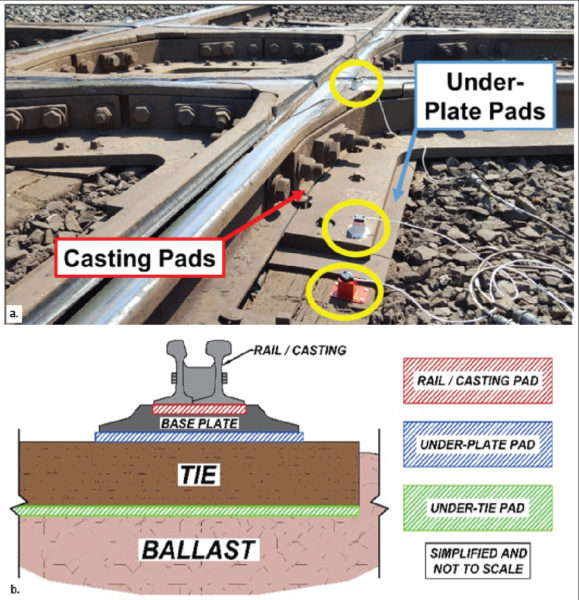
For all measurements, accelerometers were placed at three layers on the diamond: the casting, the platework, and the tie (see Figure 1). Generally speaking, accelerations can provide a useful measurement to assess vibration and impacts. The accelerometer records were analyzed by calculating the maximum and minimum peaks from passing locomotive axles. To reduce the influence of axle loads and other vehicle dynamics, only the locomotives were analyzed. The locomotive velocities were also recorded, but no significant influence from velocity was observed with the available velocity ranges (20 to 40 mph).
DIAMOND PERFORMANCE
The monitoring results showed that pad configuration and support conditions both influence diamond accelerations.
Diamond #1: Pad Configuration
Figure 2 shows the accelerometer results of Diamond #1, emphasizing the influence of pad configuration. To isolate the pad configuration from the support conditions, only Diamond #1 measurements with well-supported conditions (no visible pumping greater than 0.5 inches) are presented. The black dots represent a peak from each locomotive axle while the various colored markers represent the median values.
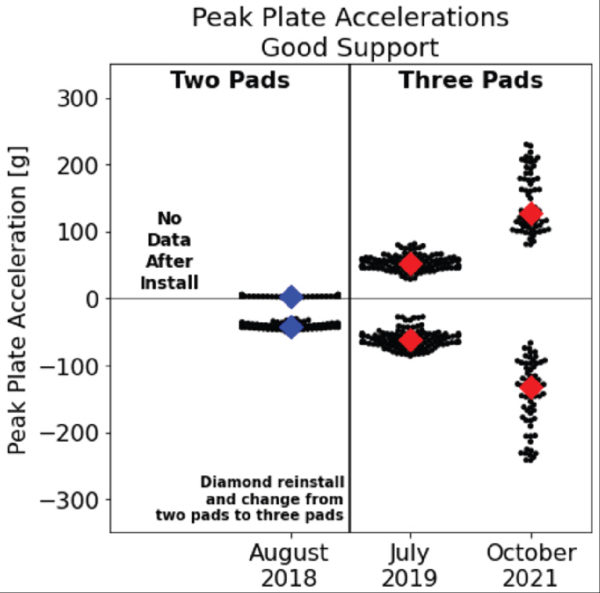
As can be observed, while the newly installed three-layer pad configuration (July 2019) is similar to the in-service two-layer pad configuration (August 2018), the three-layer pad configuration shows deterioration and has much higher accelerations after being in-service for two and a half years. These higher accelerations agreed with visual observations of more broken bolts, loose elastic fasteners, moving platework, and churned ballast in the third observation trip (October 2021).
Accelerometer Results – Pad Configuration and Support Conditions
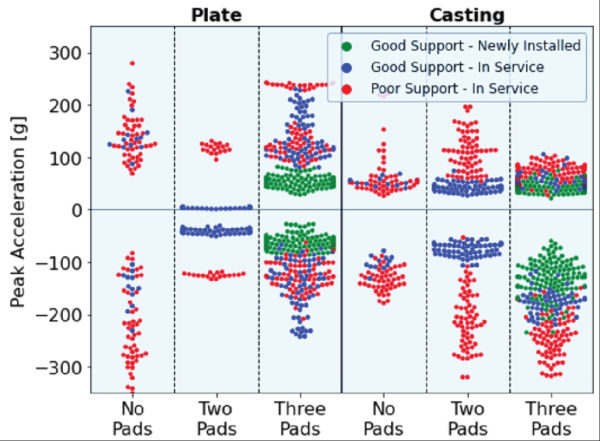
Figure 3 includes all results from both diamond crossings, both good and poor support conditions, and accelerations from both the plate and casting. The dot color represents the support condition (e.g., poorly supported in red) and whether the good support situations were newly installed (green) or in-service (blue). No newly installed diamond had poor support conditions. The results suggest the best performance (lowest casting and plate accelerations on the tested crossing diamond) occurs from a combination of two-pad configuration (UTPs and UPPs) and good support conditions. Degradeded performance (i.e., higher accelerations) can be observed from the no-pad, three-pad, and poorly supported situations.
REMARKS AND COMMENTARY
The crossing diamond field test results show that pad configurations and support conditions both influence diamond performance. The deterioration of the three-layer pad configuration was also observed on other diamonds in revenue service, and the casting pad is believed to be the cause of increased maintenance on fastening systems, bolts, and platework. The increased platework vibration has been attributed anecdotally to the casting pads, and this study seems to agree with the observations. While the cause of the increased platework acceleration magnitude is not completely clear, suboptimal casting pad stiffness may be part of the problem. Casting pads with higher stiffnesses have appeared to perform better both at FAST in Pueblo, CO, and at an in-service crossing diamond. Further study will be required before any casting pad recommendations can be made. However, for the monitored diamonds, it was noted that diamonds with either UTPs only or UTP and UPP combinations required less maintenance than diamonds with no pads or diamonds with casting pads (regardless of other pads).
Support conditions can also influence the crossing diamond performance. Increased displacement and vibration can occur from both running surface and foundational issues. This study did not directly investigate foundational conditions other than making general observations; however, best practices have been determined based on previous studies. These best practices include proper ballast maintenance (e.g., ensuring drainage), the use of premium, wear-resistant ballast, and additional foundational support methods, such as geosynthetics or hot-mixed asphalt, that can reduce the subgrade settlement in regions with poorer subgrade material.
ACKNOWLEDGEMENTS
The authors would like to thank Erik Frohberg (retired) from BNSF Railway for commentary and direction along with Edouard Valancogne from Getzner for advice and understanding of pad properties.
REFERENCES
[1] Davis, D. and R. Jimenez. 2016. “Next Generation Foundations for Special Trackwork – Phase III.” DOT/FRA/ORD-16-14.
[2] Wilk, S., K. Morrison, D. Otter, and C. Johnson. 2022. “Crossing Diamond Performance: Pads and Foundations.” Technology Digest TD-22-013. AAR/MxV Rail: Pueblo, CO.
Media
RELATED ARTICLES