San Francisco’s MUNI About to Begin Long-Awaited Replacement of Floppy Disks in Train Control System
Written by David C. Lester, Editor-in-Chief


SFMTA
SAN FRANCISCO –– The San Francisco Municipal Transportation Agency (SFMTA or MUNI) is about to embark on a project to replace the floppy disk-driven computer system that was installed in 1998.
Previous Reporting
On April 8 of this year, Railway Track & Structures reported that there is concern around how much longer the floppy disks that are an integral part of MUNI’s subway system will function. You can read that story here.
We reported that “The ABC television network affiliate in San Francisco, Channel 7 News, reported this weekend that SFMTA’s train control system software and data still run on 5-1/2-inch floppy disks. This type of floppy disk is likely only remembered by people who have been around a while. The 5-1/2-inch floppy disk is truly floppy – meaning that it’s a piece of flexible, plastic-type material that is used to input software and data into a computer. It is stored in a protective sleeve to help keep fingerprints and dust off of it during handling.
“This type of floppy disk was developed in the late 1970s and early 1980s and offered very little storage space. If you remember floppies at all, you’re more likely to remember the 3-1/2-inch floppies. While these disks contain essentially the same material as the larger ones, the material is encased in a hard plastic shell. Nevertheless, those were used primarily in the later 1980s and 1990s. Today, of course, we have internal and external hard drives that hold multiple terabytes (TB) of data.”
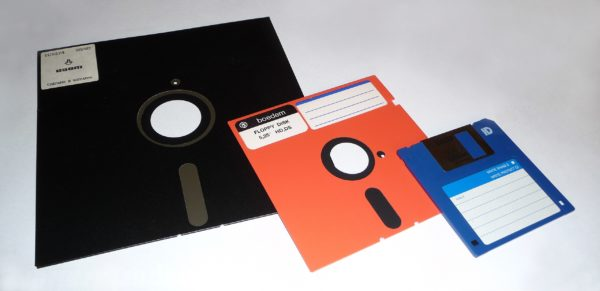
The evolution of the floppy disk. The black floppy on the left is an 8-inch disk developed by IBM in 1967. The red floppy is a 5-1/2-inch disk (the kind used by SFMTA today) and the blue one is the last iteration of the floppy, which is encased in a hard shell.
New Reporting
This week, the San Francisco Examiner reported that the state of California will provide a grant that will enable MUNI to update its automatic train control system to modern standards and get rid of the floppy disks. The portion of the system that is currently controlled by this technology is the underground subway. MUNI will receive a $130 million grant from the state to upgrade the technology, which will cost the agency a total of $212 million.
The Examiner wrote that “Officials with the state agency said the SFMTA’s current train-control system ‘communicates more slowly than a dial-up modem and limits rail frequency, reliability and travel times.’ The new system will use Wi-Fi and cellular connections to precisely track and communicate with all Muni Metro trains, as opposed to the loop cable signal wires that keep the current iteration running.”
After the new system is installed in the underground subway, the next phase of the project will be to integrate the system with those trains running in the street. There is currently some degree of signaling on this portion of the system, but operator line-of-sight is the primary control method. Once the trains running on the street are running are integrated with the underground subway, the complete system will benefit from the new train control technology.
Jeff Tumlin, SFMTA’s Director of Transportation, said “Our aging train control system is Muni’s greatest vulnerability. It needs to be replaced and modernized, and we need to deliver this project better than we’ve done before. We’ve learned from past mistakes and changed our procurement approach to select vendors who offer the best expertise, and we’ll hold them to performance goals. We’ve also learned to price risk into the cost of the project, so we’re better prepared with the right level of investment.”
SFMTA also says that “the current technology that runs the system in the subway that controls Muni Metro trains is very outdated and at risk of breaking down. Some parts are no longer made, and we will run out of the ability to replace them. Other parts are simply very limited in their capabilities.
“If the current system breaks beyond repair customers will experience major subway congestion issues, delays, and a significant decrease in Metro service and reliability citywide. We will have to operate Metro in the subway in manual mode, which is extremely slow and cumbersome. Due to the ripple effects of the subway delays, this would impact MUNI bus and other transit connections to and from Metro.”
Timeline
According to SFMTA, “Installation will take place in phases designed to reduce risk. Throughout these implementation phases [it] doesn’t anticipate major disruptions to MUNI service.
“The first phase –– the Initial Technology Demonstration –– will take place between Embarcadero and Evans where operators currently run trains in manual mode and can easily switch back to manual if necessary.
“We expect to begin phase two –– Subway Technology Upgrade –– in 2027 or 2028. This phase will completely replace the existing system in the subway, where automatic train control is critical for effective train operations because all lines converge there.
“Phases three to seven –– On-Street Technology Installation –– will install the new system on the remaining on-street branch lines, bringing the benefits of train control to surface locations which have never had it before.
“[SFMTA] currently anticipates the On-Street Technology Installation to begin with the N Judah in around 2028, the T Third, K Ingleside and M Ocean View in 2029 and the J Church and L Taraval in 2030.”
“[SFMTA] expects the Train Control Upgrade Project to take about eight years, from 2025 through 2032. This includes detailed design, installation, testing, and final delivery. The project will unfold in seven, relatively short, overlapping phases. As the project unfolds, [SFMTA] will look for ways to complete work [more quickly].”
Railway Track & Structures will continue to follow and report on this project as it progresses.