TTC: Where Innovations Meets Real-World Rail Applications
Written by TTC Operated by ENSCO


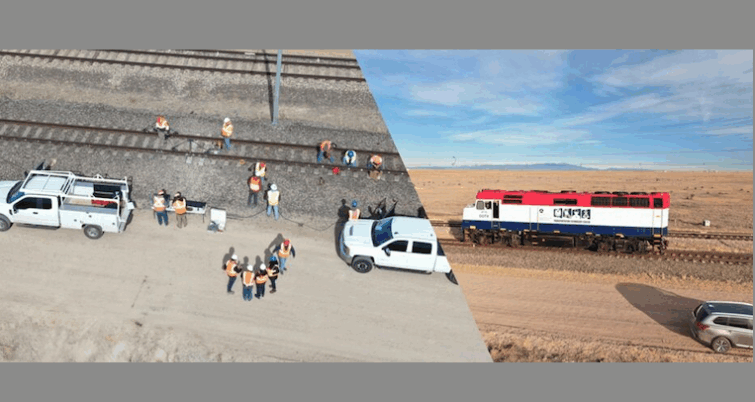
Figure 1: Researchers working at TTC’s RTT track testing site to evaluate the performance of FBG and DAS technologies under moving wheel loads.
Courtesy of TTC Operated by ENSCO
PUEBLO, Colo. - Md. Fazle Rabbi –ENSCO, Inc., Pueblo, CO; Rakan Alturk –ENSCO, Inc., Pueblo, CO; Radim Bruzek –ENSCO, Inc., Pueblo, CO; Hugh B. Thompson II, Federal Railroad Administration, DC; Mahsa Gharizadehvarnosefaderani –Oklahoma State University, Stillwater, OK; Deb Mishra –Oklahoma State University, Stillwater, OK write for TTC Operated by ENSCO in this month's issue of RT&S.
The Transportation Technology Center (TTC) is a dedicated facility for researching, developing, and testing emerging technologies. It provides a controlled environment where new innovations are rigorously evaluated before being deployed on active rail networks. TTC features a diverse range of track conditions—from well-maintained infrastructure to severely defective track scenarios—allowing for a thorough assessment of new technologies in real-world conditions.
At TTC, researchers and engineers from public and private transportation agencies, as well as academic institutions collaborate to refine and validate technologies that enhance rail safety. This ensures that innovations meet industry standards and operational requirements before being implemented.
Advancing Track Monitoring Technologies at TTC
Rail transportation agencies are constantly seeking efficient track monitoring systems to improve safety, reliability, and cost-effectiveness. Advances in sensor technology have enabled real-time monitoring of track conditions, allowing for continuous assessment and early detection of potential issues.
TTC has served as a testing ground for various fiber-optic-based sensing technologies, particularly at its High Tonnage Loop (HTL) and Railroad Test Track (RTT) [1~4]. A recent collaboration between the Federal Railroad Administration (FRA), ENSCO, Oklahoma State University (OSU), and AP Sensing aimed to develop and enhance track monitoring methods using Optical Fiber Sensors (OFS). The objective was to enhance existing techniques and develop new methodologies that were previously unattainable due to limitations associated with conventional sensors.
University-Agency Partnership: Monitoring Track Transitions with OFS
Railroad track degradation is common in transition zones, such as bridges approaches, tunnel slabs, and grade crossings, where abrupt changes in track bed properties can lead to differential settlements, hanging tie conditions, as well as amplified wheel loads [5-8]. Delayed or inadequate maintenance can accelerate track degradation, significantly increasing derailment risks.
A 2015 Vox report [9] highlighted that track failures, including broken rails and welds, account for 44.9% of train derailments. A recent incident on October 15, 2023, highlighted the importance of track monitoring. A BNSF coal train with 124 loaded hopper cars and five locomotives derailed on a bridge approach near TTC in Pueblo, Colorado. Thirty loaded coal cars derailed, causing the bridge to collapse onto Interstate 25. The National Transportation Safety Board (NTSB) determined that the derailment was caused by track failure, stemming from an improper thermite weld and an overstress fracture. [10]. The incident resulted in the tragic loss of a truck driver’s life and $15.6 million in damages.
Advanced track monitoring systems can help prevent such incidents by providing early warnings of track instability. OFS-based monitoring technology has the potential to revolutionize rail safety by enabling real-time monitoring of critical track sections and detecting issues before they become catastrophic.
Testing Optical Fiber Sensors at TTC
In 2023 and 2024, researchers conducted two phases of field testing at TTC to evaluate two key OFS technologies for track condition monitoring: (1) Fiber Bragg Grating (FBG); and (2) Distributed Acoustic Sensing (DAS). Rail-mounted FBG-based strain sensors can measure rail strain at specific points like conventional strain gauges, but with superior multiplexing capabilities, enabling a quasi-distributed system for scalable track condition monitoring. In contrast, the DAS technology utilizes the entire optical fiber as a continuous sensor, allowing real-time, long-distance distributed monitoring. The next section outlines research conducted at TTC to evaluate these sensor technologies.
In Phase I, researchers evaluated the adequacy of DAS technology for long-range track monitoring at the RTT test tracks. Phase I also included an initial comparison between wheel load induced rail strain measurements using FBG-based strain sensors and traditional strain gauges. In 2024, the second phase of field testing primarily focused on FBG-based strain sensors and evaluated different sensor locations and data analysis methods to accurately estimate the track’s response to train loading under varying support conditions. The second phase of testing was carried out at TTC’s HTL tracks. Figure 1 shows drone footage of research teams from FRA, ENSCO, OSU, AP Sensing, and Instrumentation Service Inc. in the field, conducting tests on various types of OFS alongside conventional sensors for monitoring the track degradation under moving locomotive wheel loads. Track degradation was simulated by strategic removal of selected crossties from the test section.
FBG Sensors for Railway Track Monitoring
The research was conducted in two phases, each testing with a unique approach to track monitoring:
- Phase 1 (2023): Rail-Tie Interface Force and Wheel Load Measurements
- Researchers examined whether FBG-based strain sensors could accurately measure rail-tie reaction forces and wheel loads using crib- and tie-circuit configurations.
- A specialized system was installed on the RTT test track, where FBG-based strain sensors replaced traditional strain gauges to compare their accuracy. Figure 2.a shows the conventional crib- and tie-circuit configurations to measure the vertical wheel load and tie reaction forces, where FBG-based strain sensors were used instead of conventional strain gauges.
- Phase 2 (2024): Axial Strain- Based Monitoring
- The focus shifted from shear strain measurements on the rail web to rail axial strain measurement-based techniques for improved track response monitoring.
- A total of 28 FBG sensors were installed in a multiplexed arrangement utilizing four channels of an optical interrogator.
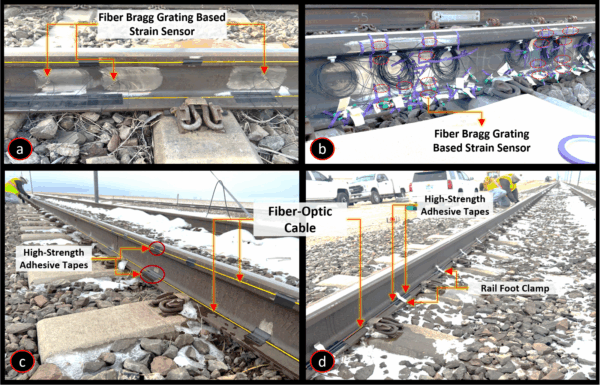
- Sensors were placed at different levels along the rail height. Figure 2. b shows FBG-based strain sensors installed along the rail head, web, and foot to identify optimal placements for the most accurate measurements.
Before installation at TTC, OSU researchers validated the FBG sensors through numerical modeling and laboratory testing to ensure accuracy [12].
Track monitoring methods, whether based on differential shear strain or rail axial strain measurements, require precise strain measurements at specific rail locations under moving loads. FBG-based strain sensors, classified as a quasi-distributed system, enable multiple sensing points along a single fiber, making them ideal for monitoring critical track sections like transitions, curves, and high-speed segments. However, FBG-based strain sensors measure strains at discrete points along the track. For long-term monitoring of track segments, Distributed Optical Fiber Sensors (DOFS) offers a more effective solution. The DAS technology is a type of DOFS. The next section of this article outlines DAS-related research activities conducted at TTC’s RTT testing facilities.
DAS Technology for Continuous Track Monitoring
The DAS technology transforms an entire fiber-optic cable into a continuous sensor, allowing for real-time, continuous (both spatially as well as temporally) monitoring of track conditions. Previous DAS research at TTC involved embedding sensor cables in the ground or placing them beside the track to monitor long-term track degradation. However, as part of this collaborative effort, researchers assessed the feasibility of attaching the optical fiber cable directly to the rail, rather than laying it adjacent to the track. This study compared the sensitivity and accuracy of the DAS technology for track condition assessment when the cables were installed on the rail head versus the rail foot (See Figure 2.c). Additionally, different fiber attachment methods and the sensitivity of different weathering protection jackets were evaluated under loading from a locomotive operating between 10 to 100 mph (See Figure 2.c&d). Findings indicated that sensor placement and attachment method significantly affected measurement accuracy, emphasizing the importance of optimizing installation techniques for future deployments.
Conclusions
The research conducted at TTC has been instrumental in advancing OFS technology for track condition monitoring. The collaborative efforts of FRA, ENSCO, OSU, and AP Sensing have demonstrated the potential of FBG- and DAS-based sensors for real-time, continuous track condition monitoring. This study found that the accuracy of FBG-based strain sensors can be improved through strategic sensor placement, making them ideal for targeted monitoring in critical track areas. On the other hand, sensitivity of the DAS technology varies based on deployment location, attachment method, and train speed, but data post-processing methods can improve accuracy and enhance sensitivity. Both technologies have the potential to improve railway safety by detecting track issues before they lead to derailments.
By providing a realistic yet controlled testing environment, TTC enables researchers to refine and validate cutting-edge rail monitoring solutions. With continued advancements in fiber optic sensing, the future of railway safety is poised for significant improvements in both efficiency and reliability. To learn more about the TTC, please visit ttc-ensco.com
Reference
- Chuang, S. L., Hsu, A., & Young, E. (2003). Fiber Optical Sensors for High-Speed Rail Applications. University of Illinois at Urbana-Champaign. Transportation Research Board, High-Speed Rail IDEA Program.
- Holcomb, M. D., & Mauger, D. (2013). Feasibility Study of Fiber-Optic Technology for Broken Rail Detection. Washington, DC: Federal Railroad Administration.
- Sutton, K., Alishio, R., Holcomb, M., Gage, S., & Baker, J. (2018). Fiber Optic Availability and Opportunity Analysis for North American Railroads (No. DOT/FRA/ORD-18/23).
- Pate, S., Sutton, K., Hall, T., Holcomb, M., & Stoehr, N. (2018). Evaluation of Fiber Optic Broken Rail Detection Systems (No. DOT/FRA/ORD-18/37).
- Lundqvist, A., & Dahlberg, T. (2005). Load impact on railway track due to unsupported sleepers. Proceedings of the Institution of Mechanical Engineers, Part F: Journal of Rail and Rapid Transit, 219(2), 67-77.
- Zhang, S., Xiao, X., Wen, Z., & Jin, X. (2008). Effect of unsupported sleepers on wheel/rail normal load. Soil Dynamics and Earthquake Engineering, 28(8), 662-673.
- Wang, P., Xie, K., Shao, L., Yan, L., Xu, J., & Chen, R. (2015). Longitudinal force measurement in continuous welded rail with bi-directional FBG strain sensors. Smart Materials and Structures, 25(1), 015019.
- Wang, H., & Markine, V. (2019). Dynamic behavior of the track in transitions zones considering the differential settlement. Journal of Sound and Vibration, 459, 114863. doi.org/10.1016/j.jsv.2019.114863
- Vox. (2015, May 13). The number one cause of train accidents? Track problems. Retrieved from https://www.vox.com/2015/5/13/8599457/train-accident-causes
- National Transportation Safety Board. (2024). Materials Laboratory Factual Report 23-100 (RRD24FR001). Washington, DC
- Ahlbeck D. R., Harrison H. D., Prause R. H., Johnson M. R. Evaluation of Analytical and Experimental Methodologies for the Characterization of Wheel/Rail Loads. Improved Track Structures Research Program, Interim Report. Federal Railroad Administration Office of Research and Development, Washington, D.C., 1976.
- Gharizadehvarnosefaderani, M., Rabbi, M. F., Stuart, C. D., & Mishra, D. (2025). Performance evaluation of rail-mounted quasi-distributed optical fiber sensors for monitoring track transitions. Transportation Geotechnics, 51, 101487.
Media
RELATED ARTICLES