More details, concerns emerge on NS Memphis project
Written by jrood


Norfolk Southern has unveiled preliminary environmental data that will serve as the foundation of its proposed intermodal terminal in Fayette County, where cargo containers will be transferred between trucks and trains, The Daily News reports.
At a public information
meeting, the company pledged that its massive facility would tread as lightly
as possible, keeping noise, light and traffic to a minimum. But not all of the
50 or so people who attended the meeting were buying the railroad’s overt
commitment to reducing the terminal’s impact on their land – or their
community.
The meeting was filled with
questions and concerns about the railroad’s project, dubbed the Memphis
Regional Intermodal Terminal. And it provided the first hint of opposition to
the project since residents last year formed the South Fayette Alliance to
protest Norfolk Southern’s plan to build a yard in another part of the county.
The meeting took on a NIMBY
feel, with residents from Fayette and Shelby counties and Marshall County,
Miss., voicing fears that the yard would drastically disrupt their neighborhoods
and their lives.
Norfolk Southern
spokesperson Susan Terpay attended last week’s meeting, held at the Piperton
branch of the Bank of Fayette County – where the railroad in July announced it
would build the $112-million facility on 570 acres owned by insurance mogul
William Adair in a newly annexed section of Rossville. Terpay said the two-hour
meeting was part of the entire process, giving residents a chance to speak with
Norfolk Southern employees and consultants and allowing the public to see firsthand
the facility’s layout, its potential economic benefit and the timeline for design
and construction.
"The public meeting and
question-and-answer session are specifically designed to provide residents with
an opportunity to express their opinions – positive and negative – concerning
this project," she said. "All the comments were recorded and will be reviewed
by Norfolk Southern and TDOT (Tennessee Department of Transportation) as part
of the NEPA (National Environmental Policy Act) environmental evaluation
process."
Residents heard Norfolk
Southern’s plan for the terminal, which will be developed between Knox and
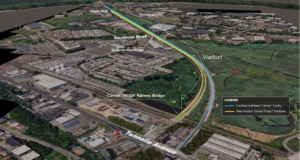
Parnell roads south of Tenn. 57 and north of U.S. 72. A rail spur will connect
the railroad’s main line with the yard to the south (going under an overpass
that will be built on Tenn. 57), and a two-lane access road will connect the
yard to U.S. 72 to the south.
Design work should be
completed by February, and construction will begin next summer. The facility is
slated to open in early 2012 with the promise of new jobs and economic
development for Fayette County and the surrounding area.
The railroad posted
information at the public meeting indicating how it intends to keep the
terminal’s profile as low as possible. For example, Norfolk Southern will cut
into the terrain on the yard’s east boundary, placing the facility 40 feet
below ground level on that side. It will use the dirt it cuts away to fill in
other parts of the footprint.
The terminal’s light poles
are only 70 feet tall, about a third shorter than the railroad’s standard
100-foot height, NS officials said, so with the recessed yard they will only
stand 30 feet above ground at some points. And the lights are designed to slant
downward, reducing the "light pollution" that is common with industrial sites
and transportation yards.
Also, the railroad plans to
reduce the sounds of trains, cranes and trucks that will run into, out of and
through the facility 24/7. And it is working to mitigate the impact the yard
has on wildlife habitats and neighboring creeks and streams.
Despite Norfolk Southern’s
attempts to paint the facility as unobtrusive, attendees overwhelmingly
expressed concern that their communities will turn into anther "Lamar Avenue
and Shelby Drive," an industrial eyesore saddled with drab warehouses and
rutted roads.
When a spokesperson for
AMEC Earth & Environmental, the project’s environmental consultant, said
the Fayette yard would see up to 834 inbound and 834 outbound trucks daily, the
crowd grew restless at the thought of how so much traffic – and the potential
for vehicles continuously braking, shifting and honking – will disturb their
rural lifestyle.
Joan Walters of Piperton,
one of the most outspoken critics at the event, said the terminal would
inevitably attract ancillary businesses such as distribution centers, fast-food
joints and cheap motels, driving down property values and driving out
residents.
But Ed Newton of Piperton
had a different perspective. Though his property will be affected by the
facility, he also saw that the railroad chose the lesser of two evils when
opting to build on the Adair property instead of the Windyke property – the
site north of Tenn. 57 originally slated for a golf course and the railroad’s
ideal site for an intermodal operation.
The railroad revealed that
it considered six sites for its new Memphis-area facility, including the Adair
property it ultimately chose. The other Fayette County sites included the
Windyke site, plus two other properties near Norfolk Southern’s main line: the
Pictsweet and Vulcan properties that would have put truck traffic onto 57. The
Memphis options were an expansion of the company’s Forrest Yard facility near
the Mid-South Fairgrounds and joining CN and CSX Corp. in Frank C. Pidgeon
Industrial Park near Downtown. The railroad nixed those because Forrest Yard
has no room to expand and Pidgeon would have required sharing track with
competitors.
Norfolk Southern’s decision
came down to the Windyke and Adair properties, with the Adair site winning out
because it impacted the fewest number of residents and posed fewer
environmental risks.
"We are compromising somewhat,
putting this here," said Charlie McMillan, an Atlanta-based systems engineer
for Norfolk Southern facilities. "Community concerns moved us over here. We did
listen to the community, and we were able to engineer solutions to make it
work."
RELATED ARTICLES