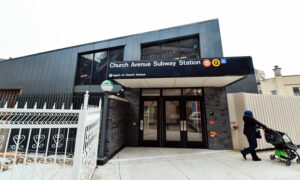
MTA C&D, Urbahn Architects, Citnalta-Forte, Gannett Fleming Complete $300MM Renovation of 14th St/Sixth Ave Station
Written by Jennifer McLawhorn, Managing Editor


MTA Construction and Development, design-build contractor Citnalta-Forte, Joint Venture and designers Urbahn Architects and Gannett Fleming completed a $300 million accessibility upgrade and other renovations at the 14th Street Sixth Avenue subway station complex in Manhattan.
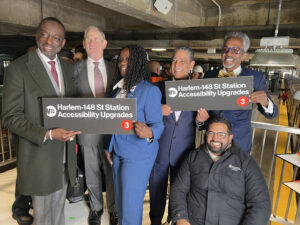
Left to right: Naik Group Senior Project Manager Mekh Gurung; accessibility advocates Debra Greif and Christopher Greif; Permanent Citizens Advisory Committee to the MTA Executive Director Lisa Daglian; MTA Chair and CEO Janno Lieber; MTA Chief Accessibility Officer Quemuel Arroyo; New York City Transit President Demetrius Crichlow; Federal Transit Administration Regional Administrator Michael Culotta; Urbahn Architects Project Manager and Senior Associate Lawrence Gutterman, AIA, DBIA; MTA C&D Vice President Matthew D. Zettwoch; MTA C&D Assoc. Vice President and Program Director Edmund C. Gbanite, R.A.; Citnalta Construction President Michael Gargiulo; Gannett Fleming TranSystems Deputy Design Manager Amr Aly, PE, LEED AP; Forte Construction President Larry Pappas; and Naik Group Lead Resident Engineer Souheil Ragheb.
Photo by Peter Wilk/Wilk Marketing Communications.
NEW YORK CITY - The 14th Street Sixth Avenue subway station is now fully accessible following a $300 million renovation.
Funded through local and federal means, the station complex is not only accessible, but it now has upgraded technology and circulation. According to the release, The MTA along with design-build contractor Citnalta–Forte, Joint Venture and designers Urbahn Architects and Gannett Fleming completed the upgrade. The MTA subsidiary, MTA Construction and Development was the project manager with Naik Group serving as the project management consultant.
Out of the $300 million in funding, $247 million came from federal funds. The complex itself stretches along West 14th Street between Sixth and Seventh Avenues with stops by F and M trains that run north and south, the L train, and the 1, 2, and 3 lines that also run north and south. According to the release, the three stations have five platforms.
Urbahn Architects (within the Gannett Fleming – Urbahn joint venture) was the architectural lead partner and architect for the Sixth Avenue portion of the project. Gannett Fleming was the architect for the Seventh Avenue portion and the structural engineer for the Sixth Avenue portion. It was also the elevator consultant and infrastructure and controls designer. Citnalta-Forte, Joint Venture, formed by Citnalta Construction Corporation and Forte Construction Corporation, was the design-build contract holder and builder. The team also included “MEP engineer A. G. Consultant Engineering, structural engineer for the Seventh Avenue portion Dewberry Engineers, communications and fire alarms engineer Geri Goldman Engineering, lighting designer Domingo Gonzales Associates, and historic restoration consultant Jablonski Building Conservation.” The Urbahn Architects’ design team included Project Architect Michael Sheedy, AIA, Design Quality Assurance Manager and Senior Associate Nandini Sengupta, Associate AIA, and Designer Tom Barcik.
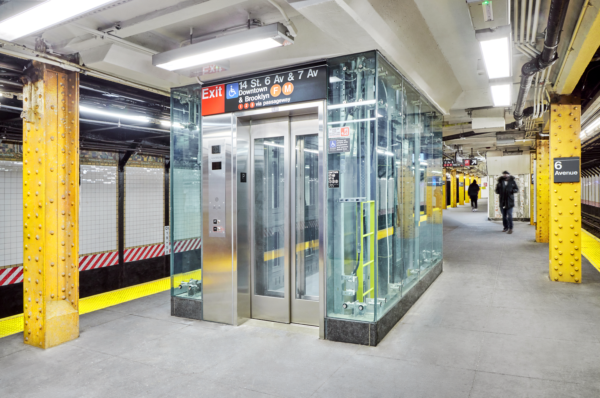
Photo by Ola Wilk Studio.
“The new MTA is completing accessibility projects five times faster than ever before,” said MTA Chair and CEO Janno Lieber. “And one of the main reasons we’re able to open elevators here and throughout the system is the support of the Biden Administration, which contributed $247 million towards this megaproject through USDOT and our congressional delegation, led by Senate Majority Leader Schumer.”
“Newly accessible stations like the 14 Street complex are the fruits of our efforts to deliver projects better, faster, and cheaper,” said MTA Construction & Development President Jamie Torres-Springer. “These accessibility upgrades coupled with critical state of good repair work and station environment improvements have transformed 14 Street into a welcoming transit hub for all New Yorkers.”
“The main goal behind this expansive $300 million upgrade and renovation was to provide full ADA accessibility to the 14th Street Station complex used by more than 130,000 passengers every day. The redesign also included improving passenger circulation and technology upgrades. The station, the oldest section of which was built in 1918, is now fully accessible and received necessary technological, lighting and infrastructure improvements” shared Urbahn Architects Principal Natale V. Barranco, AIA, LEED AP.
Citnalta President Michael Gargiulo said, “The 14th Street Station Complex is one of numerous projects that Citnalta has completed for the MTA throughout its 50-year history. Our work for the New York City Transit system has focused on accessibility upgrades and rehabilitations, resulting in improved passenger comfort, more reliable technology, and increased safety. While this project was extremely challenging, the entire team rose to the occasion to provide elevators and accessibility upgrades that are vital for the riding public.”
“The 14th Street project is part of Urbahn’s ongoing ADA accessibility redesign assignment within MTA’s initiative to make 95% of New York City’s subway stations accessible by 2045. Our firm has designed accessibility upgrades at 16 subway stations in recent years. Improving the daily lives of the New York City community is very gratifying to our entire team,” added Urbahn Project Manager and Senior Associate Lawrence Gutterman, AIA, DBIA.
Gutterman went on to state, “The MTA contracted the project in the design-build method, a process in which a client retains an entire team of contractor, architect, and engineers to deliver both the design and construction under one contract. This method, as opposed to the traditional design-bid-build process, streamlines and accelerates the work, provides one point of responsibility, and improves the overall team collaboration. MTA has been employing this innovative contracting method for several years to deliver multiple ADA upgrades and other renovations throughout the New York City subway system. The design-build process allowed the team to deliver the 14th Street station upgrades on time and on budget, a significant achievement, considering the project’s size and complexity.”
“Design-build is a powerful tool for delivering exceptional projects, allowing us to achieve elevated design standards, while meeting client needs for speed,” added Joe Tulumello, AIA, Gannett Fleming’s Executive Director, Buildings and Places. ”We’re honored to have played a role in the transformative accessibility modernization of the 14th Street Complex. This project reflects our dedication to improving the lives of NYC subway riders through innovative design and engineering and showcases the power of collaboration with Citnalta-Forte and our JV partner, Urbahn Architects.”
As for the planning, design, and construction, Urbahn Project Architect Michael Sheedy, AIA said “Early in the project’s design phase, the team surveyed all the underground utilities and structures to gain an understanding of the existing condition of the station complex, evaluate necessary upgrades and select the best locations for the new elevator and stair access points.”
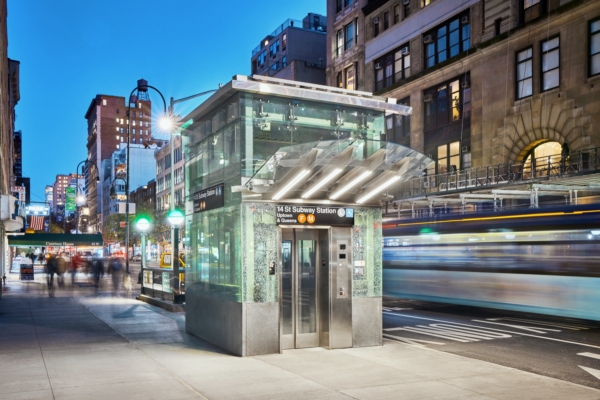
Photo by Ola Wilk Studio.
They determined the best sites for the street level elevators and worked to relocate the stairs. The release states two stairs on the Sixth Avenue side were relocated 30 feet, and one set of stairs was relocated 100 feet on the Seventh Avenue side. There were “numerous logistical and engineering challenges” that the design-build team needed to address. Not only was it necessary to relocate utility lines, but the team also needed to reconfigure and expand the upper and lower mezzanine levels of the Sixth Avenue side. This was to allow access to the new elevators. The team also needed to consider the southbound and northbound platforms for the F and M lines on the Sixth Avenue side. These are separated by PATH train tracks and a PANYNJ-operated platform. This required installing dedicated elevators for each side of the platforms in this area.
“The logistics was the most challenging aspect of the project, as our team had to complete the work without disrupting the commute of 130,000 passengers who use the station daily. Technical challenges included the complex task of excavating the bedrock to the depth of up to 40 feet to install the new elevators next to a busy street and in a densely developed area with an extensive network of underground infrastructure lines,” explained Citnalta’s Project Executive Michael Murphy. “In addition, due to the sections of the complex being originally constructed over 100 years ago, some of the existing conditions, deteriorated structural elements and locations of older infrastructure installations were not discovered until the renovation was already under way. Despite these challenges, we still met the project’s completion schedule by accelerating the work with multiple shifts and working on weekends.“
To allow for full accessibility, the team installed nine new elevators and 25 new and 39 renovated stairways. These will allow passengers to walk from the street to the mezzanines to the platforms. The Sixth Avenue section has six new elevators, and the Seventh Avenue section has three new elevators. With new internal stairways that connect the mezzanines to platforms, this increases the circulation of passengers within the complex. Additionally, there is now a new ADA ramp between both the Sixth and Seventh Avenue sides to address issues “with the preexisting ramp that made it too steep for proper wheelchair access.” The ramp runs half the length of the path and is at a lower angle for ease of use. It includes a handrail for passengers as well.
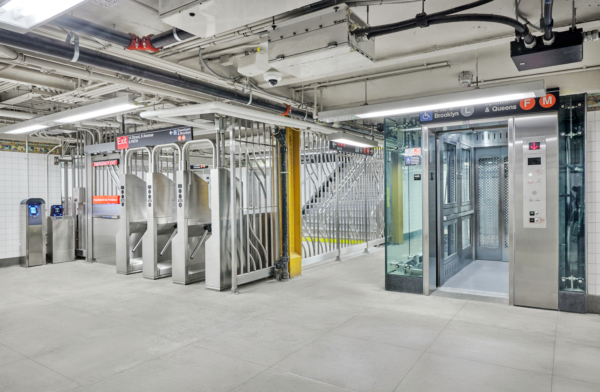
Photo by Ola Wilk Studio.
The back-of-house operation presented a “significant logistical challenge,” according to the release. This area services almost all of Manhattan’s subway stations. The upgrades necessitated the reconfiguration of offices and storage rooms, “including several areas built early in the project to allow subsequent relocation of the rooms displaced to accommodate the new elevators and elevator machine rooms.” The team also made other upgrades and repairs to the platform surfaces, signage, and walls. Crews added new concrete topping slabs and tactile warning strips on the platforms. The station also received upgrades to lighting with high-efficiency LED linear fixtures.
On the Seventh Side of the station, there is also a new agent booth that has a lower transaction window to make it ADA-compliant. There are new access control centers with turnstiles and emergency doors included on the lower mezzanine of the Sixth Avenue side to serve the new elevator in the area. Damaged tiles were replaced with new tiles manufactured by Heritage Tile. And outside of the station, the New York City Department of Transportation designed sidewalk improvements that were built by the design-build team. These include street-level elevator access and curb cuts.
The station complex also now houses six new large-scale artwork pieces titled Wild Things by Fred Tomaselli. Tomaselli is based in Brooklyn, and the artwork focuses on a species of birds “that live year-round in New York City.”
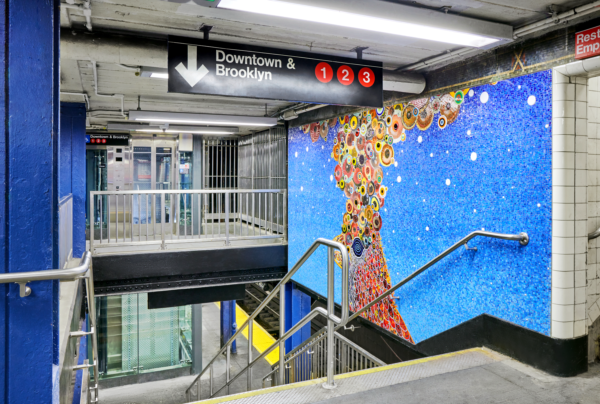
Photo by Ola Wilk Studio.
Urbahn Architects
“Celebrating its 80th anniversary in 2025, Urbahn Architects is a full-service planning and design firm based in New York City. Since its founding in 1945, Urbahn has designed projects for organizations and institutions that operate in the education, public and governmental, transportation, hospitality, healthcare, science, justice and public safety, residential and infrastructure sectors. The firm also operates a regional office in Jakarta, Indonesia, focused on projects in the Far East. The value of Urbahn’s current domestic and international projects totals approximately $4 billion.
Building Design & Construction magazine ranks Urbahn as the 75th largest architecture and planning firm in the United States. The firm designed some of the nation’s most iconic structures, including the Vehicle Assembly Building and Launch Control at Kennedy Space Center in Cape Canaveral, FL, and the Fermi National Accelerator Lab in Batavia, IL. Four principals lead the firm: Donald E. Henry, Jr., AIA, LEED AP, CPHC; Natale V. Barranco, AIA, LEED AP; Rafael Stein, AIA; and Ranabir Sengupta, AIA, LEED AP.
Urbahn’s transportation project portfolio includes the New York City Transit subway station flood mitigation resiliency program; renovations and accessibility upgrades of multiple MTA subway stations in New York City; numerous projects for the Long Island Rail Road and New Jersey Transit; and Newark City Subway Improvements in Newark, NJ.
Urbahn’s other work includes the 454-unit Tides North residential development in Arverne, NY; 154-room Four Points by Sheraton at the Piarco International Airport, Trinidad and Tobago; 140-room Courtyard by Marriott hotel at the Cheddi Jagan International Airport in Timehri, Guyana; New York City Hall Mayoral Offices and Emergency Situation Center; Centro Medico Correccional in Bayamon, Puerto Rico; Jersey City Municipal Services Complex, Jersey City, NJ; SUNY New Paltz Engineering Innovation Hub in New Paltz, NY; Lehman College School of Nursing in the Bronx, NY; Usha Martin University Master Plan in Ranchi, India; Columbia University Baker Field Facilities Master Plan in New York, NY; and P.S. 253Q Elementary School in Queens, NY.”
Citnalta-Forte Joint Venture
“Citnalta-Forte Joint Venture (CFJV) is proud to have come together once again to successfully complete Contract A37129 Design-Build Services for the 14th Street ADA Complex. CFJV was first formed in 2016 to design and construct the MTA NYCT’s design-build (DB) Enhanced Station Initiative (ESI) Package 1 – 3 Stations Project. Since then, CFJV has worked together on several other MTA design-build projects, frequently with Urbahn Architects as design partner.”
Citnalta Construction Corporation
“Established in 1974 and based in Bohemia, New York, Citnalta Construction Corp. is a leading design-builder, construction manager and general contractor in the New York Metropolitan area. Throughout its 50-year history, Citnalta’s clients have included private and public owners such as MTA Construction & Development, New York City Transit Authority, New York City School Construction Authority, Dormitory Authority State of New York, Long Island Rail Road, New York State Department of Design and Construction and New York Office of General Services, among others.”
Forte Construction
“Forte Construction Corp. is a prominent player in the field of design-build contracting. Established in 2010, the firm is a wholly owned affiliate of TAP Electrical Contracting Service, Inc. Forte’s core expertise focuses on large-scale public infrastructure projects, primarily catering to government agencies such as the Metropolitan Transportation Authority Construction & Development (MTA C&D), Long Island Rail Road (LIRR), New York City Transit (NYCT), Metropolitan Transportation Authority Bridges & Tunnels (MTA B&T), School Construction Authority (SCA), Dormitory Authority of the State of New York (DASNY), New York City Housing Authority (NYCHA), and Amtrak.”
Gannett Fleming TranSystems
“Gannett Fleming TranSystems is a privately held, best-in-class architecture, engineering, and construction firm partnering closely with clients on some of the most complex challenges facing communities today. Across North America, from more than 130 locations, the firm offers comprehensive infrastructure consulting services to a wide range of markets, including transportation, water resources, civic, education, federal, industrial, power, and life sciences. The firm’s depth of staff and breadth of experience provides clients with integrated services on projects of any. The company’s professionals include planners, architects, scientists, engineers, and construction managers, who are innovators, problem solvers, thought leaders, trainers, authors, and educators working together to deliver excellence on their projects. Bringing the specialized expertise that our clients need to thrive in a rapidly changing world, Gannett Fleming TranSystems focuses on making our communities and infrastructure better connected and safer, as well as more resilient and sustainable.”