Plans to Protect Rail Line in Orange County Presented to OCTA Board Members
Written by Jennifer McLawhorn, Managing Editor


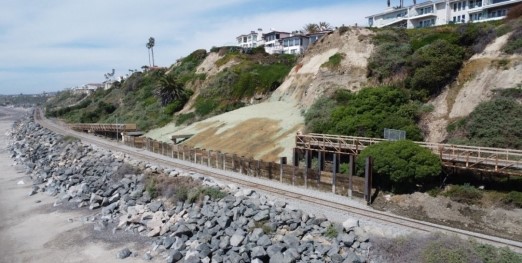
Courtesy of OCTA
ORANGE COUNTY - After landslides have disrupted rail operations in the San Clemente area, OCTA has been working with the community and its partners to seek long-term solutions.
Last year, RT&S reported on the January landslide in San Clemente that halted passenger and freight operations while OCTA and Metrolink worked to restore service. In November 2024, RT&S reported OCTA had received state and federal funding for improvements along the Coastal Rail Corridor. The report states “OCTA learned that the Federal Railroad Administration awarded $100 million in funding from its Consolidated Rail Infrastructure and Safety Improvements (CRISI) program. That money comes on top of the announcement last week that the California State Transportation Agency (CalSTA) awarded $125 million to OCTA’s rail improvement efforts through the Transit and Intercity Rail Capital Program (TIRCP), and $80 million from the California Transportation Commission’s Trade Corridor Enhancement Program (TCEP).”
In working with the community and its partners, OCTA has been working to find both short- and long-term solutions to address the issue of landslides and erosion. “An Initial Assessment conducted by OCTA identified urgent needs, which this current funding will support, including addressing four hot spots that could affect the rail line if not reinforced with additional measures such as sand, a catchment wall and rock revetment.” The four areas in need of “immediate reinforcement” will not be processed under emergency permits because the line is in operation, and “an emergency does not exist.” Below is a PDF of the Reinforcement Area Locations Map, courtesy of OCTA.
Now, OCTA has given an update on its plans to protect the rail line in this corridor. According to a report in the Orange County Register, the OCTA board members were presented with a plan and time frame for proposed projects. $40 million was spent on installing rip rap and catchment walls at various points. OCTA has identified more at-risk areas. These four areas are called the Coastal Rail Stabilization Priority Project. Previously, “nearly three dozen meetings were held with stakeholders, regulatory agencies, and the public to gather feedback on how they should be addressed.” Solutions included sand nourishment, rock revetment, “consideration of the impacts of armoring on beach erosion, supporting early-preventative action, consulting with habitat experts, and maintaining reliable railroad operations,” according to the report.
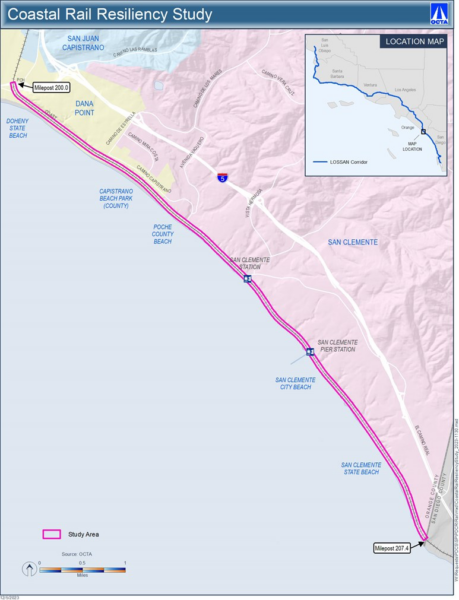
Project Manager Dan Pau told the Register that it’s a “menu of different options that we have looked at, whether it’s the bluff side, the beach side, or the rail line itself. . . It’s really more of a kitchen sink. Then the idea is to whittle it down to amore manageable number, where we’ll begin the evaluation process. . . The public stakeholder engagement is going to be part of that process.”
Such options were presented to the OCTA board this week. These include permitting through various agencies, identifying and permitting a sand replemenishment source, securing permitting for additional revetment, and securing a “timely sand transport and delivery method.” However, more stakeholder meetings will take place this year with a a final feasibility report expected by the middle of 2026.
OCTA will start its preliminary engineering phase for the alternatives, and “staff will be working with regulatory agencies to try to expedite the permitting processes.”
Notably, Susie Whitelaw, a co-founder for Save Our Beaches, invited OCTA board members to visit the area to observe “how recent sand efforts have helped to provide a buffer for the rail line.” This includes a project from the U.S. Army Corps of Engineers that involved moving 200,000 cubic yards of sand that has filled in “as far as a mile south.” Save Our Beaches is a group whose mission is “to restore and preserve San Clemente’s beaches through practical, cost-effective, nature-based solutions.” According to the report, the group has expressed concerns about using rip rap and boulder barriers to protect the rail line as an emergency measure. Whitelaw said, “You can tell because it’s a little bit darker than the native sand that was there. . . Sand works. It’s worked for 130 years to protect your tracks. That is all you need. I also really want to encourage you to minimize the rock footprint.” Save Our Beaches has stated that there was no opposition to catchment walls for emergency work, but that “boulders or other changes to the beachside should go through an environmental impact review.”
Sand sources including Prado Dam, Lapeyre Industrial Sands and the Lower Santa River have been named as potential options. These areas have various quantities and qualities available. However, the distance from these sources to needed areas play a factor. According to the current report, an estimated 540,000 cubic yards of sand is still needed, equating to 44,000 truck trips. It will take an estimated two years to go through the environmental and permitting process for sand.
Get Caught Up on San Clemente:
- San Clemente Landslide Leads to Passenger Rail Suspension
- OCTA Working with Metrolink After San Clemente Landslide
- UPDATED: San Clemente Landslide; Upcoming Storm System, Continued Hillside Movement
- OCTA Update: Still Pursuing Barrier Wall After Heavy Rain
- UPDATE: OCTA and Metrolink Continue Work; Metrolink Issues RFP
- Continued Slope Movement Halts Freight Traffic in San Clemente
- Catchment Wall Construction Begins in San Clemente
- Limited Amtrak Pacific Surfliner Rail Service Set to Resume Through San Clemente on Wednesday
- OCTA Continues Coastal Rail Resiliency Study; Catchment Wall Wooden Panels Now Up
- Passenger Service Resumes in San Clemente; OCTA Seeking Long-Term Solutions
- Sand Nourishment, Rock Revetment Among Coastal Rail Resiliency Solutions
Media
RELATED ARTICLES