CTA Red Line sets sights on South Side extension
Written by jrood


Even in a time of belt-tightening and dreams deferred, a long-sought CTA project is in the works, offering the promise of improved transportation and economic rebirth for poorly served Chicago communities, according to a story by Jon Hilkevitch in the Chicago Tribune.
In the late 1960s, when the
CTA Red Line was extended south along the middle of the Dan Ryan Expressway to
95th Street, the plan never was to stop there. Just as the north branch of the
Red Line touches Evanston at Howard Street, the goal was to build out the CTA’s
longest route to Chicago’s southern border.
But for more than four
decades, 95th Street has been as far as this train goes, leaving the Far South
Side with no rail connections to the rest of the city and adding to the
hardships of already disadvantaged neighborhoods. It has been a constant
frustration for South Siders, especially irritating when talk bubbles up at
City Hall, as it did again recently, about introducing premium express-train
service to O’Hare International Airport, which is already served by the CTA
Blue Line.
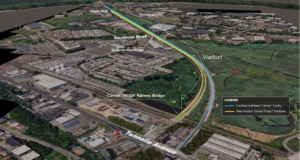
Under the CTA’s plans, four
new stations would be built – at 103rd, 111th, 116th and 130th streets – mostly
along the Union Pacific right-of-way. Two options are under review for the
location of the 130th Street terminus.
Using federal seed money,
the transit agency is starting work on a draft environmental impact study,
which the Federal Transit Administration requires as part of the CTA ultimately
receiving a federal full-funding grant agreement.
If the project is
fast-tracked, as supporters hope, construction on the estimated $1.4-billion
extension could begin within the next several years and be completed as quickly
as 2016, depending on the availability of money, CTA officials said. The
projected cost, in inflation-adjusted dollars, includes relocating the existing
CTA rail yard that is beyond 95th Street to vacant land in the area of 120th
Street and Cottage Grove Avenue.
Excitement is already plentiful
at community planning meetings for the Red Line extension, where residents are
pitching ideas regarding what they want their new stations to look like as well
as priorities for nearby development. Desired station amenities range from
bright lighting and other security-driven needs to murals designed by
African-American artists. But it’s what would be built outside the stations on
blighted parcels where there has never been a coordinated planning process that
stirs the most interest.
Mixed-use retail and
affordable-housing complexes, grocery stores and pharmacies, banks, bookstores,
ice cream shops, parks, local activity centers and many other ideas were
offered during a "visioning session" for the Red Line extension held
this month at St. John Missionary Baptist Church, which is several blocks from
the proposed 116th Street station. During the meeting, participants worked with
architects and other experts.
Without the approximately 5½-mile
Red Line extension, many south suburban residents who would clamber onto
rapid-transit service operating minutes apart during rush periods instead clog
the Bishop Ford Freeway and the Dan Ryan to get to their jobs in the city.
The CTA has moved up the
proposed Red Line extension to 130th Street to its No. 1 priority among major
capital improvement projects. In addition, in a blueprint set for release next
month for expanding economic development and improving the quality of life for
residents of the Chicago region, the Chicago Metropolitan Agency for Planning
identifies the Red Line extension as a strategic investment in transportation.
The Red Line extension
represents precisely the kind of project Congress prefers to fund. It fits the
bill as a true "new start" project, not simply a rebuilding of an
existing line. It provides much-needed transportation options to low-income,
minority communities that historically have been bypassed when it comes to
investment in infrastructure.
Plus, the economic
possibilities of transit-oriented development offer the chance to turn around
blighted neighborhoods, while attracting middle-income workers from the suburbs
to spend money at businesses likely to sprout up near planned park-and-ride
facilities along the extended Red Line, officials said.
The project is considered a
strong contender for major funding in the next multiyear federal transportation
spending bill that Congress will begin working on after the November elections.
The CTA has received
$285,000 in federal new-start money that will be used for preliminary environmental
studies for the extension, CTA spokeswoman Noelle Gaffney said. The transit
agency recently submitted an application for $2 million in funding through a
"Livability Grant" that would be used for part of the work associated
with the environmental impact study, she said.
"It cannot be
overstated how important this extension is to creating options for South Side
residents and bringing them downtown," said Karin Sommer, a project
manager with the Metropolitan Planning Council, which provided technical assistance
at the recent visioning session.
"Residents are having
their say early in the process, and the city is showing interest in receiving
their feedback," Sommer said. "That’s all good."
RELATED ARTICLES