Twelve Essential Steps for Derailment Investigation
Written by Gary P. Wolf, Wolf Railway Consulting LLC


Courtesy of Gary Wolf
ATLANTA - From the February 2025 issue of Railway Track & Structures, Gary P. Wolf walks you through twelve essential steps for investigating derailments.
You get that dreaded phone call. A major derailment has just occurred on your territory. You have only been a Roadmaster for 18 months and have never dealt with a major derailment. As you get in your truck to head to the scene, thoughts race in your head . . . What do I do when I get to the scene? What are the important first things to take care of? What can wait until later? This article will explore step by step the 12 action items required to make a good investigation for any member of the engineering team at a derailment site.
The number one priority at a derailment site is SAFETY; safety of you, safety of your team, and safety of anyone affected by the derailment. Ensure you have all your necessary PPE, including breathing apparatus if required. Make sure the derailment investigator in charge knows you are on site, and where you are working. And remember, a derailment never really stops. Equipment can be resting precariously in a jumbled position, and may slip, slide, or roll over at any time given a gust of wind or vibrations from a D-9 caterpillar sideboom. Stay in the clear, and never put yourself in a pinch point.
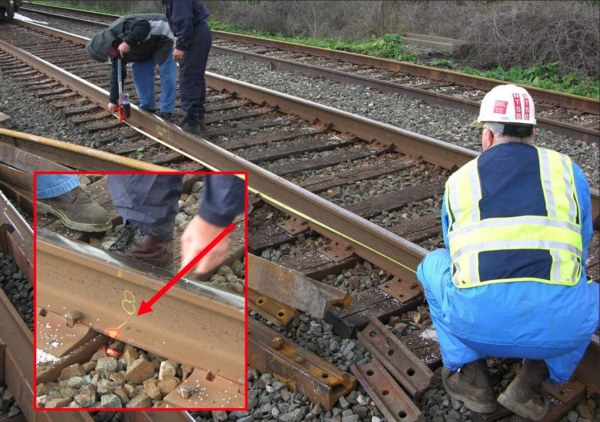
When arriving at the derailment scene, and hopefully before any site clearing has begun, your first priority is to locate the “point of derailment,” or POD. This is the first indication on the track structure that a wheel left its normal running position. It could be a wheel climb mark on the gage face of the rail, or it might be a wheel drop mark coming off the gage corner of the rail when the rail rolls outward. In other cases, it might be the first sign of some sort of catastrophic failure, like a broken rail, axle, wheel, or coupler. It is important to nail down the POD accurately since all track geometry measurements are taken with the POD as the starting point (Station 0).
The second step at the derailment site is to determine the derailment mechanism, or how the wheel derailed. Finding the POD will assist you in determining the mechanism. The basic mechanisms of how wheels derail include wheel climb, wheel lift, wheel drop in due to gage widening, or some sort of catastrophic failure.
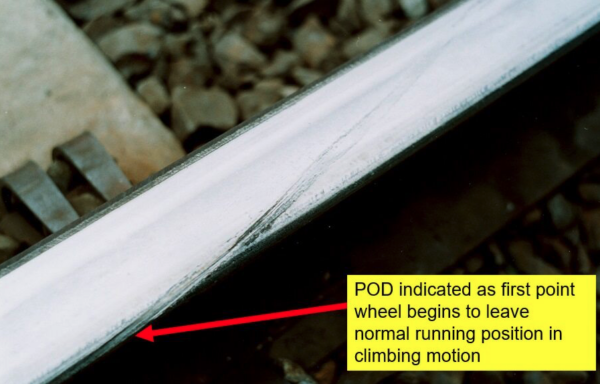
The third step is to determine which wheel, and car, derailed first. It is essential to establish which car derailed first in order to determine whether a defective mechanical condition may have caused the derailment. If you fail to accurately identify the first derailed car, you may never determine the root cause of the accident.
The fourth step is to accurately locate and mark (milepost location) where the lead locomotive came to final rest after the emergency stop of the train. Establishing the stop location will allow team members to analyze the event recorder data and determine how the train was being handled at the exact time the first wheel derailed. If you don’t know where the train stopped, it will be impossible to assess speed and train forces at the time the derailment initiated. Along with marking where the lead locomotive stopped, you should also mark where the derailed equipment came to final rest.
These first four steps are best accomplished before any remediation of the site or rerailing begins. Once you start removing track and equipment, you may never accurately locate the POD or first car to derail.
Step five involves taking a lot of photographs of the derailment. Document track conditions, such as rail, fasteners, ties and ballast, at and surrounding the POD. Next, document mechanical components such as wheels, truck frames/bolsters, and the car body. If possible, take some overview, or panorama pictures of the entire derailment site from beginning to end.
The sixth step involves data collection. There are a number of data sources that should be secured as part of the investigation. The track profile chart of the area and train consist are essential. Someone in transportation should download locomotive event recorder and video data. The latest track geometry data and rail flaw test data for the area should be collected. The crew people involved in the derailment should have statements recorded as to what they saw, felt, and heard at the time of the derailment. If it was a yard or switching derailment, you might want to get statements from adjacent crews, or even yardmasters in the tower. Historical weather data can be important in derailments possibly involving track buckle, washout, wind blowover, or winter pull aparts. The mechanical department should try to secure any recent car repair billing records on the first car to derail. And finally, wayside detector data such as Wheel Impact Load (WILD), truck hunting, hot box detectors, or truck performance, should be downloaded as appropriate. There could be other data sources that your railroad has access to that should be considered for inclusion in the derailment file.
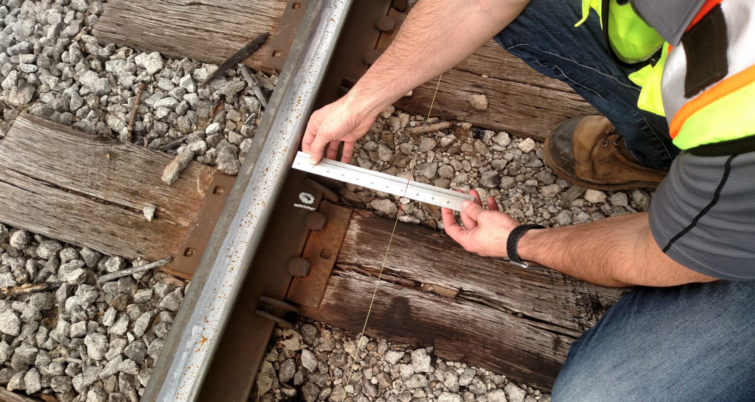
Once the site is secured, and sufficient equipment has been moved, it is now time to complete step seven which involves inspecting the track structure and comparing your findings against the FRA track safety standards. There are two important components of the track structure. First, you must assess the track geometry; and second, you must assess the track integrity. The FRA track safety standards contain regulations for the geometry of the track, such as gage, crosslevel warp and twist, track surface, and horizontal alignment. Measurement stations should be set up 15 ½ feet apart. At a minimum, go back 15 stations from the POD (Station 0) in the direction the train was approaching, and measure five stations beyond the POD if possible. For high-speed passenger derailments, you might want to measure 40 or 50 stations of data.
Other parts of the FRA track safety standards address the integrity, or strength, of the track structure. You should evaluate, at a minimum, the rail and joint bars, spiking patterns, anchoring patterns, tie condition, ballast, and drainage. Compare your findings against the FRA regulations. Remember that the FRA regulations are minimum safety standards, and the regulations do not cover a number of topics that could be causative in the derailment. A combination of track conditions might be the root cause of the derailment, even though you comply with all the individual standards for each station.
In step eight, the first derailed car, and its trucks, should be carefully measured and evaluated to determine if a mechanical failure might be the root cause. Once the first derailed car is identified, an effort should be made to collect as many of the truck components of that car as possible. Important truck components include bolsters and sideframes, wheels and axles, bearings and bearing adapters, friction castings, springs, and side bearing elements. Unusual wear conditions around the centerbowl rim, behind the bolster gibs, and on the springs should be documented. The wear may not be a defect, but could indicate poor dynamic performance of the car during truck hunting, harmonic rocking, or truck warp during curving.
Step nine involves evaluation of human performance and operation factors. Locomotive event recorder data should be compared against best operating practices. Crew performance should be compared against safety, operating, and train handling rules. Step nine should also include a close scrutiny of your railroad’s train make up rules and practices.
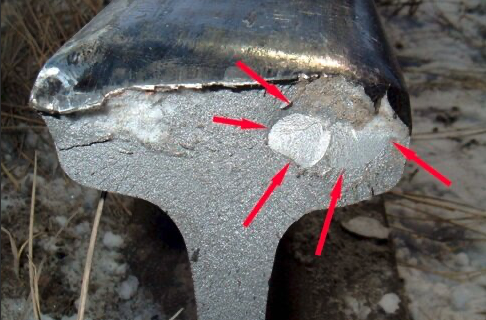
Once you have completed steps 1-9, you should be in position to compare your findings against any and all applicable operating/safety rules, FRA track safety standards, and AAR mechanical standards. This is step ten. If you have done a good job taking all the essential measurements and evaluations, at this point, the root cause should be evident. In some cases, there could still be question marks, especially where you have found some track conditions not yet condemnable, and some mechanical conditions that are approaching condemning limits. In this case, simulation analysis can help determine which conditions are most complicit in causing the wheel to derail. Simulation models such at VAMPIRE, NUCARS, TOS, and TOES, are all valuable models for derailment analysis and confirmation. In some derailments, there could be questions about a possible fatigue failure of the rail, or a wheel. In these cases, you should have a professional metallurgical lab familiar with rail components perform a failure analysis to verify a potential cause.
After going through the evaluation process in step 10, with perhaps additional simulation or metallurgical analysis, you are now in position to identify the root cause, and any contributory causes. The root cause is the one condition, that if you remove it from the mix, the derailment does not occur. Contributory causes alone are not sufficient to cause the derailment, but enhance the possibility of derailment. If you cannot make the root cause determination here in step 11, it generally means that you have failed to accurately identify the POD, or the first car to derail. You might have to start over at step one.
Finally, in step 12, you must develop corrective actions to prevent a recurrence of this type derailment. Corrective actions can range from repairs, removal of defective equipment or conditions, new rules and regulations, training, and improved inspection procedures. And check back in 6-12 months to ensure those corrective actions had the desired effects, and there were no unintended consequences.
If you diligently perform all twelve steps of this process, 99.9% of the time the root cause will fall in your lap and be obvious. Leave out one or two steps, and you may never determine the root cause. Derailment cause finding is not difficult, it just takes getting dirty, determination, knowledge, and the ability to work in an unbiased manner.
Note: Gary Wolf has investigated over 3,000 derailments in his 54-year railroad career, and is author of the only textbook on derailment investigation entitled “The Complete Field Guide to Modern Derailment Investigation”.
Media
RELATED ARTICLES