Chicago Regional Transit Authority Warns of Drastic Cuts in Service
Written by David C. Lester, Editor-in-Chief


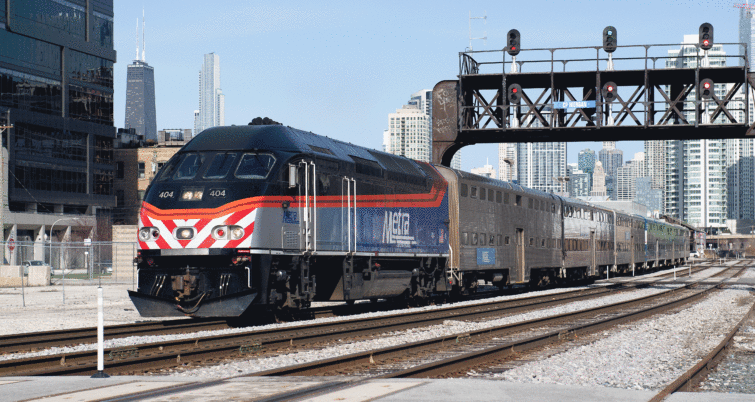
Outbound Metra commuter train. David C. Lester Photography.
CHICAGO –– The Chicago Regional Transit Authority (RTA) announced this week that transit agencies in the region, including the Chicago Transit Authority (CTA), Metra commuter rail service, and PACE bus service could all see drastic cuts in 2026 if something is not done to address the $770 million budget shortfall these agencies face.
The RTA Board of Directors passed a resolution in January that required transit agencies to provide examples of the types of cuts that would allow the region to meet the budget shortfall. The current legislative session ends in May and if a solution is not found by then, agencies would begin preparing for the changes. RTA said “The magnitude of these cuts is unprecedented and would require several rounds of schedule adjustments in 2026 and beyond.”
RTA Executive Director Leanne Redden said “This isn’t just a transit crisis –– it’s a regional emergency. If the General Assembly does not act this spring, hundreds of thousands of Illinoisans will wake up in 2026 without a way to get to work, school or medical appointments with continued uncertainty in future years about their transit services. This doomsday scenario can still be avoided as long as our state partners vote to fully fund transit operations before it’s too late.”
Nature Of Transit Cuts
CTA would likely face a 40% cut in service and close or reduce service to over 50 rail stations. Service would be suspended on all or a portion of at least four of eight CTA rail lines. The remaining rail network would see train frequencies cut by 10% to 25%.
CTA may also be required to cut 74 of its 127 bus routes, leaving 500,000 riders without a nearby bus stop.
Metra commuter rail cuts would result in a 40% reduction in service, with early morning and late evening trains eliminated, weekday trains only running once an hour, and weekend trains running only once every two hours. Metra could also need to end service on the Metra Electric Blue Island Branch. And, progress to increase frequency and shift the commuter railroad to a regional rail model would be reversed.
PACE suburban bus service would be reduced significantly. All weekend bus service could be eliminated and late-night service after 8:00 p.m. would disappear from 62 routes. ADA paratransit service, which is federally mandated, would not be eliminated, but its service area would shrink by 66% on weekends.
Transit Leadership Comments
Nora Leerhsen, Acting President of CTA, said “Public transit is what helped shape the City of Chicago and surrounding suburbs as we know it today –– it is why and how millions of us call this region ‘home.’ The results of a 40% service reduction are unconscionable, and no decisions about our service future will be made without community input. Whether you ride public transit or not, now more than ever we need your support. We’ve yet to see what public transit looks like when fully funded, and we want to make sure we can continue to provide safe, frequent, reliable, and accessible services our region deserves.
Jim Derwinski, Executive Director/CEO of Metra, said “No one wants to envision a scenario where such severe cuts are necessary. But we hope that by detailing the cost of inaction, our elected representatives will take action to make sure public transportation not only survives but thrives.”
Melinda Metzger, Executive Director of PACE, said “these cuts would have a devastating impact on our region and the people who need transit the most. Eliminating weekend service, reducing late-night options, and scaling back ADA paratransit would leave riders –– including seniors and people with disabilities –– without a reliable way to get to medical appointments, work, school, and grocery stores. All the progress we’ve made to adapt to new travel patterns, boost frequency, and expand access would be lost. The transformational improvements we have identified through our ReVision restructuring initiative will not be able to be implemented. The momentum we’ve built to create a more responsive and equitable transit system –– one that supports economic growth and connects people to jobs and opportunity –– would come to a halt, setting us back years.”
Why Is This Happening?
This story about Chicago’s commuter rail and transit funding challenges is the second story we’ve published this week on this issue, with yesterday’s report on the same challenges for Pittsburgh Regional Transit.
In September 2024, long-time Railway Age Contributing Editor David Peter Alan, a specialist in rail passenger transportation, wrote a commentary for the RA website entitled “Existential Threat to Transit,” which, of course, is about the funding challenges faced by transit agencies. Here is David’s introduction to that piece:
“When Congress authorized federal funds for transit operations in late 2020 and early 2021 as a response to the COVID-19 pandemic, that particular aid for the nation’s transit providers was meant to be temporary; a response to the steep ridership declines and consequent declines in revenue suffered by transit agencies around the nation, from the major systems I have examined in this series to small systems that operate only a few bus routes with limited service. That money is now running out, and ridership has not returned to pre-COVID levels on most transit systems, while costs continue to climb.“
I believe that for anyone who works for a transit agency, regardless of their role, David’s piece is required reading. Here’s a link to the full story. If you have time, his other writing on this issue on the RA website is worthwhile.
The graphic above that is associated with David’s story says that “Transit’s Fiscal Cliff is Coming Soon.” Based on recent reporting on transit agencies, it looks like it’s already here.