From the Dome –– Whither The American Freedom Train? November 2025 RT&S Commentary
Written by David C. Lester, Editor-in-Chief


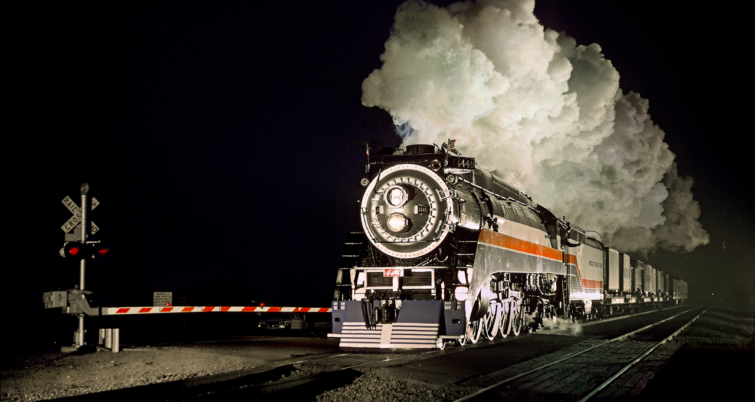
If there was ever a photographic equivalent of “the shot heard ’round the world,” this is it. The American Freedom Train photographed on December 22, 1975, traveling at 50 m.p.h. north of Bakersfield, Calif. Photograph by Tom Gildersleeve, collection of the Center for Railroad Photography & Art.
ATLANTA –– Chances are the majority of this magazine’s readership did not see, and may not even be familiar with, the two editions of The American Freedom Train that operated in the twentieth century.
The first was run in 1947-48 and consisted of a specially painted red, white, and blue locomotive pulling a set of matching cars containing a number of artifacts from American history, such as an original copy of the U.S. Constitution, the Declaration of Independence, the Gettysburg Address, the Emancipation Proclamation, and documents of surrender from both Japan and Germany signed at the end of World War II. A special exhibit was the flag raised on Iwo Jima after U.S. forces captured that Pacific Island after one of the bloodiest battles of the war.
The 1947 edition of the train was conceived by President Harry Truman and others who thought that after years of severe economic depression and war, from which the United States emerged victorious, the nation’s spirits would be buoyed by a special train to celebrate the hard-won freedom. The train operated from September 1947 to January 1949 and visited all 48 states (Alaska and Hawaii were not admitted to the Union until 1959), traveling nearly 40,000 miles. Approximately 3,000,000 people visited the train, each likely having a new appreciation of American history after the terrible stress of the previous 15 years.
The 1947-49 Freedom Train also celebrated the performance of U.S. railroads during World War II. During the war, railroads remained in private control, although there was close cooperation with the U.S. Government through the Office of Defense Transportation. Automobile and truck traffic were curtailed significantly during this period due to lack of availability of rubber tires and gasoline because of rationing. Therefore, the railroads had to provide the majority of freight and passenger transportation during the war years.
While The American Freedom Train after the war was a grand event, another was operated from April 1975 through December of 1976. The primary focus of this train was the celebration of America’s 200th birthday in 1976. As when the 47-49 Freedom Train ran, America had just emerged and was still recovering from national tragedies –– the Vietnam War and the Watergate scandal. Nevertheless, the Bicentennial train, pulled mostly by restored steam locomotives, drew 7,000,000 visitors.
Like the first train, the second edition traveled through all 48 contiguous states. Wall Street commodities trader and railroad enthusiast Ross Rowland developed and solicited corporate support for the 1976 train. The most prominent steam engine to pull the train, which pulled it further than any other, was ex-Southern Pacific 4-8-4 GS-4, numbered 4449 (its original number, built in May 1941) that was part of the Daylight fleet of passenger trains and represented one of the finest examples of steam locomotion in American railroad history.
Next year marks the 250th birthday of America. Will we see another edition of The American Freedom Train to celebrate it? Probably not. I’m not aware of any plans at all, much less on the scale of the two previous ones. One reason may be that Ross Rowland, mentioned above, passed away in July. My understanding is that he was trying to develop interest in a 2026 edition but, apparently, nothing got off the ground. Another is probably that no railroad or other funding entity is interested. That is a real shame.