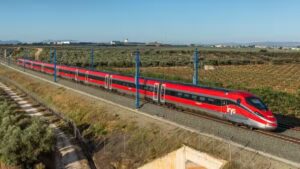
Britain Considers HS2 Speed Cut
Written by Robert Preston, International Railway Journal



Photo Credit: HS2 Ltd
GREAT BRITAIN –– HS2 Ltd CEO asked to examine lowering maximum speed from 360km/h [224 m.p.h.].
THE British government is considering lowering the maximum speed on HS2, the high-speed line under construction between London and Birmingham, from its current specification of 360km/h [224 m.p.h.] in order to reduce costs and accelerate delivery of the troubled project.
Transport secretary, Heidi Alexander, has commissioned Mark Wild, CEO of project delivery company HS2 Ltd, to assess the benefits of reducing the maximum speed. Wild is due to report back before the House of Commons pauses for its summer break on July 16, and Alexander says that she will consider his advice carefully.
Alexander announced the plan while publishing the government’s latest six-monthly report to Parliament on HS2 on March 23. The transport secretary said that Wild has been asked to consider “adopting a specification for HS2 that is more in line with the high-speed railways successfully delivered by the rest of the world,” which could involve using proven technology.
Alexander noted that the current HS2 specification of 360km/h [224 m.p.h.] would make trains operating on it the fastest in the world using steel wheel on steel rail technology, pointing to the maximum design speed of 350km/h [217 m.p.h.] in China and Spain.
As no railway in the world is currently engineered for 360km/h, Alexander said, tracklaying would have to take place on HS2 before any trains could be tested. This approach could increase costs and delay completion of the project, with the alternative being to conduct testing at up to 360km/h on a test track outside Britain.
According to Alexander, Wild’s initial and provisional estimate is that a lower speed specification could deliver savings in the “low billions” of pounds, while bringing HS2 into service more quickly by reducing risk in programme delivery and testing. The early outcomes of this work will be considered by the government alongside progress on engagement with HS2 Ltd’s main suppliers. This would take place ahead of publishing new cost and schedule estimates under the project “reset” being undertaken by Wild since he was appointed in 2024.
“It is clear that this review of specification and the wider reset are not going to undo the failures that have led to this point, but they will set a realistic and controlled path to completing the remaining work,” Alexander said.
Project Progress
Alexander also reported that £43.6bn [about $60 billion] at nominal prices had been spent on the HS2 programme up to the end of last month, including land and property. The budget for 2025-26 is £7.1bn [$9.5 billion]. A total of £30.7bn [$41 billion] has been spent on civils work.
Good progress has been made in the last six months, Alexander said, with all major deep-bore tunnelling completed between Old Oak Common in west London and Birmingham Curzon Street in October 2025. The final two tunnel boring machines (TBMs) to be deployed on HS2 are now excavating the twin-bore tunnel between Old Oak Common and London Euston, the first launched on January 27 and the second on March 16.
“With performance moving in the right direction, we are rightly exploring options to create further efficiencies,” Wild says.
“Speed has never been the primary objective. This railway will deliver better journeys, more capacity on the network, and economic growth, all of which are vital to the country’s future prosperity.”
For detailed data on high-speed project worldwide, subscribe to IRJ Pro.