Rail Break Identified Before Fatal Spanish Accident
Written by David Uwakwe, International Railway Journal


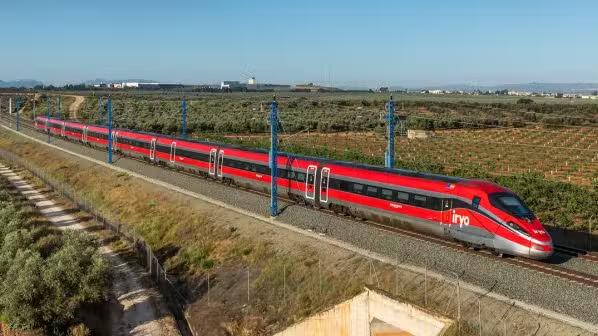
Photo Credit: David Gubler
SPAIN –– Preliminary investigations have found that the fractured rail, which caused the derailment, was identified 22 hours before the accident at Adamuz in January.
The broken rail that caused Iryo train 6289 to derail into the path of an oncoming Renfe Alvia service near Adamuz on January 18 was detected the night before the tragic accident, according to a report issued on April 8 by Spain’s Civil Guard.
An investigation by the Civil Guard’s judicial unit in Córdoba found that a sharp voltage drop in the track circuit, consistent with a rail fracture, was detected 22 hours before the crash which killed 46 people. However, no alert was triggered because it remained above the 0.78V threshold at which infrastructure manager Adif’s system registers warnings. The recorded drop of 0.5V persisted for nearly a day, which investigators describe as highly unusual.
While Adif acknowledges that the voltage anomaly was logged, it says the information was not reviewed because data from the detection system is typically analysed only during scheduled maintenance or after failures. Hitachi Rail, which supplied part of the monitoring equipment, confirmed that the defect was technically identifiable but was missed due to the parameters set by Adif. According to Adif’s 2017 technical specifications, “the system design must include the ability to detect rail breakage.” The Civil Guard’s report states that Adif, despite its own regulations, “did not demand” this capability for this high-speed line.
The Civil Guard’s report, submitted to the judge investigating the accident, follows media reporting on March 16 by Spanish news outlet The Objective that the Railway Accident Investigation Commission (CIAF) was already aware that the rail had fractured the night before the accident, although CIAF has yet to comment on this.
A preliminary report published on January 23 by CIAF pointed to long-term deterioration or a defect in the rail weld as the most probable origin of the fracture. CIAF investigators are considering factors such as metallurgical or manufacturing imperfections, anomalies in steel composition, and compound stresses that may have resulted in the failure of the rail. Issues relating to welding are also being investigated, including whether the correct procedure and materials were applied.
The CIAF investigation has so far ruled out sabotage, terrorism, driver error, or damage caused by falling objects from other trains, but found inconsistencies in documentation submitted by subcontractors. It also found that Adif removed fragments of rail and welds from the crash site between the night of January 22 and the early hours of January 23, before judicial authorisation was granted and without a formal request from CIAF.