
Picture Perfect (Updated July 22) — From Railway Age
Written by Joanna Marsh, Railway Age Contributing Editor


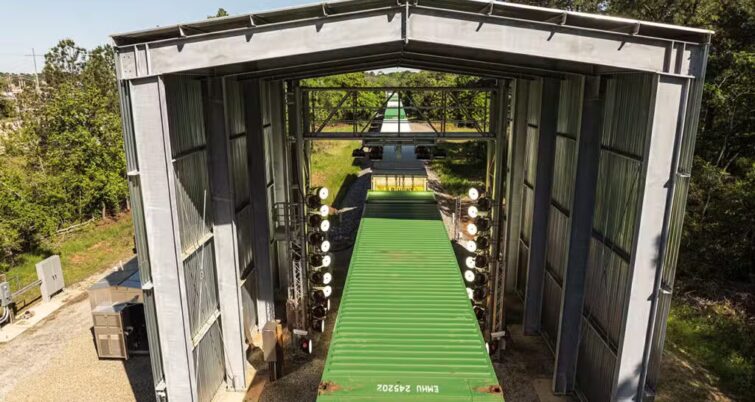
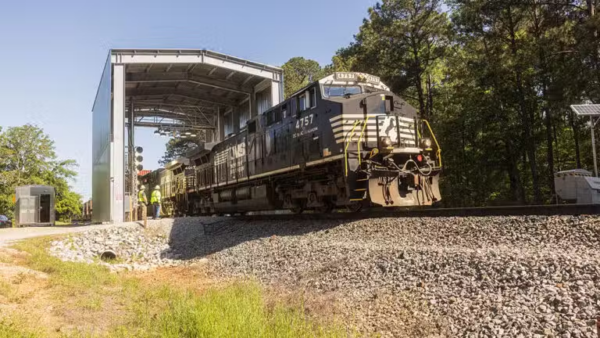
Norfolk Southern Digital Train Inspection Portal (DTI). NS Photo.
NEW YORK –– RAILWAY AGE, JULY 2026 ISSUE: How digital train inspection portals produce substantial safety benefits.
At 10 locations across Norfolk Southern’s network are 11 DTI (digital train inspection) portals that hum with activity each time a train passes through (above). High-speed cameras capture about 1,000 ultra-high-resolution, 360-degree images of each component of a passing railcar. The portals are taking images of trains for automated defect detection.
NS Chief Information and Digital Officer Anil Bhatt says the portals cover a majority of NS’s monthly railcar traffic. “Our ML (machine learning) models are continuously trained on new inspection data in real-time, refining their detection accuracy and expanding the range of defect types they can identify over time,” he says.
NS is just one example of one railway using automated inspection portals to detect anomalies as trains conduct their everyday operations. And as AI (artificial intelligence) and ML enable the technology to become more sophisticated and better at capturing anomalies, the technology’s advocates hope for their deployment to become more widespread.
“We believe automated visual inspection technologies will continue to play an increasingly important role as operators seek better and safer visibility into asset condition, improved maintenance efficiency and enhanced operational resilience,” says Duos Technologies, a Jacksonville, Fla.-based digital train inspection solutions provider. While freight rail is Duos’ primary focus, many of the same inspection and asset management challenges exist across passenger rail, transit and other transportation environments, Duos says.
NS says the portals reflect how the railway manages risks and reliability. NS is shifting from reactive maintenance to predictive operations powered by AI, according to Bhatt. “This isn’t about replacing human expertise; it’s about amplifying it with a level of precision and speed that simply wasn’t possible before,” he notes. “At scale, this is driving a change in safety, network fluidity and asset reliability, moving us from reactive maintenance to predictive, intelligence-led operations powered by hundreds of AI models, all without slowing down the network.”
The Technology Now
NS portals anchor a broader inspection ecosystem of 92 DTI and 39 ATI (automated track inspection) advanced ML models, developed by the NS data science and AI team in collaboration with its technical and engineering teams, Bhatt says. Indeed, NS implementation of these portals reflects how the technology behind automated inspection portals has grown more sophisticated.
Duos Technologies offers several products that utilize advanced sensor technologies, AI and ML. The Railcar Inspection Portal (RIP®), Duos’ flagship offering, assesses railcars in real time, even as trains travel up to 125 mph. According to Duos, the RIP® captures and analyzes high-resolution imagery to identify potential defects.
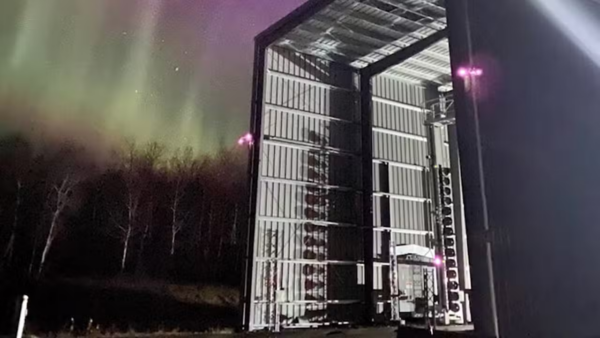
Duos Technologies Railcar Inspection Portal RIP®. Duos Photo.
Duos’ second offering, the Mobile Railcar Inspection Portal (m-RIP™), offers many of the capabilities of fixed inspection portals. The mobile aspect gives operators flexibility and the capacity for rapid deployment or targeted inspection. For this offering, “a trained Duos crew can complete a full m-RIP™ installation typically within a single day. Teardown is equally fast,” Duos says. “The m-RIP™ enables railroads and asset owners to conduct automated inspections without requiring permanent infrastructure, creating new opportunities to extend inspection coverage across the network.”
A third offering, the Vehicle Undercarriage Examiner (VUE®), applies Duos automated inspection expertise to vehicle undercarriage assessments. Through this offering, customers can detect hidden issues under vehicles quickly, enabling companies to be proactive with maintenance, Duos says.
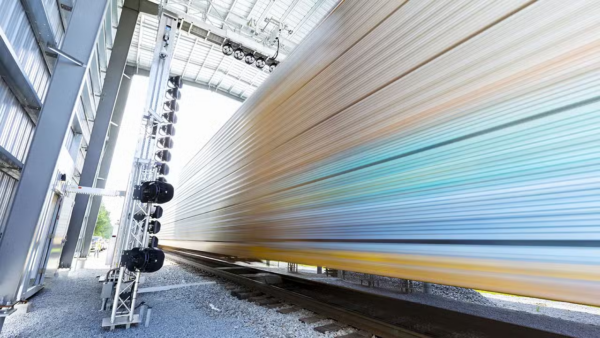
The RIP®, Duos’ flagship offering, assesses railcars in real time, even as trains travel up to 125 mph. Duos photo
“Together, RIP®, m-RIP™, and VUE® reflect our broader vision of delivering automated visual inspection and asset intelligence solutions wherever safety-critical transportation assets need to be assessed,” Duos notes. “Built on a modular and scalable platform, RIP® can be configured to support virtually any vehicle inspection application, enabling customers to deploy the right capabilities for their operational needs today while maintaining flexibility for future expansion. By providing accurate, actionable information, Duos empowers customers to make faster, safer and more informed maintenance and operational decisions, ultimately helping them reduce risk, improve reliability and optimize resource allocation.”
“As automated wayside inspection technologies continue to evolve, their value extends well beyond capturing high-resolution images of passing trains,” ENSCO, which provides systems in the rail, cyber, national security and aerospace sectors, tells Railway Age. “Modern machine vision systems generate precise measurements and objective condition information across multiple safety-critical rolling stock components, enabling railroads to move beyond periodic inspections toward continuous train health monitoring and condition-based maintenance.”
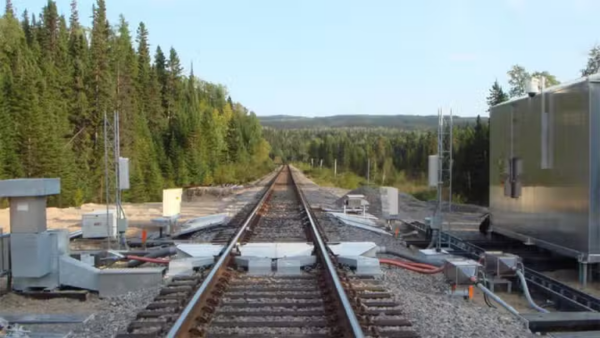
ENSCO
Through its train health monitoring portfolio, ENSCO provides automated wayside inspection systems that combine high-resolution machine vision, specialized measurement and sensing technologies, and advanced analytics to evaluate wheels, brake systems, trucks, undercarriage components and other critical rolling stock assets during normal operations (pictured, above). “With decades of experience developing machine vision technologies for railway applications, ENSCO’s inspection systems help railroads continuously assess asset condition without interrupting operations,” the company says.
“While automated inspection systems generate significant volumes of inspection data, the greatest value is realized when information from multiple inspection technologies is integrated to provide a more comprehensive understanding of rolling stock condition,” ENSCO explains. “By correlating data across multiple asset systems, railroads can move beyond isolated inspection results toward continuous fleet condition awareness, improving maintenance planning, resource allocation and operational decision-making.
“Advances in artificial intelligence and machine learning continue to enhance these capabilities by improving anomaly detection, increasing inspection consistency and helping maintenance personnel focus their attention on conditions that warrant further evaluation. These technologies are not intended to replace experienced inspectors, but rather to augment their expertise by providing timely, objective information that supports faster and more informed maintenance decisions.
“As railroads continue to expand their use of automated inspection technologies, the industry is shifting beyond image collection toward integrated train health monitoring solutions that transform objective inspection data into operational intelligence. By combining precision machine vision, measurement technologies and integrated analytics, automated wayside inspection systems are helping railroads improve safety, optimize maintenance strategies and maximize the reliability and availability of their rolling stock assets.”
Pittsburgh-based Wabtec also works in this space. Its KinetiX Inspection Technologies combines multi-sensory inspection, edge AI and actionable data to help railroads operate with greater safety, lower cost and improved reliability, according to Director of Product Management Adam Hausmann. KinetiX Inspection Technologies is an automated wayside inspection offering that Wabtec launched about three years ago as a combination of two businesses the company acquired over the years.
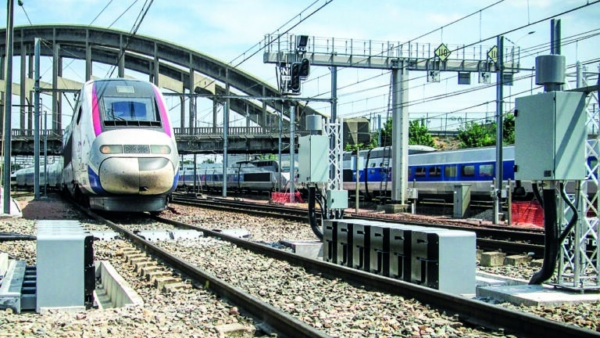
While North American Class I railroads are a main customer base, Wabtec has a large global installation base that includes high-speed intercity passenger rail. Wabtec photo.
“We offer a multi-sensory rail inspection suite, as well as inspections of particular components, including wheels, brakes, couplers and bearings,” Hausmann says. “This allows us to do non-contact inspection at main line track speeds as well as automated condition monitoring. While the visual element consists of taking multiple images of a passing train by cameras that look from the outside and inside, the non-visual elements include an acoustic detector, a wheel impact load detector and thermal sensors, so it’s really a complete solution allowing this multi-sensory inspection.”
While North American Class I railroads are a main customer base, Wabtec has a large global installation, according to Hausmann, including heavy-haul railroads such as mining customers in Brazil and Australia. Passenger operators also utilize this technology, and they range from high-speed intercity passenger rail to local rapid transit systems. “We are continuously assessing the technology to stay on top of the innovations, and we do work with our customers to make sure that when we do the updates, it’s the most opportune time for them,” Hausmann says.
Wabtec also incorporates AI and ML by running machine vision algorithms as the technology takes images of different parts of the railcar. The algorithm processing occurs at the edge location, “so it allows us to process those results there and provide those results to our customers,” Hausmann says. “Companies that may find this type of advanced technology offering beneficial are those striving for condition-based maintenance, seeking to address safety improvements from a preventative lens and looking for operational efficiencies such as minimizing dwell time but maximizing the safety benefits that automated inspection portals provide.
Looking Ahead
As companies fine-tune their existing automated inspection portal offerings or work to engineer new solutions, expect AI and ML to become even more integrated and central. “Over the past year, we have continued to strengthen the AI and ML capabilities that power our inspection platforms,” Duos says. “A key area of progress has been expansion and refinement of our detection models as the volume of inspection data collected across operational environments has grown. Access to a broader range of equipment types, operating conditions and real-world defect examples enables us to continuously improve detection performance and system reliability.”
Duos adds it has focused on improving precision by reducing false positives while maintaining high sensitivity for safety-critical defects so that maintenance teams can respond promptly. Other areas where Duos is seeking to improve include enhancing automation throughout the inspection workflow, which Duos says enables faster processing, improved reporting and better integration with customer maintenance and asset management systems.
“As adoption grows, we position AI not as a substitute, but as a powerful force multiplier. Our technology enables organizations to anticipate issues sooner, maximize resources, and make optimal, data-driven decisions with confidence,” Duos says. “The broader industry, meanwhile, sees the clear value in automated inspection technologies, but the challenge of adoption lies in ensuring integration—particularly the successful integration of inspection data into maintenance and operational workflows—measurable outcomes and seamless data sharing. The greatest value is realized when automated visual inspection systems become part of day-to-day decision-making, helping maintenance teams prioritize resources and respond more quickly to emerging issues in a safer, more efficient environment.
“Use of automated inspection technologies will also grow as the rail industry seeks to quantify the benefits of the technology, including how the technology can improve asset availability, reduce dwell time, enhance safety, optimize workforce resources and support more efficient maintenance programs. The industry is moving toward greater use of data-driven maintenance practices, creating opportunities for automated inspection systems to serve as a critical source of objective, repeatable condition data. As these technologies become more widely deployed, the ability to integrate with existing operational systems will remain an important consideration.”
Indeed, Hausmann is seeing more progress toward increased levels of integration. “One of the biggest things that we see is how ingrained this technology is into our customers’ operations,” he says. “When these systems were first deployed a couple decades ago, these detectors were nice to have, but since then, the customers have really embraced the technology.
“The days of automated inspections being a nice-to-have are gone, and now railroads are relying on the multi-sensory inspection in their day-to-day operations. They are mission- and operationally critical to our customers. The standards customers are expecting of us are raised. They are looking for fast, accurate results and good system reliability. We’ve got hundreds of systems installed globally, and we continue to innovate our technology. We get a lot of feedback from our customers, but we’re always interested in more.”
Norfolk Southern photo.