OIG: Amtrak Has Opportunities for Improvement on HTP
Written by Jennifer McLawhorn, Managing Editor


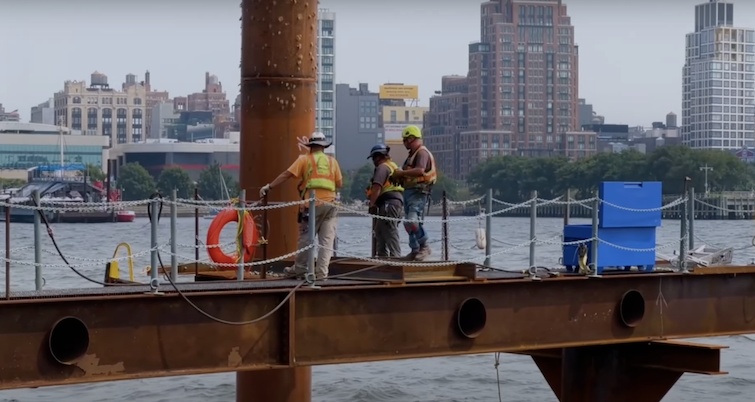
Screenshot of “Building America’s Most Urgent Infrastructure Project: The Workers of the Hudson Tunnel Project”
Gateway Program via YouTube
WASHINGTON, D.C. - An OIG report shows Amtrak can reduce risk and improve the Hudson Tunnel Project.
Amtrak Office Of Inspector General (OIG) released a report that concluded that while Amtrak has made progress meeting its obligations for the Hudson Tunnel Project, it can still work to reduce risks and improve the project’s performance. The $16 billion Hudson Tunnel Project seeks to build a new two-tube tunnel underneath the Hudson River by 2035 and rehabilitate the North River Tunnel by 2038. The project is also part of the Gateway Program, which is a $40 billion portfolio of projects that seek to upgrade infrastructure between New Jersey and New York City.
Part of the progress made on the project includes advancing three near-term responsibilities that are in support of the project. OIG says these include “acquiring necessary real estate parcels, staffing its project team, and beginning planning for the testing and commissioning of the new tunnel and rehabilitated North River Tunnel.”
Room for Improvement
However, OIG says the company “could do more” to protect interests by first clarifying its role with external partners and to better engage with relevant internal stakeholders. Additionally, Amtrak can also better manage the “thousands of documents it will receive over the life of the project.” Amtrak has reportedly not been involved on risk assessments on construction packages it is not leading but for which it has future cost and schedule risks, says OIG. Its report has examples of Amtrak’s responsibility for one third of cost overruns on certain construction packages and has noted “the company cannot plan for potential overruns without access to emerging cost risks.”
Visibility and Accountability
The Gateway Development Commission (GDC) stated Amtrak does not have access to certain risk registers due to sensitive information that could affect the bidding process. OIG said Amtrak “already works with the Commission on processes that involve sharing confidential procurement information” that includes bidder packages it does not lead. The “lack of full visibility into risk management efforts” by Amtrak happened because both Amtrak and the GDC had “differing expectations” about the role Amtrak would play in project risk management.
By having more transparency into project risks, Amtrak says it could better anticipate cost and schedule liabilities, thus being able to prepare mitigation strategies. Amtrak is responsible for not only integrating the infrastructure into the existing system, but as the tunnel owner, it is also responsible for its operation and maintenance. If Amtrak were to increase its involvement in risk management “joint evaluation and shared understanding of risks”, then that would improve project performance.
As aforementioned, engaging internal stakeholders is another avenue that Amtrak is advised to explore. While Amtrak has reportedly “made progress in this area,” the report states some company officials are not fully familiar with support activities on the project, including how it impacts their own work and when the project necessitates their participation. As an example, the OIG says it discovered Amtrak accounting officials were “unaware that Amtrak’s Hudson Tunnel team projected an excess payment to the Gateway Development Commission of more than $100 million in fiscal year 2024.” These officials did not “recognize the implications of this for the financial statements.” After they were alerted, Amtrak reportedly recorded a refund before the end of the fiscal year to ensure financial statement accuracy.
Elsewhere, Amtrak’s Procurement department was unaware of its responsibility for procuring construction materials to equip the Hudson Tunnel in May 2025, despite the fact that preparations to support deliverables can require up to five-year lead times.
These were the result of the Hudson Tunnel team at Amtrak having “not identified and documented all the relevant internal stakeholders and their related project support activities, as called for by project management and internal control standards.”
OIG Recommendations
First, the OIG recommends that Amtrak assess its own interpretation of its role on the project and compare it to the interpretations of project partners to note any and all discrepancies. Then, it should take steps to “remedy those differences.” Secondly, Amtrak is recommended to work with the GDC to ensure adequate visibility on project risks “on the construction packages it is not leading.” It should also work to identify internal support activities that are necessary and assign accountability for each one. Lastly, the OIG says Amtrak should finalize its internal project document management system and procedures.
According to the report, Amtrak has agreed with the OIG’s recommendations and plans to address them.
Media
RELATED ARTICLES