
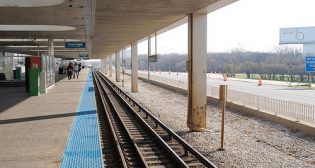
CTA to make largest Blue Line investment in 30 years
The Chicago Transit Authority’s (CTA) will overhaul its Blue Line O’Hare Branch, which will provide faster travel times and updated stations while creating more than 1,300 jobs.
The Chicago Transit Authority’s (CTA) will overhaul its Blue Line O’Hare Branch, which will provide faster travel times and updated stations while creating more than 1,300 jobs.
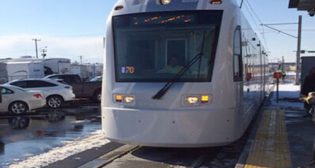
The first segment of the Utah Transit Authority’s (UTA) Sugar House Streetcar line (S-Line) will open December 8. The UTA says new service connects thousands of area residents with local employers, shops and area attractions while spurring millions of dollars in residential and retail development along the route.
The Illinois Commerce Commission (ICC) issued an order approving construction of a new highway-rail grade rail crossing on Broadway Road in Coal City.
RailComm has provided a yard control system to a yard in Stevens Point, Wis. The yard is now able to wirelessly control 15 switches using RailComm’s Domain Operations Controller (DOC®) system, RailComm’s RADiANT™ data radios, universal switch machine controllers and field control panels.
American Public Transportation Association (APTA) President and CEO Michael Melaniphy reiterated the commuter rail industry’s commitment to Positive Train Control (PTC) installation but said Congress needs to help cover PTC costs for the technology to be implemented as soon as possible.
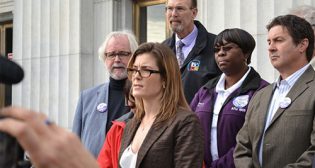
Bay Area Rapid Transit’s (BART) largest unions, SEIU 1021 and ATU 1555, filed a lawsuit against members of the transit agency’s board of the directors, challenging the directors’ action on the ratification of the unions’ contract.
Rep. Sean Patrick Maloney (D-NY-18) introduced the Commuter Rail Passenger Safety Act, to help commuter rail lines, such as Metro-North, fund and implement positive train control (PTC) systems.
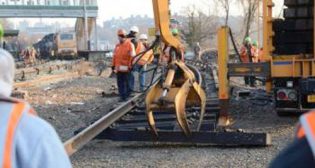
New York’s Metropolitan Transportation Authority (MTA) Metro-North Railroad resumed more than 98 percent of its regular Hudson Line service December 4, following last weekend’s derailment.
Claude Mongeau, president and chief executive officer of Canadian National, said the railway’s reach, service, innovation, understanding of its customers’ markets and commitment to delivering safely make it a true backbone of the economy.
Union Pacific plans to strengthen Colorado’s transportation infrastructure by investing $6.5 million in the rail line between Boyero and Limon. The project, funded entirely by Union Pacific, began November 21 and is scheduled to be completed by the end of December.
Construction of the twin tunnels is complete for the Toronto-York Spadina Subway Extension (TYSSE). The final segment of tunneling was finished when tunnel boring machine (TBM) “Torkie” broke through the headwall at the Vaughan Metropolitan Centre Station site, finishing the 10th and final tunnel drive for the project.
The Metropolitan Washington Airports Authority (MWAA) said that additional tests are needed on Phase 1 of the Silver Line, focusing on software updates related to the automatic train control system, before the project can be turned over to the Washington Metropolitan Area Transit Authority (WMATA).
Bay Area Rapid Transit (BART) has completed one phase of the Transbay Tube earthquake safety project ahead of schedule.
Canadian National started a special program to acquire additional monitoring equipment to enhance its technological base for early detection of defects.
Canadian Pacific appointed Bart Demosky to executive vice president and chief financial officer (CFO), effective December 28, 2013; Brian Grassby will retire as the company’s senior vice president and CFO at year-end.
The Office of the Auditor General of Canada issued its 2013 Fall Report and criticized Transport Canada’s safety management system (SMS) of the nation’s rail network saying the department “needs to address significant weaknesses in its oversight of safety management systems implemented by federal railway companies to manage safety risks on a day-to-day basis.”
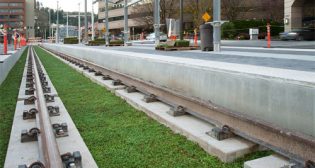
The Portland-Milwaukie Light Rail Transit Project is taking sustainable transit further with a pilot installation of eco-track on SW Lincoln Street downtown.
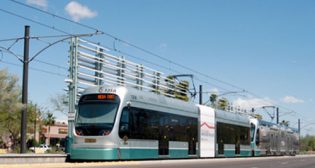
Phoenix’s Valley Metro has received the Finding of No Significant Impact (FONSI) from the Federal Transit Administration (FTA) for the 1.9-mile Gilbert Road light-rail extension.
U.S. Rep. Rob Andrews (D-NJ) introduced two pieces of legislation he says would improve rail safety.
It is expected that U.S. Rep. Earl Blumenauer (D-Ore.) will introduce legislation on December 4 to fund U.S. transportation infrastructure in the nation now and into the future, reported the United Transportation Union.
The two bills will establish a series of pilot projects to further study the application of a vehicle-miles-traveled fee and establish a 15-cents-per-gallon increase to the federal gas tax.
“Increased vehicle-fuel efficiency allows for increased demands on our transportation system without contributing as much to its maintenance. An analysis by the Congressional Budget Office based on current driving patterns demonstrates the newest fuel economy standards for automobiles will result in a 21 percent reduction in Highway Trust Fund revenue by 2040,” Blumenauer said.
He pointed to already significant funding challenges and said that Congress has transferred $55 billion in general fund revenues to the Highway Trust Fund to avoid bankruptcy since 2009. When the current authorization expires, the Highway Trust Fund will require almost $15 billion a year in addition to existing gas tax receipts, merely to maintain 2009 funding levels.
“Our failure to adequately fund transportation infrastructure imposes huge costs on American citizens and businesses. Last year, congestion cost urban Americans $87.2 billion a year in time wasted sitting in traffic and higher transportation costs have pushed logistics costs to nearly 10 percent of our gross domestic product. A recent analysis by the American Society of Civil Engineers suggests that the cost of our declining transportation system could result in the loss of 876,000 jobs by 2020. Until we tie our transportation revenues to our transportation demands, this situation will worsen.”
The National Surface Transportation Policy and Revenue Study Commission noted that a vehicle-miles-traveled charge is the “the most promising alternative revenue measure” to the existing gas tax, while the National Surface Transportation Infrastructure Financing Commission reported that “a charge for each mile driven . . . has emerged as the consensus choice for the future.” Both commissions found that this system was efficient at raising revenue.
A number of states, including Oregon, Nevada, Minnesota, Iowa, Texas and New York have tested pilot projects where they charged drivers for the number of miles they traveled rather than the fuel they consumed. The tests have proved convenient for drivers, demonstrated strong protections for personal privacy and have been easily administrable, he says.