What’s All The Fuss About Tariffs?
Written by David C. Lester, Editor-in-Chief


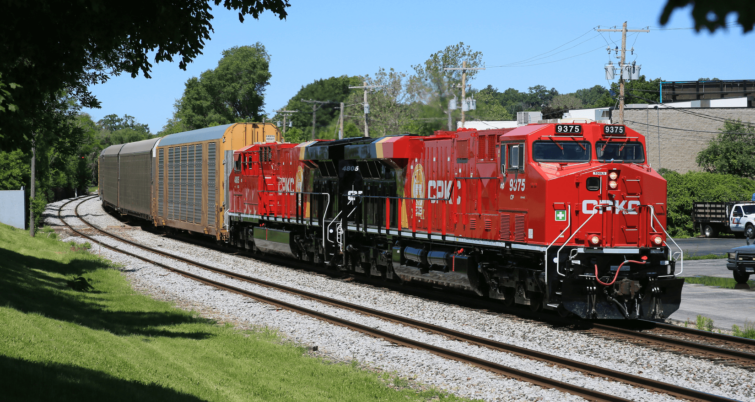
CPKC
ATLANTA –– From the April 2025 issue of Railway Track & Structures, FROM THE DOME.
Most know that international trade, that is the buying and selling of goods among different countries, is important to the North American railroad industry. The Association of American Railroads says that international trade directly drives 38% of carloads and intermodal units and 37% of rail revenue. Significant numbers to say the least.
Countries buy and sell goods with one another because, generally speaking, different countries are often better at producing certain things. While this is not always the case, there are instances where it makes more sense for a particular country to specialize in the production of certain items that can be sold in domestic and overseas markets. For example, let’s consider we have countries A and B. Country A is a large, industrialized country that has the resources, skillsets, and industrial base to build, say, tractors, while Country B is smaller but produces a lot of agricultural products. Country A could produce lots of agricultural products, too, but Country B is not able to produce tractors as efficiently and cheaply as Country A can. So, from a free trade, market perspective, it makes more sense for Country A to produce tractors and Country B to specialize in agricultural products. In the language of the economist, we can say that Country A and Country B each have a comparative advantage in producing tractors and agricultural products, respectively.
Another thing that economists point out is that, theoretically, if Country A decided to produce agriculture goods instead of tractors, there would be an opportunity cost to Country A associated with this. In other words, if Country A devoted resources to producing agricultural goods, it would lose the opportunity to build as many tractors as it otherwise would, theoretically reducing the number of tractors available to be sold in the world. This discussion of international trade presents the way a free-market economy works, and as the world economy has become more sophisticated, globalization of production has enabled everyone to enjoy lower-cost goods. Of course, this is a simple example, but it’s a starting point for understanding how international free trade works in a market economy.
Remember that a free-market economy operates best when there are minimal barriers to free trade among different countries. For example, the relatively free trade that has existed between Canada, the United States, and Mexico brought about a need for reliable, low-cost freight transportation among these countries. While some railroads do cross national borders, the Canadian Pacific Kansas City (CPKC) is North America’s first trans-national railroad, offering service between and among all three countries. For CPKC to be successful, artificial barriers to cross-border trade must be minimized. Although barriers to free trade impact all railroads who provide international service, CPKC is more sensitive to barriers to free trade because it serves three countries.
What is an artificial barrier to free trade? There are several, but the one we’ll focus on here is a tariff. A tariff is a tax on imported goods collected by the importing nation. The exporter might absorb this tax to protect its market share, but more likely will pass-on much or all (depending on competition for the product) of the tax in the form of a higher sales price.
Referencing our earlier example, if Country A imports agricultural goods from Country B, Country A can impose a percentage tax on the sale of the goods, which eventually will be reflected in the retail price. While the tariff generates additional revenue for the nation imposing it, the consumer is less well off because of the higher (inflated) price, which can be seen domestically as a hidden tax on consumers.
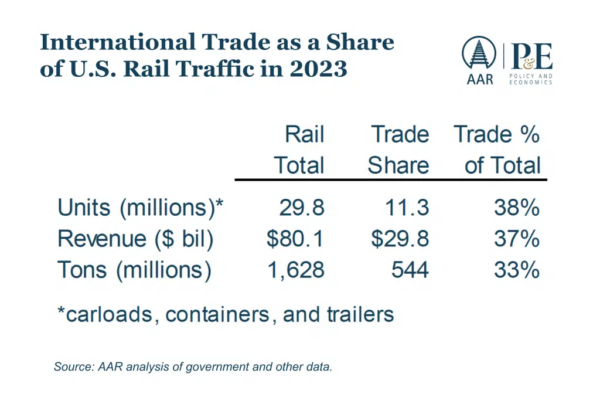
Association of American Railroads
There are additional impacts of a tariff, not the least of which is that domestic producers or other exporters will raise the price of their same or similar goods up to or just below the new price of the tariff-targeted goods. Domestic consumption of the product, no matter its origin, will likely drop owing to the higher price charged by all producers.
While proponents of tariffs say those tariffs will spur more investment in producing that good domestically, it can take years – if ever – for that investment to be made. Such a strategy causes the importing nation to suffer. By shifting investment from goods with which the importing nation has a comparative advantage to those where it does not, is counterproductive.
Where tariffs are used to prop up domestic industries and protect them from foreign competition, this may be useful for only a short time and is of no benefit to consumers who will pay more. As for national security, there are other policy tools to keep such production on-shore, such as subsidies. Tariffs can also create uncertainty in markets since countries and investors may not know if the amount of the tariff will increase or decrease as political majorities shift, or if the tariff will remain at all.
Another consideration is imposition of reciprocal tariffs – a tit-for-tat against another nation imposing them. Such action leads to trade wars that history demonstrates are highly destructive. Moreover, tariffs imposed by a developing nation can be globally beneficial in maintaining that nation’s political stability.
Critics of tariffs argue that they raise costs for businesses, disrupt supply chains, and dampen economic activity. A consequential reduction in demand for consumer goods would weaken the freight transportation industry, especially intermodal rail. Proponents, however, say that domestic industries and jobs are protected by tariffs and allow influence on the policies of trade partners. Long-term benefits outweigh the costs, they say. The key dilemma for railroads is trying to figure out where trade policy is headed and whether tariffs will help or hurt freight demand.