Land is being cleared, leveled for new bypass track in Vancouver, Wash.
Written by jrood


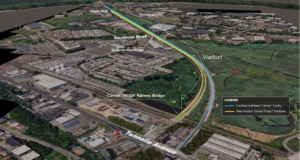
Excavators are eating into a slope above BNSF's main line in the Fruit Valley neighborhood, the Columbian reports. The work is to prepare the site for a 3.2-mile-long set of bypass tracks designed to help ease a railroad chokepoint in Vancouver, Wash. The new line will run along the east side of the BNSF main line from downtown Vancouver all the way to the Fruit Valley Road overpass.
Contractors demolished
two old houses on the west-facing slope last week.
BNSF is contracting to do
the earthwork north of the 39th Street overpass, which will replace a bumpy
grade-level crossing over seven sets of tracks in west Vancouver. The $11.6-million
overpass also will accommodate the new bypass track paralleling the east edge
of the railway’s yard.
The entire $150-million
project is due to be finished in 2013. The Washington Department of Transportation
is overseeing the project, which taps state and federal funding. State
officials believe it will also qualify for federal economic stimulus funding
for high-speed passenger rail, although a specific allocation has not yet been
awarded.
Officials say the bypass
tracks, along with a slew of other improvements planned by the city and the
Port of Vancouver, ultimately will free up space to accommodate projected
increases in freight traffic while improving the speed and on-time reliability
of passenger trains. The state plans to add two Amtrak Cascades trains to the
four daily round-trip journeys currently operating between Portland and
Seattle.
The Vancouver project is
among several along the BNSF main line in Western Washington.
"It’s a necessary piece
to make the program work," said David Smelser, project delivery manager for the
DOT’s high-speed rail program. "Vancouver’s a step toward that."
The laying of track won’t
occur until after right-of-way has been acquired between 39th Street and the
southern end of the bypass near 8th Street in downtown Vancouver. However, BNSF
crews and contractors began excavating the slope north of 39th Street last
month.
"BNSF and WashDOT both
recognized this dirt’s going to have to move at some point," Smelser said.
Railway spokesman Gus
Melonas said engineering and surveying actually began in September. Twenty-five
graders, excavators and heavy trucks are scooping dirt along the hillside, he
said. Some of that material is being trucked to the Port of Vancouver, where
contractors are filling and leveling a new site for light-industrial expansion
on the former Rufener farm in the Vancouver Lake lowlands.
In fact, the port is in
the midst of a rail-enhancement program of its own. The port recently finished
a $14.2-million set of loop tracks at the site of the former Alcoa aluminum
smelter, which the port acquired two years ago. The 35,000 feet of track can
easily accommodate mile-long unit trains without clogging the BNSF main line.
Port officials believe
they are well-positioned for growth. The port already handles 16 percent of all
American wheat exports, and officials foresee growing demand in Asia for
agricultural products such as beef, corn and soybeans. Much of those products
will logically arrive in Vancouver via Union Pacific and BNSF main lines
extending across the northern tier of the United States, through the Columbia
River Gorge.
"Rail is really key for
us," said Curtis Shuck, the port’s economic development director. "We are
located on a more efficient route from the agricultural-producing states."
To that end, the port
anticipates spending a total of $137 million in rail projects, roughly tripling
the port’s capacity to 160,000 rail cars per year.