300,000 Railcars at Risk – Commentary
Written by Robert H. Cantwell, Contributing Editor, Railway Age


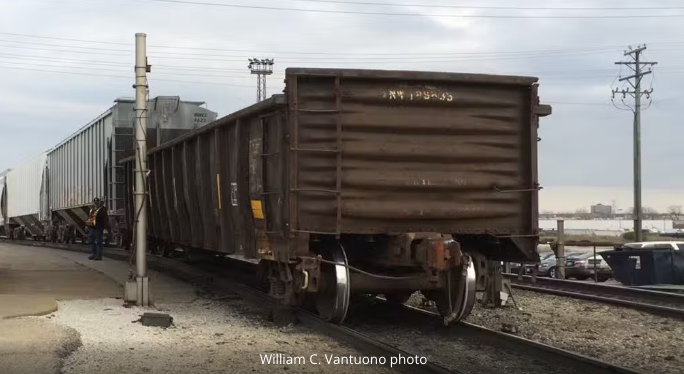
NEW YORK –– Warning: A lot of people in the freight rail industry, particularly owners of railcars built before 2004, are not going to like this.
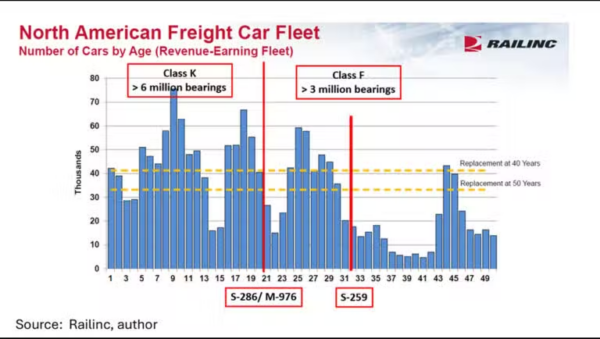
Freight railcars manufactured prior to 2004 and designed for 263K gross rail load (GRL) that have been loaded to 286K GRL are accidents waiting to happen. The current active fleet of these railcars number more than 300,000 and has been operating for more than 20 years.
Background
In 1988, the industry started to explore increasing the lading capacity of the 263K GRL railcar. This spawned the Heavy Axle Load Initiative spearheaded by the Association of American Railroads. They considered various options, including loading the railcar up to 315K GRL, but thought that would be pushing things too far. They ultimately settled on 286K GRL. After considerable economic analysis, Specification S-259 went into effect in 1993 allowing the loading of 263K GRL railcars to 286K GRL in interchange service. This was a windfall for the industry, as it immediately increased railcar capacity by 9% without changing a thing.
It wasn’t very long after S-259 went into effect that several in the industry started to question things. “Wait a minute. There is no free lunch here. Something has got to give.” Indeed, it was soon realized that this change elevated the “stress state” of the industry. The elevated stress state encompassed not only wheel/rail stresses, but carbody stresses as well. In addition to higher wear and tear on wheels, rail and carbodies, safety became a bigger concern. It was also recognized that fuel consumption could be improved with an improved suspension.
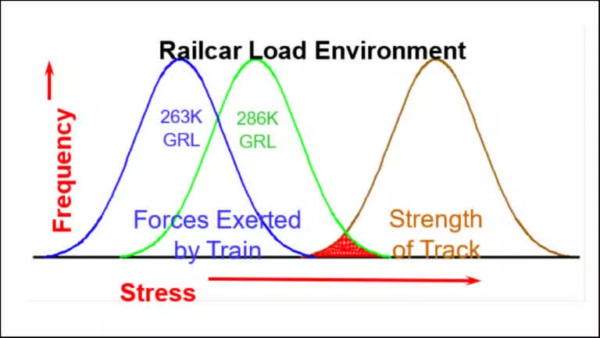
Source: “Reducing the Stress State of the Railroad,” Dr. John Samuels, Norfolk Southern Senior VP of Operations & Planning, Chairman of AAR Technical Working Committee, circa 2001.
In 1998 the AAR, realizing the issues surrounding S-259 railcars, published a report highlighting the need for an improved suspension system for 286K GRL railcars. Considerable research, development and testing led to the implementation of the S-286 carbody and M-976 suspension (truck) specifications that became effective for interchange service in 2004.
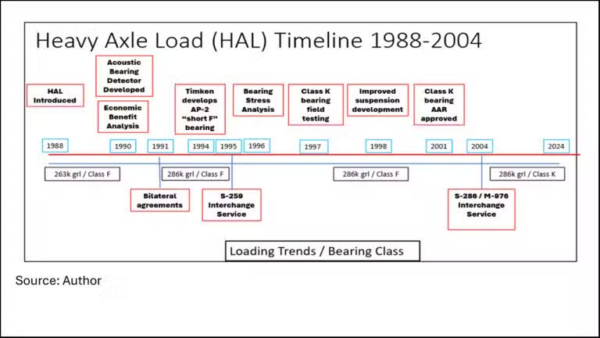
Design Features of S-286 and M-976:
- S-286 Carbody Features (following are excerpts from the AAR S-286 specification in italics): Design of the carbody (including the sides, ends and underframe unless otherwise noted) shall be based on a GRL of 286,000 lbs. A fatigue analysis in accordance with Chapter VII of M-1001 must be performed on all cars built to this specification. When applying fatigue design criteria to a 286,000-lbs. design, 263,000 lbs GRL related REPOS loading multiplied by 1.09 must be used for new car analysis, if 286,000 GRL REPOS are not specified. All cars built for 286,000 lbs GRL after the effective date of this specification must have a minimum computed fatigue life of 1,000,000 miles. High-utilization cars must have a minimum computed fatigue life of 3,000,000 miles. Trucks shall have Preliminary, Conditional or Full Approval under AAR Truck Performance Specification M-976
- M-976 Truck Features:
- Reduce wear and friction at the wheel / rail contact patch.
- Reduce vertical forces imparted to the track.
- Improve lateral forces through curves, by using “passive steering.”
- Improve high speed stability with better damping systems.
- Superior derailment safety by reducing L/V force ratios.
- Shorter bearings and axles to reduce the bending caused by heavier loads.
There are significant differences and improvements between S-259 and S-286 railcars that have been demonstrated over the past 22 years. Most important, the S-259 railcars and components were designed and fatigue tested for 263,000 GRL, not 286,000 GRL. The fatigue life of the 263K GRL castings that have been loaded to 286K GRL is unknown.
The impact of S-286 / M-976 has been enormous. From an FRA study completed in 2017: “The AAR M-976 truck performed significantly better in terms of developing less predicted RCF (Rolling Contact Fatigue). Studies predicted four times more RCF for a 3-piece truck than for an AAR M-976 truck at 5-degree and tighter curves. The AAR M-976 truck and 3-piece truck traveled 0.03% and 0.15%, respectively, above the shakedown limit for all trips. This represents an 80% reduction in RCF damage.”
To put it in terms that we all can understand: There are approximately 15% fewer wheels consumed annually today than were consumed annually prior to 2004, resulting in annual savings of more than $120 million. And just more than half of the revenue generating fleet is equipped with M-976 trucks.
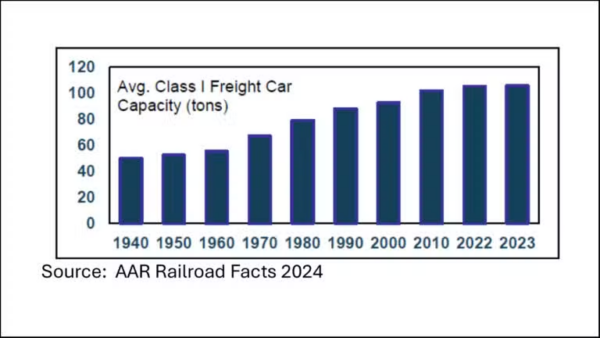
In addition to wheel and rail savings, the economic impact of a 9% increase in railcar GRL has been enormous. The average railcar capacity since 1990 has grown a whopping 20%, to 105.7 tons per railcar, as shown in the chart below:
S-286/M-976 Bearing Improvements
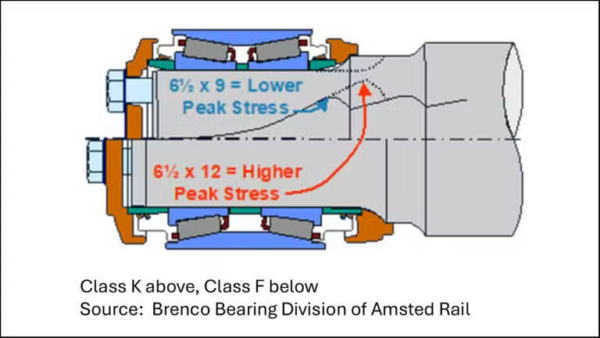
The February 2023 East Palestine derailment taught us a very valuable lesson: Derailments today can be very expensive! Norfolk Southern incurred more than $1.1 billion (and counting) in expenses related to a bearing failure. S-259 railcars are all equipped with Class F bearings, a design found to be inferior to the Class K bearings applied to S-286/M-976 railcars, ref my article from 2024 “Bearing Down on Bearings”. The East Palestine derailment was caused by a bearing burnoff (a reconditioned Class F bearing) on a covered hopper car that was produced in 1997 under 263K GRL guidelines and was fully loaded with plastic pellets.
The evidence is clear: Class F bearings are inferior, especially reconditioned Class Fs, as they have a 4x higher probability of fallout from Acoustic Bearing Detectors. There are more than 20,000 bearing defects detected by ABDs annually, the vast majority of which are Class F.
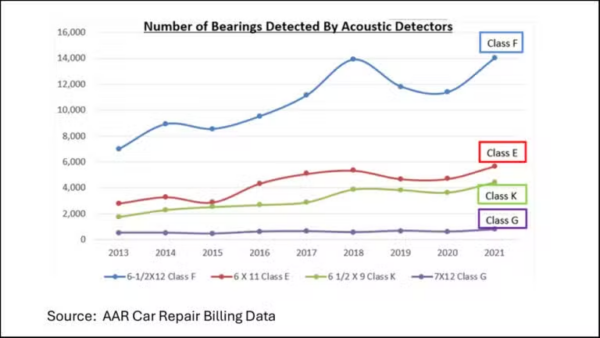
In another initiative, the industry thought it would be a good idea to apply reconditioned Class F bearings onto S-259 railcars to save a few bucks. It has been clearly demonstrated that the life of a reconditioned Class F bearing is much shorter than that of a new one, and far more shorter than that of a new Class K bearing. Applying a reconditioned precision component to an already over-stressed application makes no sense.
The Options
Given the compelling benefits of S-286/M-976 along with the increasing risks of continuing to operate equipment that wasn’t designed to haul 286K GRL over the long term, the industry is facing several options:
- Do nothing and hope we don’t have another East Palestine. In addition, face higher maintenance costs caused by long-term fatigue, wear and tear.
- Upgrade the railcar from Class F to Class K and likely extend the car’s useful life to the full 50 years.
- Downrate the carrying capacity of the railcar to 263K GRL, as originally designed.
The Economics
From the 2026 Rail Equipment Finance Conference, the following residual values were shared:
- 1980-built covered hopper, 4,750cf, 263K GRL: $13,077.
- 1995-built covered hopper, 5,161cf, 286K GRL (263K trucks): $48,077.
- 2015-built covered hopper, 5,200cf, 286K GRL (M-976 trucks): $82,308.
This is helpful background to understand when evaluating the various options. For example, the 1995 built “S-259” covered copper still has significant value, given 20-30 years of constant service It is a workhorse of the industry and is currently garnering attractive lease rates. Lessors love these cars because they are likely fully depreciated and are “cash cows.” The residual value of a 10-year-old S-286/M976 covered hopper has remained elevated, for good reason. From the car owners’ perspective, the questions become: Should I risk doing nothing, invest in extending its life, or downrate it and play it safe for its remaining life?
Doing nothing carries significant risk if there is a severe accident. You are also facing ever-increasing maintenance costs. Upgrading to Class K bearing will likely retain and possibly enhance its value and increase the likelihood of lasting another 20 years. The second option would likely have significant negative impact on the car’s value and lease rate potential going forward and would impact overall industry capacity significantly.
This is where things get interesting. To convert a railcar from Class F to Class K would likely cost $12,000 to $14,000 per car to replace the axles, bearings and bearing adapters. Changing wheels and/or castings would add significantly to this amount. And keep in mind that S-259 railcars are now 20-30 years old. From an industry perspective, this would amount to a $3.6-$4.2 billion expense if 300,000 railcars were converted. The benefits would be many to railroads and car owners, but that’s a big price to pay. On the other hand, the cost of another East Palestine weighs heavily on this decision.
From a car owners’ perspective, those with newer fleets will benefit, while those with older fleets will have some tough choices to make.
Summary
Railway Age published my first article on March 3, 2021, “Rough Riders Should Be Taxed.” It was all about the virtues of S-286/M-976 and how these specifications have benefited the rail industry. It went nowhere and didn’t capture much attention. Car owners didn’t believe in the merits of S-286/M-976 and believed it was just another costly mandate shoved down their throats. It’s now five years since the article and 22 years since implementation, and the results are staggering (the residual value of a 10-year-old S-286/M-976 railcar supports this). There are a lot fewer wheels and rails wearing out and a lot less fuel consumed. There are a lot fewer train disruptions due to bearing issues. Average railcar capacity has increased 20% since 1990. And then there was East Palestine—a wakeup call for us all. The sooner we address the S-259 fleet, the safer and more cost effective the freight rail industry will be. There is no free lunch.

Principal of Rail Supply Chain Associates, Robert H. Cantwell spent more than 40 years in executive positions in the rail supply industry. He spent the first 26 years of his rail industry career growing a successful company, Hadady Corp. (now part of Caterpillar), a designer and manufacturer of truck (bogie) components and systems for locomotives and transit railcars. Following the sale of his business, Bob helped transform Amsted Rail, holding various executive positions for 16 years. He has been active in the Rail Transportation Division of the ASME (American Society of Mechanical Engineers) and is past Chairman of the Division. Bob holds degrees in Mechanical Engineering from the Georgia Institute of Technology and an MBA from the University of Chicago. He possesses a unique perspective on the rail supply industry, combining his engineering experience along with robust economic and financial acumen. As an active investor in the rail industry, he has a vested interest in the success of the industry. He has also actively advocated with members of Congress in support of the rail and rail supply industry. The opinions expressed here are his own.

Media
RELATED ARTICLES