For Passenger Service in Santa Cruz, 28 Bridges Need To Be Replaced, Costing Nearly $1B
Written by Jennifer McLawhorn, Managing Editor


Map of proposed coastal trail rail, part of the Zero Emission Passenger Rail & Trail Project.
Courtesy of Santa Cruz County Regional Transportation Commission
SANTA CRUZ, Calif. - HDR and the Santa Cruz County Regional Transportation Commission stated that in order to bring passenger service to the county, it would require replacing 28 bridges at a cost of up to $1 billion.
According to a report in Lookout, staff from the Santa Cruz County Regional Transportation Commission released recommendations last year to replace 23 of 33 bridges on the Santa Cruz Branch Rail Line. 16 of the bridges are wooden, five are steel-girder, one is steel-truss, and one is wrought-iron truss. Now, in a public session that took place this week, HDR reported that 28 of the 33 bridges will need to be replaced. The remaining five will need to be repaired. Reportedly, trestles located over the San Lorenzo River were part of the recommended replacements. These recommendations come as part of the Zero Emission Passenger Rail and Trail project, which is a 22-mile passenger train with a coinciding pedestrian and bike path. It seeks to “take advantage of the publicly owned rail right-of-way to provide passenger service” in Santa Cruz County.
The reason for the recommendation to replace the bridges is that many of said bridges were “not built to modern rail standards and are not capable of carrying passenger train loads.” However, the needed number of bridge replacements and subsequent costs are important factors to consider. A concept report with these details is expected later this fall, according to the commission’s Executive Director Sarah Christensen. Originally, it was scheduled for this spring. The delayed release date is to allow more time for community input and engineering work.
HDR project manager Peter Graff stated the “Most of the existing railroad bridges were originally installed by Southern Pacific Railroad as far back as the early 1900s. . . We looked at the various span types along the line, which included steel spans, concrete spans, timber bridges and some steel trusses.” The estimated cost of these replacements is $980 million, but this estimation does not include the necessary costs to build trail segments, stations, labor facilities, or vehicles. Reportedly, the RTC will also consider improving the vertical clearances. As for what’s next, Graff said HDR is working with geotechnical engineers to “ensure the new bridges will meet vertical and horizontal clearance requirements, not block the flow of water for bridges over drainages, and to create layout drawings.” Once these are finished, they will have a better idea of the estimated cost.
Regarding whether it requires similar infrastructure to freight railroads, HDR Vice President Mark McLaren said, “We’ve got to remember that while the multiple-unit doesn’t look like a freight train, it’s still a heavy piece of railroad equipment. . . The standard for that type of equipment is not much different and there is not a significant savings at this point.”
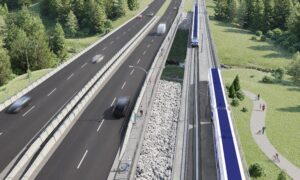
Both project manager Graff and RTC associate engineer Riley Gerbrandt have reportedly discussed having separate bridges for the train and trail in some areas on the line and that “separate structures allow for more design flexibility and are more practical and less costly than combining the two structures.” Graff added that maintenance also plays a factor in the design because with the addition of a trail, track maintenance may necessitate a full closure and shut off public access.
Additionally, funding for the project would come from federal sources. The rail is owned by UP in Watsonville and its plan to run to a proposed passenger station provides a “federal funding advantage, because it would be considered intercity rail.”