How Sound Transit Handles Weather on Floating Bridge
Written by Jennifer McLawhorn, Managing Editor


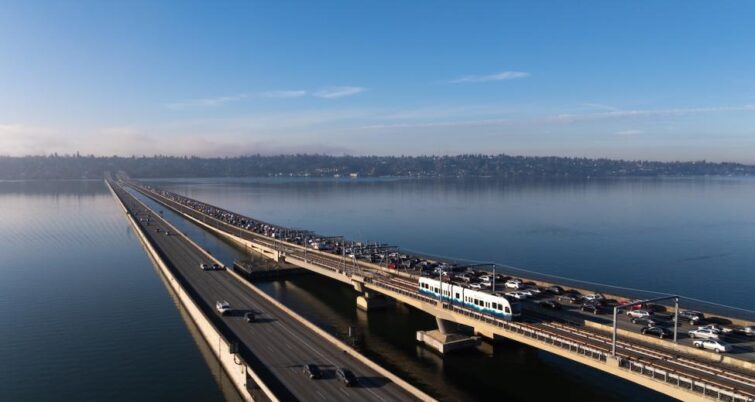
Homer M. Hadley floating bridge on the right. Lacey V. Murrow floating bridge on the left acts as a breakwater.
Sound Transit
SEATTLE - Sound Transit's Homer M. Hadley floating bridge is designed to handle three types of movement across six directions.
RT&S has reported on Sound Transit’s Homer M. Hadley floating bridge, the fifth-longest floating bridge in the world. It traverses Lake Washington, which is the second-largest natural lake in the state. The bridge measures 5,811 feet long. Last September, “the first Link light rail vehicle crossed the Homer M. Hadley bridge ‘under its own power.’ This is reportedly the first time trains under power have operated across a floating bridge.”
Now, Sound Transit has detailed how the structure handles wind and waves. The bridge is supported by a series of connected pontoons, says Sound Transit. These are hollow concrete boxes that float on the water and allow the bridge to span Lake Washington as opposed to resting on the lakebed. The bridge’s design in handling various types of movement makes it flexible, which is necessary for maintaining stability and optimal performance.
During design, engineers also needed to be cognizant of “a variety of weight sources on the bridge, which carries both the westbound lanes of I-90 and the Link 2 Line’s light rail tracks in both directions.” If there is more weight on one side, the other side can lift, leading to more stress on the structure. Sound Transit cites this as the reason it operates two Link trains on opposite tracks on the bridge at the same time. Sound Transit works with the Washington State Department of Transportation (WSDOT), which owns the bridge, to keep those stress levels low.
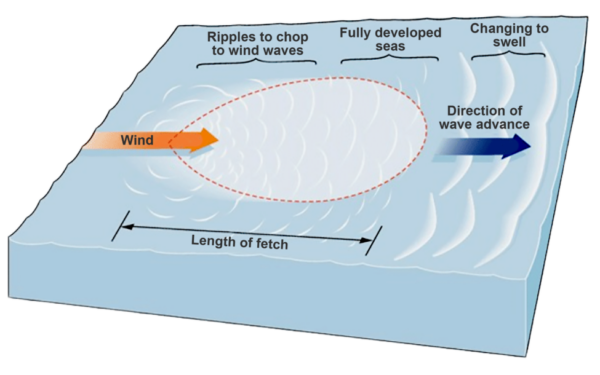
Due to the size of Lake Washington, when wind picks up and travels over a large body of water for a longer period of time, waves can build. The size of the waves creates stress on the structure. Additionally, Sound Transit says the wind often blows from the south, and because of the Lacey V. Murrow floating bridge that sits south of the Homer M. Hadley bridge, it does not directly impact the floating bridge. This sister bridge carries eastbound traffic and absorbs the waves. This creates a breakwater effect to protect the light rail floating bridge. While wind can and does come from the north at times, this is “much more rare.”
The Homer M. Hadley bridge is outfitted with anemometers on its north side. These are meteorological devices that measure wind speed, duration, and direction, all factors that impact wave height. The data collected from these devices is used to calculate estimated wave height. When those calculations reach a certain threshold, sound Transit says It works to alert and control critical aspects of light rail service with its Wind and Wave Monitoring System. The thresholds are as follows:
- Trains will run normally if the wind blows steady to create ripples or waves that measure 1.4 feet or less.
- Sound Transit will scale back to one operating train on the bridge (as opposed to the aforementioned two) if waves reach a height of 1.5 feet. This is caused by winds blowing from the north at 30 miles an hour for at least 83 minutes.
- Service will be temporarily suspended if the waves reach 2.21 feet. This is caused by winds blowing from the north at 40 miles an hour for 71 minutes.
However, Sound Transit says this system is also built for redundancy, in the event one sensor has triggered an alarm, but the others have not due to any other reason not weather-related.
Media
RELATED ARTICLES