Tri-City Railroad Company names VP, COO
Tri-City Railroad Company hired John Miller as vice president and chief operating officer.
Tri-City Railroad Company hired John Miller as vice president and chief operating officer.
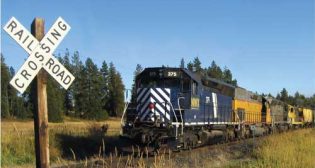
Washington State Department of Transportation (WSDOT) seeks public input on a plan for prioritized improvements to the Palouse and Coulee City (PCC) Rail system in eastern Washington. Once finalized, the plan will be used to help develop future funding, policy and planning goals.
U.S. Sens. Ron Wyden (D-Ore.) and Mike Crapo (R-Idaho) introduced the Short Line Railroad Rehabilitation and Investment Act of 2015, which would extend the shortline railroad track maintenance tax credit that expired in 2014.
The U.S. Department of Transportation has awarded New Jersey Transit $147,086,000 through the Federal Transit Administration’s Public Transportation Emergency Relief Program for repair, recovery and resiliency projects associated with Superstorm Sandy.
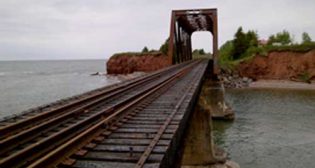
The Quebec government has laid out a plan to buy the Gaspé Railway Company line between Matapédia and Gaspé in the eastern part of the province. Ownership of the line currently belongs to four county municipalities that are served by the line.
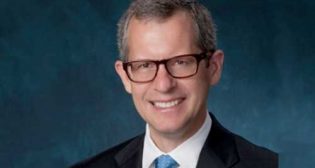
Norfolk Southern named James Squires chief executive officer, succeeding Wick Moorman. The action by the company’s board of directors is part of its planned succession process and will be effective June 1, 2015.
Implementation of Positive Train Control (PTC) technology on Kansas City Southern is a major, ongoing initiative, especially for the Signal, Mechanical, IT and Telecommunications groups, the railroad says. The railroad provided an update on its progress of PTC implementation in an employee newsletter.
The North Carolina Department of Transportation (NCDOT) has programmed approximately $3.7 million to fund 15 projects across the state through the Freight Rail and Rail Crossing Safety Improvement program for Fiscal Year 2015.
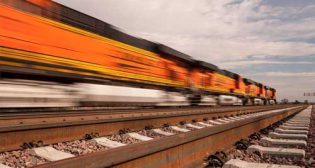
BNSF continues to detail plans for its $6-billion capital program with $141 million estimated to be spent in California and $103 million in Kansas.
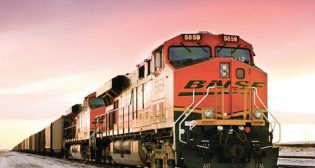
BNSF‘s 2015 capital program for its operations in Oklahoma will be an estimated $118 million for rail maintenance and capacity improvement projects.
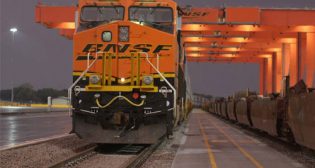
BNSF detailed more of its plans for its record-setting $6-billion capital program with $124 million estimated to be spend in Montana and $141 million in Colorado.
Genesee & Wyoming Inc. has agreed to acquire approximately 95 percent of the shares of Freightliner Group Limited (Freightliner) from Arcapita and other shareholders for cash consideration of approximately $755 million and to assume approximately $13 million in net debt and capitalized leases.
Peru Industrial Railroad, LLC, a managed affiliate of OmniTRAX, Inc., is purchasing the Peru Rail Line from the city of Peru, Ill. Peru Industrial Railroad will run freight service on three miles of track starting immediately. Terms were not disclosed.
In its investigation report, the Transportation Safety Board of Canada (TSB) determined that numerous rail fractures led to the October 2013 derailment and fire involving a Canadian National (CN) train in Gainford, Alberta.
On October 19, 2013, a CN freight train, travelling from Edmonton, Alberta, to Vancouver, British Columbia, derailed 13 cars, including four DOT 111 tank cars containing petroleum crude oil and nine DOT 112 tank cars containing liquefied petroleum gas (LPG) in the siding at Gainford, Alberta. Two LPG tank cars were breached during the derailment and caught fire and a third LPG car released product from its safety valve which ignited. About 600 feet of track was destroyed and a house located directly north of the derailment site was damaged by the fire.
The investigation determined that the train derailed when one or more rail breaks occurred in the high rail as the train travelled through the curve in the Gainford siding. TSB said numerous defects were found along the length of the high rail in the curve. A rail-flaw detection test through the area two months earlier had not identified these defects. In March 2013, the low rail had been replaced with a new rail that reduced the curve’s superelevation. TSB noted that in this situation, more stress was placed on the high rail, increasing the risk of rail defect development and failure.
One of the DOT 112 tank cars carrying LPG was punctured in the underside by the coupler from another car. This caused it to release its load and explode. None of the DOT 111 tank cars, which were built to the CPC-1232 standard, released petroleum crude oil, as the cars derailed in a line on their sides and did not suffer secondary impacts.
Following the occurrence, CN conducted walking inspections and rail-flaw detection re-testing on all 25 mph sidings. Speed was reduced to 15 mph in these sidings until they were retested. Rail grinding within these sidings was also programmed to remove rail surface defects.

Canadian National and Unifor have negotiated a tentative labor agreement with the Unifor union. As a result, CN has withdrawn its lockout notice to Unifor, which would have come effective at 11p.m. local time tonight in the absence of a settlement.
The N.C. Department of Transportation (NCDOT) will hold a public meeting to review results of the recent study of reactivating the Murphy Branch rail line between Andrews and Murphy (A2M- Rail Reactivation Study).
Kansas City Southern, as part of its succession planning process, appointed Patrick Ottensmeyer president, effective March 1, 2015.
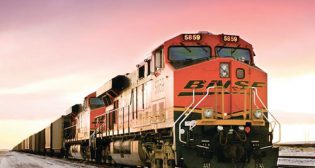
BNSF ‘s 2015 capital program for its operations in Wisconsin will be an estimated $120 million for rail maintenance and capacity improvement projects.
Fortune named Union Pacific the most admired among trucking, transportation and logistics companies for the fifth consecutive year, marking the twelfth time in 16 years the company has been named No. 1.
BNSF‘s 2015 capital program for its operations in Missouri will be an estimated $153 million for rail capacity improvement projects and maintenance.