
2025 RT&S Engineer of the Year: Carl Walker
Written by David C. Lester, Editor-in-Chief


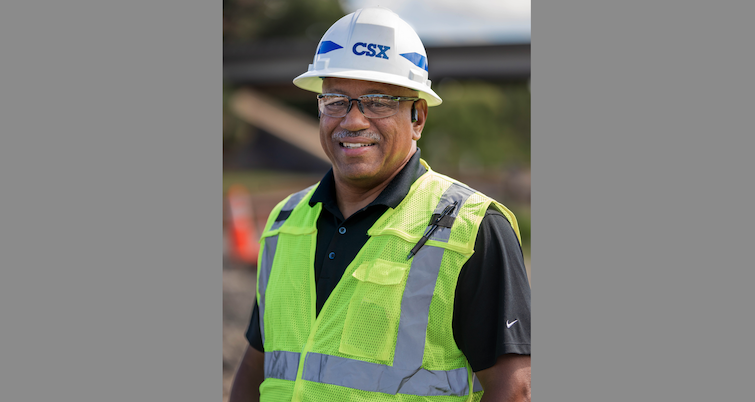
ATLANTA - CSX and the U.S. Navy: Training grounds for a top-flight engineer - Carl Walker, Engineer of the Year, CSX.
Railway Track and Structures is pleased to honor CSX’s Carl Walker, Vice President of Engineering responsible for Communications and Signals, PTC, and Dispatch Systems, as our 2025 Engineer of the Year. Like last year’s winner, Jeff Watson of Genesee & Wyoming, Carl has combined a military background with a successful railroad career.
Carl spent much of his U.S. Navy career as a communications officer aboard the USS George Washington, a Nimitz-class aircraft carrier, responsible for communications among the different ships, submarines, and aircraft that make up a carrier battle group. While he was fascinated and effective with this work, Carl says his most gratifying portion of his Navy career was serving as a drill instructor. He spent two more tours in this role. “It helped me become a better leader,” Carl says, “because it’s a role in which I could motivate people to do what they didn’t think they could do.” He adds that “changing a person’s life in eight weeks is a big deal.”
Carl finished his Navy career as a combat systems officer at the Trident Training Facility in Kings Bay, Georgia. After spending so many years in the Navy, he developed an interest in customs operation and earned a degree in criminal justice in preparation for a position with U.S. Customs. He also earned a communications degree, and while he was at King’s Bay a friend retired from the Navy to become a locomotive technician at CSX. This got him to thinking about a career with the railroad, and he reached out to another Navy alum who was a submariner, whose sister worked at CSX. His friend’s sister put him in touch with a gentleman who was responsible for hiring engineering trainees at the railroad and met with him.
However, at the time, CSX was not hiring anyone from the outside, and the engineering lead asked to call him every Thursday and something might break loose. Well, Carl called him every Thursday for 18 months.
He called one Thursday and the gentleman said “let’s go to lunch.” While the engineering lead did not have a job for Carl, he told Carl that there may be some opportunities in CSX Technology and encouraged him to meet with that group. Carl was concurrently talking to U.S. Customs about a position and told RT&S that “ironically, I got calls on a Thursday from both CSX and U.S. Customs with job offers.” He accepted the job at CSX, a manager in the communications solutions group, and called U.S. Customs and told them that he had accepted the position with CSX but thanked them for the offer and the time they had spent recruiting him. Customs told Carl that “if you ever change your mind, you’ll have a place with us.”
Carl says that while he had a lot to learn about the railroad industry, the transition from the military to the railroad was fairly straightforward. That’s because the structure, demands, and requirements are very similar. For example, a system that operates 24 hours per day, one could be called any time at night and be told to be somewhere in hours. The way the operations group goes about its business is similar. Get done what needs to be done and eliminate roadblocks. “On my first day on the railroad, I was running conference meetings,” Carl says. “The first meeting I ran on the railroad wasn’t as difficult as some I had run in the military, so despite some railroad knowledge gaps, I was able to handle it successfully.”
Carl’s first project at CSX was managing a new communications system for the crew call center and the railroad’s customer service center. A few months later, in January 2000, his group was given a big project to replace 100 AEI readers out on the railroad. I had been with the railroad for eight months at the time. “I was able to report to my manager that the work was complete in October 2000. In addition, there were ten tag readers that were supposed to have been installed in 1999, and we got those in, too. So, we put in 110 new AEI tag readers in 2000 and we only took ten months to do it.”
For his team’s successful installation of the AEI readers, they received a Technology All Star award that was given for key projects, completed successfully on time and on budget, no one hurt. “I was in a project-driven group,” Carl said. Carl was then placed in a position called Director of Program Management and reported directly to the head of the communications group. He stayed in that position for two years, then took over as Director of Communications South until June 2006, then moved to Assistant Chief Engineer for communications and directors from both the south and north regions reported to him.
During the challenging years of PTC installation, Carl was named chief engineer of signal construction. He had the responsibility of making sure that PTC was installed correctly from a communications and signals perspective. In March of 2017, Carl was appointed Chief Engineer of Communication and Signals then, in 2021, Systems Vice President of Communications and Signals, PTC, and Dispatch Systems. In January 2024, he was named Vice President of Engineering for Communications and Signals, Dispatch, and PTC. “My responsibility involves managing these areas from field and regulatory perspectives, and I’m also a board member of Mediacomm, which is a communications organization owned by the four U.S. Class I railroads, with each owning 25%.” Carl also just finished a term on the AREMA Board of Governors and leads the African American inclusion group at CSX.
Like most railroad engineering groups, Carl speaks highly of the ability of data analytics to provide data-driven, factual analysis for capital planning and equipment performance. “I’m particularly impressed with predictive analytics when it comes to evaluating our wayside equipment. We’re able to accurately anticipate when equipment end-of-life is approaching so we can replace it beforehand.” Carl’s group spends a lot of time during the year talking about wayside device performance, along with the many other types of equipment in its capital plan.
As other engineers have reported to RT&S, capital planning meetings are more effective today because requests for capital spending by various groups is driven by the data. “It used to be that the senior person in the meeting was often the most successful in obtaining capital for their projects, but now that allocation is based on facts and data, each department receives the capital they need to keep the railroad running in good order.”
Carl has also been impressed with the evolution of technology since he began his railroad career.
“Technology is significantly better today than when I started and, in many ways, we are a technology-driven company. We’re able to know more about what’s going on the railroad and anticipate problems before they become problems.”
He adds, though, that new technology is not added for its own sake. While we are always on the lookout for new technology that will help us run the railroad more effectively, we don’t always believe we have to have the latest tech. We often do pilots with new technology that becomes available, but unless we see it significantly improving our operation, we don’t implement it.”
Asked what a typical day on the job is like for Carl, he provided RT&S with the following outline. “My day begins at 6:00 a.m. with morning call, followed by a 7:00 a.m., 8:00 a.m., and a 3:45 p.m. call. These calls are opportunities to discuss safety and operations with various operational leaders and other departments to ensure our key focus of safety, customer service, and people are at the forefront of what we do.” Carl adds that much of his day is spent addressing questions and issues from the field, and he also walks the floor to see what’s going on with his team and people in other departments, looking for ways to help out in any way possible. “During the evening, I monitor my email and usually go to bed around midnight.”
Carl believes that one’s leadership style is an important part of job effectiveness. “I have had the opportunity to observe a lot of leaders in my careers in the military and on the railroad,” Carl says, “and I’ve seen some that are very good and some that are bad.” Carl’s first opportunity to lead people was in the military, which taught leaders to teach someone reporting to then to assume your responsibilities in case something happens to you. “Make sure your people are properly trained, respectfully hold them accountable, understand that their jobs are demanding, and they need some semblance of quality of life. A leader can be respectfully demanding without being demeaning,” Carl adds.
“My leadership style is to be a servant leader,” Carl says. “I am here to serve the people I work with and the company I work for. People I’m responsible for are more important than I am –– they always come before me.” Carl also points out that nothing should be more important to a leader that the people they’re responsible for. Also, leading by example, building trust, and empowering those who work for you by giving them the opportunity to make decisions will build the confidence of the team.
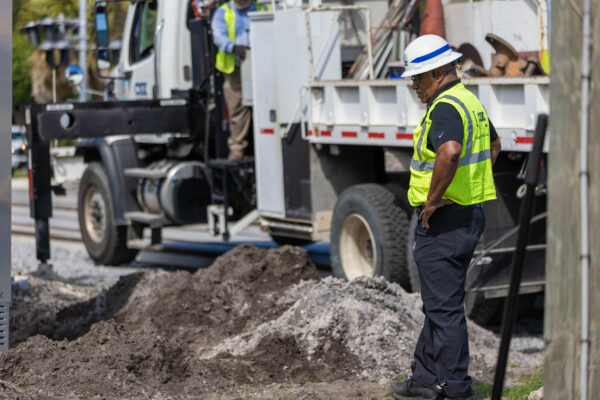
Carl concluded our discussion by offering the following observations. “I’ve had two jobs in my life –– the military and CSX. Both organizations are ones that serve this country, and if I had it to do all over again, there is nothing I would do differently. Doing the best for my country, company, and leading people. I’ve had tremendous support from my family, and I’ve built some great relationships that I’ll have for the rest of my life.” Carl is also bullish on the railroad industry. “There is a lot of opportunity ahead in the rail industry, and the vendors that support the industry are going to play a major role in realizing those opportunities. The importance of being a team in the rail industry, and one that people want to be a part of, is paramount. Together, we can develop the best service products, safety metrics, and service reliability. I’m very optimistic that everyone in, and those who support, the rail industry will continue to develop as a team and forge a bright future for railroading.”


Leave a Reply