TSB Releases Safety Investigation Report on December 2025 QNS&L Derailment
Written by Jennifer McLawhorn, Managing Editor


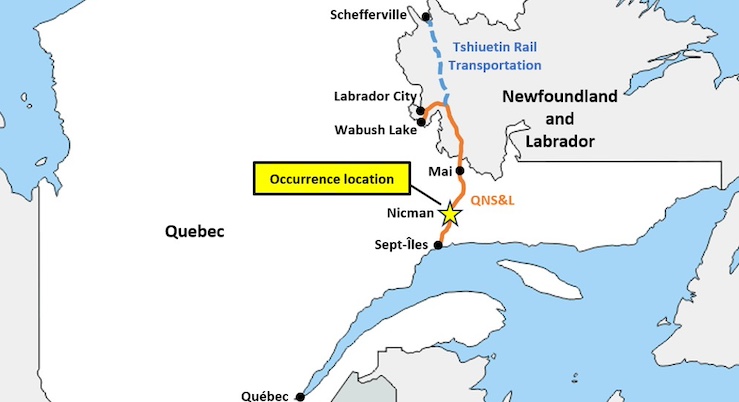
Map of December 2025 derailment of QNS&L train.
Courtesy of d-maps.com, with TSB annotations
DORVAL, Quebec - The Transportation Safety Board of Canada (TSB) released an investigation report regarding the Quebec North Shore and Labrador Railway ore train derailment last December.
As a Quebec North Shore and Labrador Railway (QNS&L) ore train PL676D was traveling south on the Wacouna Subdivision and operated by a single locomotive engineer, a train-initiated emergency brake application occurred near Mile 36.8. After stopping and securing the train, the LE conducted an inspection, observing a broken coupler knuckle on the north end of the 137th car. The LE continued inspecting and noted several cars had derailed around Mile 37.7, all sustaining “extensive damage.”
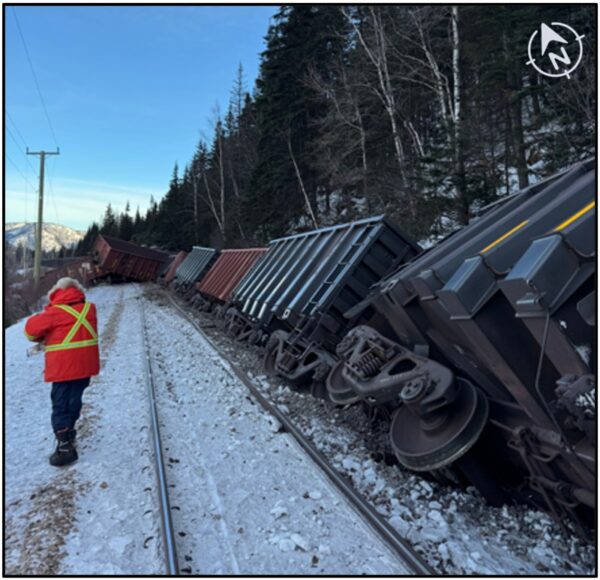
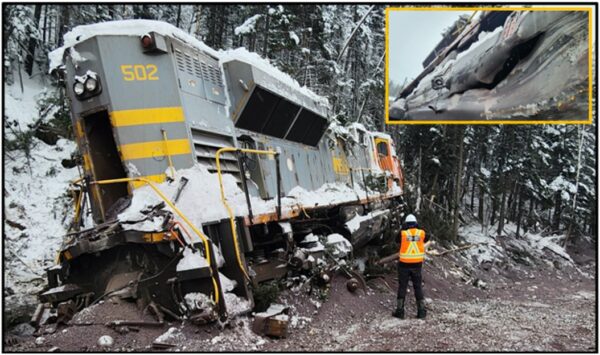
While the derailed cars had spilled its contents, “no significant quantity of iron ore” ended up on the frozen Nipississ River. The cars that had remained on the rails were not damaged. One fuel tank was punctured (as shown in the figure below) and spilled an estimated 1,000 L of diesel under the locomotive.
The TSB states it conducted a limited-scope, class 4 investigation in order to “advance transportation safety through greater awareness of potential safety issues.” Conditions on the day of the derailment included a mostly clear sky and a temperature of -9°C.
In the investigation report, the TSB states the area of occurrence is mostly level ground with only slight gradients of +0.1% to -0.2%. A right-hand curve of 4 degrees over 480 feet is located at Mile 37.83, followed by “a short section of tangent track, then a left-hand curve of nearly 6 degrees over 493 feet (up to Mile 37.65).” Throughout 2025, there are 47 recorded instances of broken rails on the main track of this subdivision, 25 of which occurred in January and December, 13 and 12 respectively.
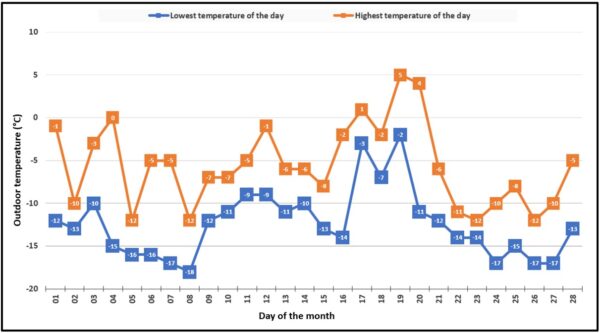
On October 20, 2025, roughly two months before the derailment occurred, a track geometry inspection was conducted, and no urgent defects were identified. On December 4, 2025, the TSB says ultrasonic testing was performed between Mile 9.0 and Mile 57.82, also finding no internal rail defects. On December 25, 2025, an inspector, using a hi-rail vehicle. found no defects or anomalies in the area. Fluctuating temperatures throughout the month of December, a relatively short period (as shown in the figure above), “place heavy stresses on the rails.” The cold temperatures cause steel to contract and generates tensile forces within the rail. As the outdoor temperature rises, the material expands, causing compressive forces.
These “repeated cycles can cause internal defects to form and spread.” Continuous welded rail is susceptible to failures, “particularly at the welds.” Additionally, this can be compounded with flat spots, areas where the rail is “hammered with each wheel revolution at an intensity that varies with the severity of the defect and the speed of the train, which can cause various types of rail damage, up to and including rail failure.”
However, the TSB states in the investigation report that it was not able to determine with certainty the cause of the derailment or the track condition due to the extent of the derailment. The area is not easily accessible. The TSB states that it is “likely” the rail broke due to “thermal stresses and impact forces,” as noted above.
Media
RELATED ARTICLES