Report: Will Minnesota Shutter Northstar? –– From Railway Age
Written by Marybeth Luczak, Executive Editor, Railway Age


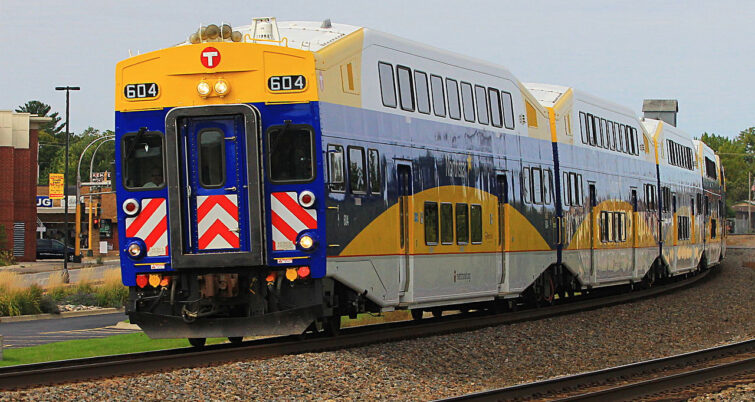
Northstar Line cab car 604 leading a train south through Elk River, Minn. Wikimedia Commons/Mulad
Northstar commuter rail service between Minneapolis and Big Lake, Minn., may be replaced by bus service, according to the Minnesota Star Tribune and other local media outlets.
“MnDOT’s recent Twin Cities – St. Cloud-Fargo/Moorhead Corridor study makes it clear we can provide more cost-effective transit service in the corridor currently being served by Northstar Commuter Rail,” the Minnesota Department of Transportation (MnDOT) and the Metropolitan Council said in a Feb. 24 joint statement, according to FOX 9 KMSP. “As the world and consumer demand changes, we must be willing to be flexible and innovative to offer better service while saving dollars. We have jointly started the process to explore transitioning to bus service in this corridor. That process includes working with our federal partners and our rail partners at BNSF Railway, who we have appreciated as a critical [host freight rail] partner. In the coming months, we will have more information, including timeline information and projected future savings. For Minnesotans who currently utilize this service, we are committed to working with you to ensure you have access to high-quality transportation in this corridor.”
The MnDOT study (download below) “found that transitioning to bus service between Minneapolis and St. Cloud would cost millions less than the status quo,” according to the Minnesota Star Tribune. “It costs about $12 million annually to operate Northstar, a budget that would shrink to $2 million if buses were used.”
“This is the beginning to finally end Northstar service, with its ridiculously low ridership, its ridiculously huge operating subsidies and its ridiculously expensive maintenance costs,” said Minnesota state Rep. Jon Koznick, a Republican who serves District 5A, according to the Tribune. Koznick, also on Feb. 24, debuted a bill to shut down the rail line, which “passed the House Transportation Finance and Policy Committee on Monday [Feb. 24], and will be sent to the House floor for further debate,” said the paper, which added that “several Democrats thought the move was premature.”
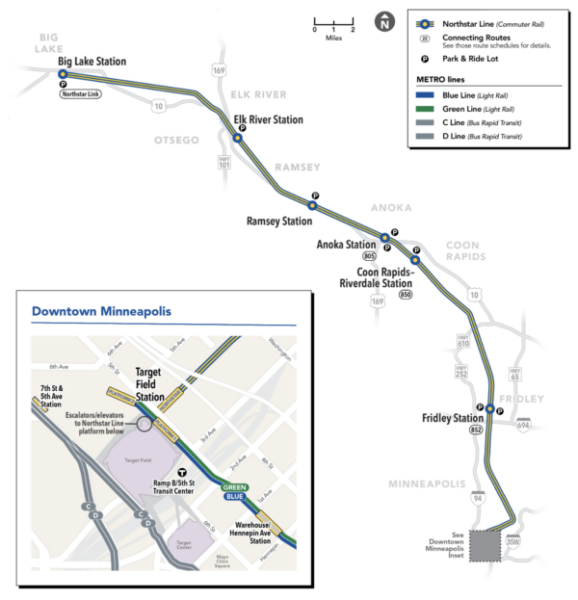
The Northstar Line offers service between Big Lake and downtown Minneapolis, stopping at stations in Elk River, Ramsey, Anoka, Coon Rapids, and Fridley. It connects with buses (Northstar Link) for service to and from St. Cloud. (Map Courtesy of Metro Transit)
The 40-mile Northstar service in the Northstar corridor opened Nov. 16, 2009, between downtown Minneapolis and the northern city of Big Lake (see map, right); it was originally envisioned to link with St. Cloud, but connects to that city via bus. From 2011 through 2019, it carried between 2,200 and 3,300 weekday riders during the morning and evening peak commute hours; it also featured special event service on evenings and weekends for Minnesota’s Twins, Vikings, and University of Minnesota Gopher sporting events. MotivePower (Wabtec) MP36PH-3Cs power the trains, which comprise Alstom (originally Bombardier) bilevels.
The COVID-19 pandemic led to a dramatic ridership drop of nearly 98%—just 60 weekday rides in April 2020, according to the Metropolitan Council, which is the regional policy-making body providing transit, wastewater collection and treatment, and affordable housing services in the seven-county Twin Cities metro area, and is charged under state law with establishing regional growth policies and long-range plans for transportation, aviation, water resources, and regional parks. In 2021, daily ridership peaked in October at 346 daily rides or just over 13% of the October 2019 pre-pandemic level. In 2022, Northstar carried around 300 daily rides. The service provides four weekday trains and no weekend service unless there is a special event.
While employees have been returning to in-person work, “Northstar’s recovery has been lackluster, with just over 127,000 riders last year, renewing Republican lawmakers’ chorus to shut it down,” the Tribune reported.
“‘We know travel patterns have changed’ since the pandemic,” Met Council Chair Charlie Zelle said, according to the Tribune. “He said bus service would likely be more frequent to reflect the new paradigm.”
MnDOT was charged with conducting the Twin Cities – St. Cloud-Fargo/Moorhead Corridor study by the state legislature. The purpose: “to conduct an analysis and evaluation of options for development of transit and rail service improvements in the corridor between the Minnesota cities of St. Paul, Minneapolis, Coon Rapids, St. Cloud and Moorhead, and Fargo, N.Dak.” It assessed alternatives for transit service in the corridor and the elimination of Northstar commuter rail in conjunction with those alternatives.
According to the Tribune, the “study laid out different options for Northstar, but didn’t recommend that the service be terminated altogether. It explored the potential cost to extend service to the Fargo/Moorhead area, either by extending Northstar’s route, by expanding Amtrak service or by combining bus and train service.” MnDOT, it noted, is studying expanding Amtrak’s Chicago-to-St. Paul Borealis service to Coon Rapids and St. Cloud.
If the Northstar service were to end, it would involve “unspooling contracts” between MnDOT, Met Council, BNSF, the state of Minnesota, and the Federal Transit Administration, which provided a Full-Funding Grant Agreement for the $320 million project, according to the Tribune. “The federal government and possibly the state would have to be reimbursed if Northstar shut down, athough it’s unclear how much,” the paper said. “Congress would have to approve any waiver of those costs.”
The Tribune added that “[t]he remaining interest in Northstar is about $30 million to $35 million, according to the report, not including property and buildings along the line, which would need to be appraised to determine current market value.”
Commentary
“I reviewed the report, and it looks like one of the many studies I have seen that tells the client what the client wants to hear,” comments Railway Age Contributing Editor David Peter Alan. “In this case, it’s that the Northstar service is not worth keeping, and that it would be a better deal just to run a bus. While I’m not sufficiently familiar with the subject matter of the study, I rode the Northstar years ago, after getting off Amtrak’s Empire Builder at St. Cloud, spending the day there, and taking the connecting bus and then the Northstar into Minneapolis. The operation was not conducive to encouraging ridership.
“The service today consists of three peak-hour trains in prevailing direction and one in reverse direction, with no service at any other time. From what I remember and some research I did, all stations are park-and-ride, with the towns some distance away from them. There has never been service to St. Cloud, except taking the train halfway there to Big Lake and a bus the rest of the way. Service outside the commuting peak has also been very limited, even when there was a bit of service on the weekends. There was never any interest, as far as I could ascertain, to run a more-robust level of service or to run trains to St. Cloud, which is a destination worth visiting.
“All in all, it does not appear that the Northstar service was ever designed to carry more than the number of commuters who could fill up the spots in the parking lots, which inherently limited its effectiveness in providing mobility in the region. Now a consultant’s report is calling for its termination, so its days are probably numbered. Maybe it’s just an example of how not to design and build a passenger service.”