Lou Thompson: California HSR ‘Has Reached a Dead End’ –– Commentary
Written by William C. Vantuono, Editor-In-Chief, Railway Age


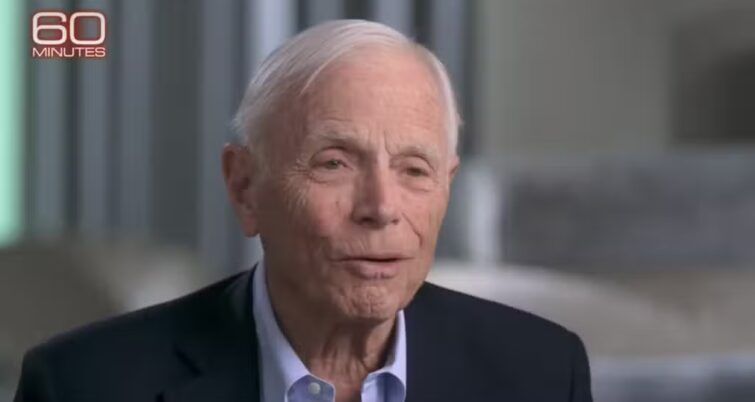
SACRAMENTO, Calif. –– Above: Lou Thompson on a recent edition of CBS 60 minutes. From 2009 to 2024, Louis S. (Lou) Thompson, whose distinguished career has included formation of Amtrak in the early 1970s and railways advisor to the World Bank, was a member of the California High Speed Rail project Peer Review Group reporting to the California State Legislature. He was Chairman from 2012 to 2024.
In his 2024 resignation letter, Thompson said he “emphasized the Group’s recommendations that the legislature commission an independent study of the problems experienced in the project, what to do about them, and the lessons that should be learned. Subsequent reports by the Authority—the 2025 Project Update Report, the 2025 Supplemental Project Report, and the Draft 2026 Business Plan—have underlined the urgent need for such a study, both because of the difficult situation the project faces and because of the risks the project poses to the State.“
On March 27, 2026, Thompson wrote to the Legislature with his personal views on a project he stresses “has reached a dead end.” The entire letter can be downloaded below. Following are highlights:
“Despite contrary claims, the [California High Speed Rail] Authority cannot complete the promised 171-mile link from Merced to Bakersfield by the end of 2032 with the funding available. The full Phase I project that the 2008 Business Plan promised would cost $33.8 billion and yield a 2 hour, 40-minute trip time from San Francisco to Los Angeles is now estimated to cost $231 billion. The Authority proposes an ‘optimized’ plan that would cost $126 billion, but the plan is based on questionable savings due to proposed design and sequencing changes, and on poorly described scope reductions … ”
“The grand ‘vision’ of the project sold to the public in Proposition 1A was far short of any realistically achievable cost and schedule. This could have been due to naiveté, ‘irrational exuberance,’ ‘strategic misrepresentation,’ short-sighted political self-promotion or, more likely, a combination of all four. The funding plan had three fatal flaws: It was far below a reasonable estimate of the project’s actual capital costs … It propounded state, federal and private shares of financing that were completely unrealistic. The state share was to be a one-time bond issue of roughly one-third of the cost. The proposed federal share of roughly one-third of the cost was based on aspirations for federal programs that did not exist then and do not exist today. The project did benefit from minor federal financing programs and was boosted for a while by the American Recovery and Reinvestment Act of 2009 (ARRA) funding, most of which has been rescinded (twice) by the [POTUS 47] Administration. It should be noted that the Authority has recently decided not to sue the Federal Railroad Administration for restoration of that funding, possibly recognizing that it does not have a convincing business case. Similarly, outreach by the Authority has shown that private investors will not make a significant contribution to project construction, but will await completion and proof of the projected demand and operating costs. Probably most important, the funding has come in insufficient and unpredictable pieces, not a stable and adequate flow that would permit effective planning and management of construction over the life of the project. The recently awarded $1 billion in annual funding from the Cap and Invest program through 2045 has helped, but it will not suffice even to complete the 171-mile Merced to Bakersfield segment by the end of 2032 as promised in the Draft 2026 Business Plan.”
“The Authority’s and Legislature’s state of denial should end. Until this happens, the downward spiral of overpromising, followed by budget problems, followed by disruptive scope reductions, followed by contractor claims, cost increases and service reductions, cannot be halted … The Legislature and Governor should direct the Authority to stop overreaching and reformulate the Merced to Bakersfield segment into a set of separable, achievable stages, in order of priority, with each stage to be commenced only if the prior stages can clearly be completed within available funding … The Legislature and Governor should urgently address the question of whether the system is to be extended beyond Merced to Bakersfield, what the extension would look like, and how the $91 billion to $196 billion gaps will be addressed.”
“Mega-projects tend to be doomed from the beginning by poor definition of scope and objectives, poor cost and schedule estimates, and over-optimism about the difficulty of the project. These are often boosted by people with no ‘skin in the game’ or with a vested interest in making the project go ahead whether or not a justifiable basis exists. Once a project actulaly commences, political pressures from short-term beneficiaries—consultants, construction contractors and labor unions—intensify, so efforts to support careful planning and evaluation by independent agents to assess the objectives and costs of the project before it is committed are always a good idea.”
Thompson appeared, albeit briefly, on a recent CBS 60 Minutes report on the California HSR project as well as Brightline West and Brightline East. It’s well worth a watch. It runs just over 13 minutes.