News and Opinion

STB adopts final arbitration rules

The Surface Transportation Board (STB) today announced its adoption of final rules to revise its arbitration methods in compliance with the requirements outlined in the Surface Transportation Board Reauthorization Act of 2015, P.L. 114-110 (2015) (Act).

Congressman reintroduces Freight Mobility bill

Congressman Adam Smith (D-WA) reintroduced the National Freight Mobility Infrastructure Act, H.R. 3607, that will ensure federal support for the national freight mobility network and critical freight infrastructure and transportation improvements throughout the United States.

"America’s freight transportation system is a national asset and critical to our productivity and global competitiveness," said Rep. Smith. "Over the next 20 years, it is estimated that the volume of domestic freight will double while international freight will triple. This bill ensures our freight and transportation infrastructure remains competitive and strengthens economic growth."

This legislation creates the Freight Mobility Infrastructure Improvement Program within the U.S. Department of Transportation to provide long-term financing for critical infrastructure improvement goals. Through it, states, ports and regional transportation authorities would work in collaboration with non-governmental stakeholders and freight transportation industry entities to identify high-priority projects and apply for funds. The Secretary of Transportation would then competitively award grants based upon a project’s impact on freight mobility improvement, cost effectiveness and regional/national economic impact.

"Our multimodal freight transportation system is a national asset that we have failed to appreciate and support. Nowhere is this need more pressing than in the freight system that provides for our nation’s commerce," said Port of Tacoma Commissioner Don Meyer.

Funds for this program would be generated by a freight-specific user fee and deposited into a newly-created National Freight Mobility Infrastructure Fund exclusively dedicated to supporting freight mobility projects. The fee would be imposed at a rate of one percent on the fair market value of multi-modal ground transportation costs, with a few exceptions for federal, state and local government transportation and transport within a local geographic area.


VTA Board awards $772 million design build contract for BART extension project

The Santa Clara Valley Transportation Authority’s Board of Directors unanimously voted Thursday, December 8, 2011, to award the first major contract for BART Silicon Valley, to Skanska-Shimmick-Herzog a Joint Venture.This first contract includes completing the design and construction of the line, track, systems and stations for the 10-mile Berryessa Extension Project, the first phase of the 16-mile BART Extension into Santa Clara County.

"Today’s vote by the VTA Board keeps faith with the voters and taxpayers of Silicon Valley, who cast visionary votes in 2000 and 2008 that made the dream of BART service to Silicon Valley a reality," said Silicon Valley Leadership Group CEO Carl Guardino.

The decision marks a key project milestone and will immediately generate local jobs. Nearly 5,500 jobs will be created during the construction of the line, track, systems and stations elements of the Berryessa Extension. An additional 4,000 indirect jobs are created due to activities related to this contract and 3,800 more jobs are created to support construction of the station campus areas, access roadways, parking structures and transit centers.

"The extension of BART into the South Bay is the priority project in VTA’s Measure A Transportation Improvement Program. Skanska-Shimmick-Herzog a Joint Venture, was able to propose constructing the Berryessa Extension at $77 million less than the engineer’s estimate while also accelerating the construction schedule, making it possible to deliver BART sooner than 2018," stated Margaret Abe Koga, chair, VTA Board of Directors.

Skanska-Shimmick-Herzog a Joint Venture brings more than 150 years experience to the project management team.

VTA is seeking a $900 million federal grant for the Berryessa Extension Project from the Federal New Starts funding program and anticipates receipt of it early next year. The grant will complete the funding plan and enable major construction to begin by mid-2012. BART Silicon Valley’s Communications and Outreach team will conduct public meetings prior to commencement of major construction activities. VTA continues project development activities for the second six-mile phase of the project that includes a 5.1 mile-long subway tunnel through downtown San Jose and ends in Santa Clara near the Caltrain Station. Construction on the second phase of the project will commence as additional funding is secured.

CP extends clean energy supply chain

Canadian Pacific Logistics Solutions developed a new wind energy supply chain connecting manufacturers in Quebec, Canada, and Florida with a new clean energy transload facility in upper New York state.

"CPLS has demonstrated competence and expertise in the movement of these super-sized dimensional wind energy components," said Stephen Whitney, vice president market development. "Our end-to-end logistics solution creates value and drives service to new levels for these specialized customers."

The new supply chain connects wind tower sections produced in Trois Rivière, Québec, Canada, and machine heads produced in Pensacola, Fla., move in dedicated unit trains or multiple car blocks using specialized railcars to a dedicated transload facility in Plattsburgh, N.Y. The components will then travel by truck to the wind project site in Pennsylvania. CPLS coordinates the entire logistics process, including permitting, scheduling, transloading, trucking and freight rail movements.

Rail will benefit from Governor Cuomo’s $785 million Regional Council funding

New York State awarded $785 million for the Regional Economic Development Council initiative, continuing New York Governor Andrew Cuomo’s efforts to redesign the way state government works in order to drive economic growth and create jobs.

Announced in July, Regional Councils represent a fundamental shift in the state’s approach to economic development from a top-down development model to a community-based, performance-driven approach, which empowers individual areas to develop comprehensive strategic plans that invest in regional solutions to create jobs and economic growth. As part of the Regional Council process, a Strategic Plan Review Committee was chosen to analyze and rank the strategic plans for each region competing for $200 million in specially targeted economic development funding.

The plans are the result of months of consideration by the Regional Councils and input from the public in each region. The process included holding more than 100 public meetings, forums and community workshops across the state. Thousands of New Yorkers contributed to the development of the plans through these events.

Consistent with the Governor’s Executive Order issued earlier this year to increase Minority and Women Business Enterprise participation in state contracting, all projects awarded grants through this initiative must use best efforts to reach the goal of 20 percent MWBE participation.

Southern Tier awarded up to $49.4 million

The Southern Tier Regional Council developed a vision for economic growth and job creation that builds upon the region’s strengths. This includes, $1.8 million to the Wellsboro & Corning Railroad Co. for the restoration of mainline railroad track and the reconstruction of a former second main track. This project will help advance necessary improvements in transportation infrastructure, allowing the railroad to continue to provide timely, efficient and environmentally-friendly service to rail commuters in the Southern Tier.

Additionally, $1.5 million will go toward the rehabilitation of the Utica line between Broome and Chenango and Bath & Hammondsport to provide timely and efficient rail service to industries in the Southern Tier.

North Country was named Best Plan Awardee and will receive $103.2 million

The North Country Regional Council Strategic Plan provided a long-term roadmap to attract private investment, promote and facilitate connectivity between communities and create a climate that will allow entrepreneurs to flourish. Funds of $9.9 million will rehabilitate the Newton Falls Rail Project to rehabilitate and reopen the 46-mile Newton Falls Rail Line. This project will restore and enhance the most efficient, environmentally-friendly and reliable form of transportation, at the most cost-effective price, to service the paper mill at Newton Falls and the operations at Benson Mines.

Additionally, $2.5 million will support Bombardier’s expansion of their main plant in Plattsburgh, which will increase their capacity for new contracts. The project includes a 57,000 sq.-ft. increase of the main plant, a 2,100 sq.-ft. expansion at the off-site testing facility and electrification of an additional half mile of railroad track at the test facility.

Capital Regional was awarded $62.7 million

The Capital Region Economic Development Council Strategic Plan presented a vision to collaborate locally and make the region globally competitive and economically vibrant.

Funds of $2.2 million will support the development of a rail transloading facility in Columbia County, which will serve businesses in the Capital Region that do not have rail access. The project will allow businesses to transfer products from trucks to rail cars for outgoing purposes and to move incoming products.

Additionally, $4 million will construct the Ronkonkoma-MacArthur Transit Hub project, providing for a new sewage treatment plant and allowing construction of a new transit-oriented, live-work-play destination in a blighted area. This project will also strengthen ties between Suffolk’s busiest rail station and LI MacArthur Airport.

BNSF names Andersen AVP, Community and Public Affairs

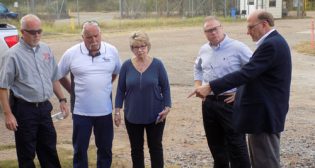
BNSF named Zak Andersen assistant vice president, community and public affairs, effective January 16, 2012, reporting to John Ambler, vice president, corporate relations.

Andersen will oversee the public affairs team within the corporate relations department, with additional responsibility for community relations, public policy messaging and public affairs communication and strategy. To better integrate BNSF’s community activities with its contribution programs, Andersen will also work to manage the BNSF Foundation, under the leadership of Ambler, who will continue to serve as president of the foundation.

"Zak Andersen is an insightful leader," said Ambler. "With his deep understanding of national public policy issues and how to effectively interact with community interests, we expect to further enhance relationships with our stakeholders and their support for the railroad."

Andersen joined BNSF in March 2006 as director, federal government affairs. He was promoted to assistant vice president, federal government affairs, in November 2008, with responsibility for federal legislative matters primarily related to economic regulation, energy and environmental issues.

CP expands Saskatchewan Bakken rail shipments

Canadian Pacific is expanding the transportation of crude oil by rail from the Saskatchewan Bakken Formation.

CP is now increasing volumes of crude oil movement by rail out of the Saskatchewan Bakken oil formation through a new CP transload facility, operated by Bulk Plus Logistics in Estevan. This is in addition to railcar loads already moving out of the Dollard, SK, transload facility, located on the Great Western Railway, a shortline partner of Canadian Pacific. This oil is destined to various refineries in both Canada and the United States.

The Bakken Formation, encompassing sections of Saskatchewan and North Dakota, is a key area of focus for Canadian Pacific and part of the railway’s growing energy portfolio. In the past three years, CP has demonstrated its ability to deliver crude oil by rail. Volumes of rail shipments out of North Dakota, for example, have grown from roughly 500 carloads in 2009 to more than 13,000 carloads in 2011. This is expected to grow to 70,000 annual carloads in the future.

"To move the crude by rail opportunities to the next level, CP will take what it has learned and the products developed in North Dakota and apply them in the emerging Saskatchewan and Alberta Bakken markets," said CP Energy and Merchandise VP Tracy Robinson. "The model we developed in North Dakota is proven and we’re now bringing that north. To fully capitalize on these opportunities, CP has established a specialized Energy Development Team to proactively position CP’s products and capabilities in this rapidly emerging market place."

CP is investing more than $90 million (US$88.5 million) to enhance capacity on its U.S. mainline south of Saskatchewan, through North Dakota and into Minnesota to handle anticipated increased Bakken crude shipments. This includes upgraded track and sidings.


STB initiates second independent audit of CN’s EJ&E acquisition

The Surface Transportation Board has initiated a second independent audit to verify the Canadian National’s monthly operational and quarterly environmental reports to assist the board in monitoring the impact of CN’s acquisition of the EJ&E West Co.


This second audit will focus on the information in CN’s operational reports for the months of November and December 2011 and on CN’s 4th Quarter 2011 Environmental Report. The audit will evaluate CN’s progress in constructing rail improvements, progress in road closure issues and grade crossing improvements and operational considerations. The audit also will include an assessment of the information submitted by CN related to the November 3, 2011, derailment near Bartlett at Spaulding, Ill.


Portland to Vancouver light-rail link pushes ahead with Columbia River Crossing OK

Plans to replace the aging Interstate 5 Columbia River Crossing bridges connecting Vancouver, Wash., and Portland, Ore., and build an interstate transit link can now move forward.

The Record of Decision represents the final clearance of the project’s environmental review and allows Oregon and Washington to begin right-of-way acquisition and construction.

"We are making the long-sought after rail transit link between Portland and Vancouver possible," Federal Transit Administrator Peter Rogoff said. "This is the type of forward-leaning project that will greatly benefit the entire region well into the future."

At a cost of approximately $3 billion for bridge, transit and highway improvements, the project is considered a long-term, comprehensive solution to address safety and congestion problems on five miles of I-5 from State Route 500 in Vancouver to Victory Boulevard in Portland and will be funded through a combination of state and federal sources.

The nearly three-mile light-rail portion of the project will extend from Portland’s Expo Center MAX station to Clark College in Vancouver. It is expected that the transit rail project will reduce the duration of daily congestion on I-5 near the Columbia River by 60 percent. By 2030, the light-rail line is expected to carry more than 22,000 daily passengers.