MxV Rail: Building the New Facility for Accelerated Service Testing
Written by Chris Johnson, Scientist, MxV Rail


MxV Rail
PUEBLO, Colo. - Scientist Chris Johnson writes about the Facility for Accelerated service Testing (FAST®).
MxV Rail recently completed the second year of operations at the newly constructed Facility for Accelerated Service Testing (FAST®), which serves as an industry testbed. FAST provides controlled testing of track and mechanical components accumulating over 140 million gross tons (MGT) of traffic annually under an 18,000-ton train with individual cars weighing up to 315,000 pounds. MxV Rail operates FAST as part of the Association of American Railroad’s (AAR) Strategic Research Initiatives (SRI) test program.1
BACKGROUND
Established in 1976, FAST was designed as a facility for evaluating conventional railroad track and equipment under controlled conditions with higher volume and faster mileage accumulation than practicable in revenue service testing.2 FAST started as a 4.8-mile loop with five curves and 22 test zones running 60–70 car trains.3 Over time, the original 4.8-mile loop was shortened to a 2.7-mile loop with four curves, a bypass track was constructed, and support facilities were added to improve operations.
The largest change to FAST came with the implementation of the Heavy Axle Load (HAL) program to study the effects of increased use of heavier 110- and 125-ton cars on existing infrastructure. A train of 125-ton cars was introduced, four-axle locomotives were replaced with six-axle locomotives with radial trucks, and train length increased to 114 cars. FAST operations on the original loop concluded in May 2022 with the accumulation of over 5,000 MGT, almost 4,000 MGT of which was HAL traffic.4
A NEW FAST
In 2021, MxV Rail built new testing facilities with the primary goal of improving the capabilities and efficiency of FAST. Drawing on the FAST successes over the past 45 years, designers met with stakeholders to identify five focus areas that would guide concept development and require balancing in the final concept and design.5
Test Capabilities
The physical requirements for potential tests at FAST were determined and prioritized early in the development process because many test requirements would affect the length and alignment of the FAST loop. For example, rail tests required a tighter curve with an unlubricated high rail while tie and fastener tests required curved track and higher speeds.
Track Length
Shorter loops were initially considered for more efficient tonnage accumulation. Modeling showed the normal FAST train could safely operate on a 2-mile-long loop, however, a shorter loop was ultimately ruled out and a 2.8-mile loop was planned due to concerns regarding 1) the lack of track, particularly tangent track, available for testing and 2) more frequent train passes leading to increased rail heating.
Track Alignment and Lubrication
Starting from scratch, the alignment of the new FAST loop had none of the constraints of the previous loops. Several options, such as sharper curves for rail testing, were considered, however these options were not included to keep the track speed at 40 mph. Similarly, a figure-eight design was considered to improve truck performance and reduce steering issues, but this design was also rejected due to the lack of a long tangent and complications with lubrication. Ultimately, a loop with a single reverse curve was chosen for the new FAST loop.
Train Storage and Turning
To minimize logistics moves and reduce the contamination of other unlubricated test tracks, every effort was made to keep FAST self-contained. A turning loop that combined storage and turning of the entire train was included inside the main FAST loop, thereby increasing operational efficiency while reducing the overall footprint of FAST.
Train Maintenance and Access
A self-contained maintenance facility was included inside the loop in the final FAST concept. Access to FAST was still required so equipment could be brought into and out of the facility. To reduce the turnouts on the mainline, a One-Way-Low-Speed (OWLS) crossing diamond was included to allow access to the rest of the site.
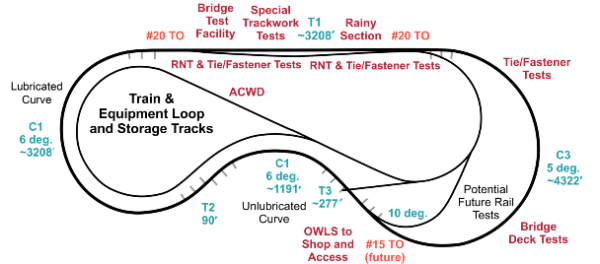
Following additional review by stakeholders, the final concept plan was ready for design. Figure 1 shows the final concept.
DESIGN AND CONSTRUCTION
Once a site was selected for construction of the FAST loop and other MxV Rail test tracks, civil design began. The High-Speed Loop (HSL) was the first test track to be completed, and the new FAST loop was placed inside the HSL. The design also allowed for future maintenance and storage facilities, a switching lead track, a 90-degree OWLS crossing, and turning facilities for smaller consists independent of the storage loop.
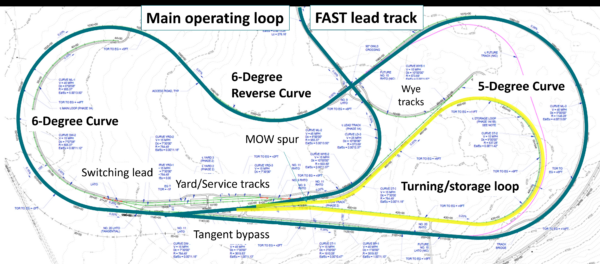
Construction of the full FAST concept is intended to take place over several years, not only to accommodate budget requirements but also to allow for adjustments to the concept and design after gaining operational experience at the new site. The design of the main loop, access track, and storage loop were completed first so construction could begin. Once bids were received, MxV Rail proceeded with the construction of the FAST loop and access track. Grading for the turning and storage loop was also included to realize cost savings with the understanding thattrack construction would follow as resources allowed. Figure 2 shows the final design for the FAST Loop, with the constructed tracks highlighted.
Construction began in March 2023. Because the new FAST loop would be located on surplus federal property, additional restrictions were placed on construction. These restrictions included strict access requirements for all personnel on site and environmental restrictions on site use. The grading contractor was able to avoid delays due to unexpected archeological sites, discarded ordnance discoveries, or other environmental restrictions.
In June 2023, track construction began on the completed subgrade. The new FAST was built to current North American heavy haul mainline railroad standards. Outside of specific test zones, the track materials included 136RE rail, a mix of concrete and timber ties, and standard fastening systems.
Materials in test zones included composite ties, various elastic fasteners in wood ties, intermediate- and high-strength rails from multiple suppliers, and a bridge deck testing facility. Due to the variety of test components being installed, MxV Rail worked hand in hand with the contractor to determine which test zones could be installed during the initial construction phase. Most ofthese test zone modifications consisted of changes in material that could be installed by the contractor after planning and under supervision. Rail tests were welded into strings ahead of installation. Only a few tests, such as instrumented concrete ties, were deemed too sensitive for installation during initial construction, and these were installed later by MxV Rail.
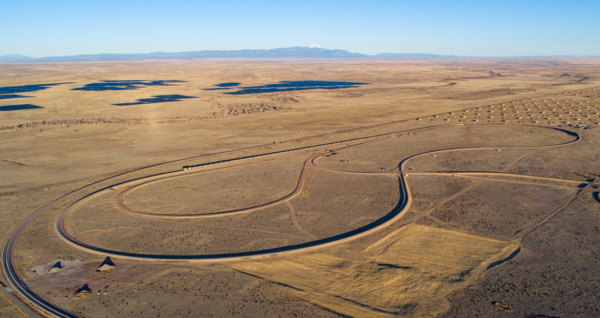
Following the initial track construction, ballast was dumped and the track raised to the correct profile. The rail was then destressed to achieve a rail neutral temperature of 100oF, in accordance with local Class 1 railroad policies. Closure welds were made with electric flash butt welding wherever possible. Figure 3 shows the initial newly constructed FAST loop.
OPERATIONS
Operations at the new FAST began in November 2023, eight months after construction began. The 2023 operations served as 1) settlement laps for the newly constructed track, 2) familiarization for test crews operating on the new loop, and 3) identification of any issues with the new track, installed tests, or safety systems.
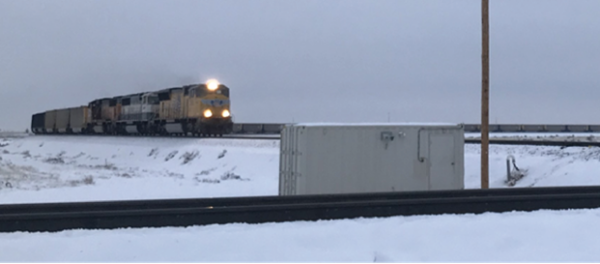
The first full year of operations began in January 2024. Operations improved with the completion of the turning and storage loop in April 2024, which allowed the regular turning of the train and improved steering and tracking of the trucks. With the improved performance of the train, broken welds and rails were the largest obstacle to operations. After a planned summer shutdown to perform maintenance and install new tests, operations concluded in October 2024 after reaching the annual goal of 140 MGT. These initial operations set the pattern for regular operations in 2025 and beyond. Figure 4 shows the FAST train in all-weather operations.
FAST has always hosted a wide mix of tests across broad subject areas. Many of these tests are long-term tests with multiple component measurements designed to monitor changes over time. Other tests are short term, looking only at immediate capabilities or changes. Initial plans called for a mix of 32 tests at FAST. With the opportunities presented by the operating loop, this number grew to over 50 total tests by the end of 2025 operations.
SUMMARY
For 50 years, FAST has provided a controlled environment for testing new railroad industry components and materials. Following the two years of full operations at the brand-new track, FAST continues to be an industry-leading facility for testing railroad infrastructure, equipment, components, maintenance practices, and detection technologies.
The Technology Digest this article is based on can be found in the MxV Rail eLibrary along with more than 1,000 other publications describing the railway research, testing, and analysis available from the Association of American Railroads (AAR) Strategic Research Initiative (SRI) program. Explore www.mxvrail.com to learn more about MxV Rail and to register for the 31st Annual AAR Research Review to be held April 28–30, 2026.
REFERENCES
- Johnson, C. 2024. “Building the New Facility for Accelerated Service Testing.” Technology Digest TD24-028. AAR/MxV Rail. Pueblo, CO.
- Punwani, S.K., J. Lundgren, and G. Martin. 1975. “Functional Requirements for a Facility for Accelerated Service Testing (FAST).” FRA/OR&D-76-139. Department of Transportation.Washington D.C.
- McIntosh, G. 1981. “FAST Overview.” Proceedings FAST Engineering Conference in Denver, CO. Federal Railroad Administration. Washington, D.C.
- Johnson, C. and S. Wilk. 2023. “Evolution of the Facility for Accelerated Service Testing.” IHHA 2023. Rio de Janeiro.
- Johnson, C., T. Martin, B. Bakkum, and J. Becker. 2023. “FAST Forward: Designing a New Accelerated Service Test Facility.” AREMA 2023 Annual Conference. Indianapolis, IN.
Media
RELATED ARTICLES