Georgia Ports Authority Reports Dredging Project Under Way at Port of Brunswick
Written by David C. Lester, Editor-in-Chief


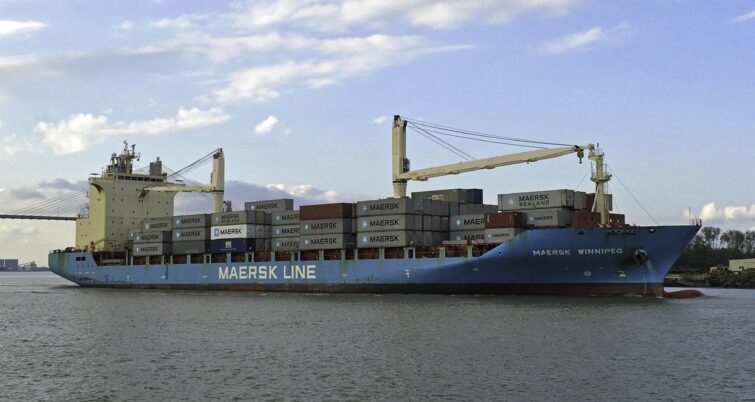
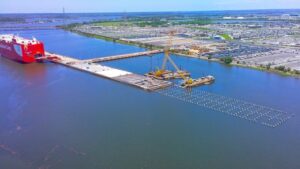
Maersk container ship at Port of Savannah (David C. Lester photo)
SAVANNAH, Ga. –– The Georgia Ports Authority (GPA) reports that dredging is underway at the Port of Brunswick's inner and outer harbor, with the plan to return the channel to it's authorized depth.
The project is being run by the U.S. Army Corps of Engineers and is addressing shoaling [the natural accumulation of sediment in shallow water areas] and other natural processes found in harbors across the country. A normal requirement for harbor maintenance, these dredging operations are scheduled to be completed in March, with additional work to be completed this summer.
Georgia Ports President and CEO Griff Lynch said “This is terrific news for our customers, who rely on the Port of Brunswick to serve the fast-growing Southeast market. Deeper water will mean increased vessel transit efficiency at America’s premier auto port.”
Col. Ronald Sturgeon, Commander of the Savannah District for the U.S. Army Corps of Engineers, said “In partnership with the Georgia Ports Authority, we are advancing crucial improvements to Brunswick Harbor while launching a feasibility study to shape the future of the Savannah Harbor. This work will enhance the safety and efficiency of these vital waterways to support economic growth for both Georgia and the nation. We are committed to making smart, data-driven decisions from the outset, keeping environmental stability front and center.”
The president of the Brunswick Bar Pilots Association, Bruce Fendig, said keeping up the channel enables Roll-on/Roll-off vessels to transit the channel with increased efficiency and safety. He added, “Greater depth also allows vessels loaded with more cargo to transit the channel without having to wait for high tide.”
Ro/Ro ships are growing in size, which makes harbor maintenance increasingly important. The most common new build size for vessels has reached a capacity of 4,000 to 8,000 CEUs (car equivalent units), enabling carriers to move more cargo in fewer trips. Vessels up to 10,000 CEUs are eventually expected to serve the U.S. East Coast. [For those not familiar with the “car equivalent unit” measure for vessels, it is a standard unit of measurement that is used to quantify the number of automobiles a Ro/Ro vessel can accommodate. This measure enables shippers to determine and compare vessel capacity.]
As with all modes of transportation, greater capacity generally lowers the per/unit cost of transportation.
Additional Harbor Improvements
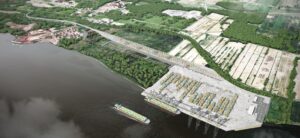
Construction has begun for a new $100 million fourth berth for Ro/Ro cargo at Colonels Island, increasing capacity at the harbor there, which is located not far from Savannah and Brunswick. This work is scheduled to be completed in the fall of 2027.
An additional, but separate, Brunswick Harbor improvement project, led by the Corps of Engineers, is slated to start later this year. This project will focus on a bend widener and expansion of the turning basin, which is where tugboats help ships turn downriver for docking and quick departure. This project has already garnered $11.35 million in federal funding and over $6 million from the State of Georgia.
Savannah: Corps of Engineers to Begin Savannah Harbor Deepening Study
The U.S. Army Corps of Engineers is about to begin a study to determine the feasibility of deepening and widening the Savannah Harbor to better accommodate large vessels coming to the Port of Savannah.
Deeper water would allow large vessels to transit the Savannah River with fewer tidal restrictions. Wider sections would enable big ships to pass each other in two-way traffic, enhancing the efficient flow of cargo.
Congress’s recent approval of the Energy and Water Appropriations Act of 2026 will provide $500,000 to start the study. The Corps’ review will begin after it receives the federal funding and a cost-sharing agreement is reached with the State of Georgia. Total cost of the three-year study is expected to be $3 million. The Corps of Engineers is overseeing the project because the Savannah Harbor is a federal waterway.
Ed. Note: RT&S readers know that without strong and continuous infrastructure improvements at ports on all U.S. coasts, international intermodal business would not grow for ocean shipping firms or railroads. Therefore, we think it’s important for us to cover this critical element of the supply chain. DCL
Media
RELATED ARTICLES