Transportation Safety Board of Canada Continues To Call For PTC-Like System After Review of 2024 Collision
Written by David C. Lester, Editor-in-Chief


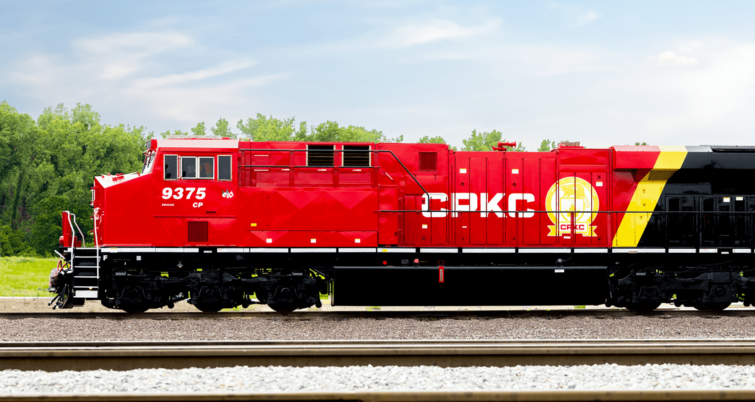
CPKC
Calgary, Alberta –– This week, the Transportation Safety Board of Canada (TSB) released its investigation report (R24C0020) into a 2024 accident where a train collided with a second stationary train near Greely, British Columbia (BC).
What Happened –– 2024 Collision Information
A Canadian Pacific (CPKC) loaded unit coal train was traveling west on the north main track of the Montana Subdivision at 22.3 miles per hour on February 16, 2024. At approximately 10:00 p.m. Pacific Standard Time, the train ran into the trailing car of a standing unit grain train at milepost 116.8 close to Greely, British Columbia. There were four locomotives at the head-end of the train. All derailed and one caught fire. Four cars on the unit grain train also derailed, and one of those caught fire. Both crew members of the coal train were taken to a local hospital, one of whom had serious injuries. The crew of the grain train sustained no injuries. About 400 tons of grain spilled from the grain train, and about 4,620 gallons of diesel fuel spilled from the derailed coal train locomotives, some of which burned.
You can read more details of the accident and what led up to it by clicking here. You can download a PDF of the complete report here:
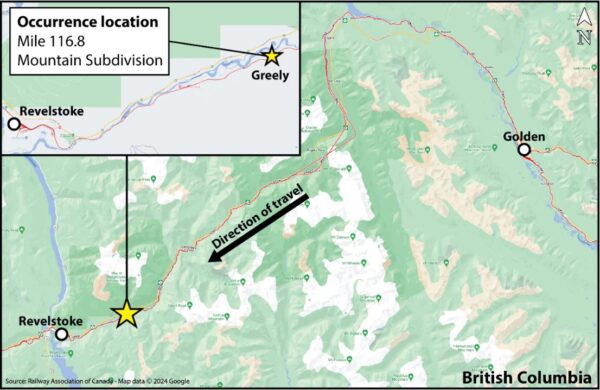
Map of the occurrence location, with inset map showing the location’s proximity to Greely (Source: Railway Association of Canada, Canadian Rail Atlas, with TSB annotations)
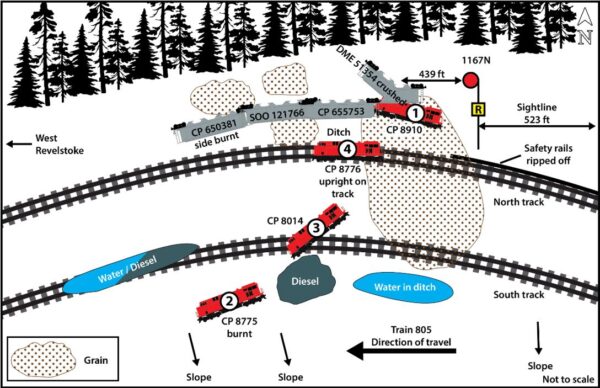
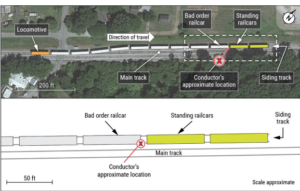
Schematic of the occurrence site showing the derailed rolling stock after the collision, including the derailed locomotives and their order in the train consist (Source: TSB)
Review of United States Positive Train Control (PTC)
The TSB report includes a discussion of PTC in the United States and notes that such a system has not been implemented in Canada.
“After a head-on collision in 2008 between a freight train and a passenger train in Chatsworth, California, that resulted in mass casualties, U. S. lawmakers mandated the development and implementation of physical fail-safe train controls (i.e., positive train control or PTC). Since 29 December 2020, PTC technology has been in operation on all 57 536 required freight and passenger railroad route miles in the United States.
“PTC is designed to prevent train-to-train collisions, overspeed derailments, incursions into work zones, and movement of a train through a switch left in the wrong position.
“PTC addresses the risk of crews going past a Stop signal. Stopping distance is automatically calculated based on actual train speed and braking force algorithms. If a train has proceeded beyond the calculated stopping distance and no action or insufficient action has been taken, the system initiates a penalty brake application to bring the train to a controlled stop before the point of restriction. The train’s penalty brake stop distance is monitored and, if calculated to be insufficient to stop short of the point of restriction, then an emergency application of the train brakes is initiated. Emergency braking can generate about 20% more brake cylinder pressure at each car in the train.
“While physical fail-safe train controls in the form of PTC have been implemented in the United States, the infrastructure required to fully support a system similar to PTC has not yet been implemented in Canada. Furthermore, its implementation is not yet mandated under the Railway Safety Act.”
Previous Canadian Accidents Reports Which Included Calls to Action
“The TSB has issued 3 recommendations calling for additional backup safety defences (i.e., physical fail-safe train controls) in signalled territory:
“In August 2022, following a main-track train collision and derailment involving 2 CN trains on 03 January 2019, at Portage la Prairie, Manitoba, the TSB issued Recommendation R22-04 to the Department of Transport, which calls for major Canadian railways to expedite the implementation of physical fail-safe train controls on Canada’s high-speed rail corridors and all key routes. In its December 2024 response to Recommendation R22-04, TC indicated that it continues to engage with industry and other stakeholders to progress in developing its corridor risk assessment methodology for the implementation of physical train controls; the term enhanced train control (ETC) has been adopted to describe such systems. TC also plans to draft regulations in 2025, with an anticipated publishing in the Canada Gazette, Part I in 2026. The timelines for implementation will be determined when the regulations are developed. The response from TC was most recently assessed in March 2025. Although the Board considers the response to show Satisfactory Intent, continued delay to expeditiously address the recommendation may result in a reduced rating in the future.
“In February 2001, following a rear-end collision between 2 Canadian Pacific Railway Company trains that occurred on 11 August 1998 near Notch Hill, British Columbia, the TSB issued Recommendation R00-04 to the Department of Transport, calling for the implementation of additional backup safety defences to help ensure that signal indications are consistently recognized and followed. The latest response from Transport Canada (TC) was assessed as Satisfactory in Part in March 2021 and the recommendation was assigned a Dormant status. It is linked to TSB Recommendation R13-01 and will be reassessed in accordance with this recommendation.
“In June 2013, following a main-track derailment involving a VIA passenger train that occurred on 26 February 2012 at Aldershot, Ontario, and in which the operating crew members were fatally injured and 45 people sustained various injuries, the TSB issued Recommendation R13-01 to the Department of Transport, calling for the implementation of physical fail-safe train controls for major Canadian passenger and freight railways, beginning with Canada’s high-speed rail corridors. The response from TC was most recently assessed in March 2023 to be Satisfactory in Part and the recommendation was assigned a Dormant status. This recommendation is linked to Recommendation R22-04 and will be reassessed in accordance with this recommendation.”
TSB Letter to the Minister of Transport
“On 17 April 2024, as a result of 3 other investigations that were ongoing at the time, the TSB sent a letter to the Minister of Transport concerning the absence of physical fail-safe defences for trains operating in Canada. The letter stated that, despite the calls from the TSB for additional physical fail-safe defences in signalled territory since 2000 and the implementation of such a solution in the form of PTC in the United States in 2020, the Canadian railway system continues to rely on administrative defences centered on compliance with rules by train crews. TC and the railway industry have been discussing the framework needed to address the issue since 2013 and, while TC has taken positive steps toward identifying a solution for physical fail-safe defences in the form of ETC, the pace of development has remained slow. Without physical fail-safe defences to protect train crews and the public, there is a significant risk of collisions and a potential mass casualty event on Canadian railways. Given the risk to train crews and the travelling public, the TSB strongly urged the Department of Transport and the railway industry to accelerate the implementation of physical fail-safe train controls on Canada’s high-speed rail corridors and all key routes in Canada. At the time of writing, the TSB had not received a response.”
RT&S will continue to monitor the discussion of PTC (or ETC) on Canadian railroads.
Media
RELATED ARTICLES