Sound Transit Weighs Options as Everett Link Extension Costs Climb
Written by Jennifer McLawhorn, Managing Editor


Sound Transit
SEATTLE - Sound Transit is weighing growing costs on the Everett Link light rail extension.
Sound Transit released its Capital Delivery Cost Workplace Update on September 11. In it, Sound Transit identifies light rail projects that provide benefits, including the improvement of passenger service and cost savings. The Everett Link Extension has a planned opening between 2037 and 2041 and will span 16 miles. The project is in the environmental review phase of planning, and a draft Environmental Impact Statement (EIS) will be available for review and comment in early 2026. Construction is expected to begin in 2030.
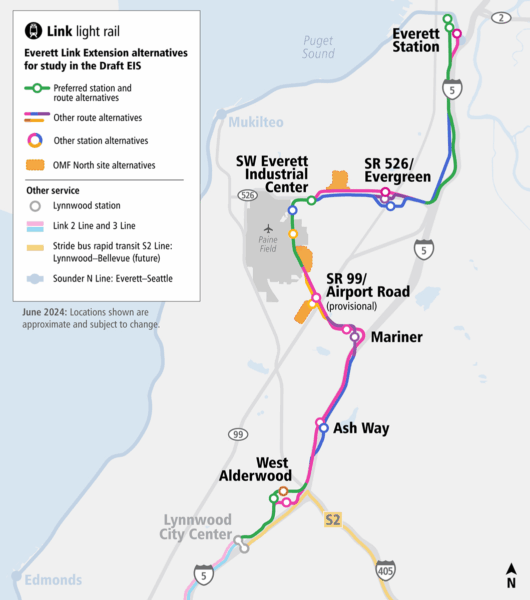
For the Everett Link Extension, the Capital Delivery Cost Workplace Update goes over the 2021 Financial Plan versus the Current Cost Estimate for 2025. This comparison shows an increase between $200 million to $1.1 billion. The 2021 Financial Plan originally had a total cost of $6.6 billion for the Everett Link Extension. That number has increased to $6.8 to $7.7 billion in the 2025 Current Cost Estimate. One of the biggest reasons? Guideway & Track Elements made up 23% of the cost drivers. With 11.5 miles of aerial guideway, these structures are “significantly more expensive than at-grade or surface alternatives,” says Sound Transit.
However, cost-saving measures were presented to “bring Everett Link’s costs down to meet the initial estimates presented in the Sound Transit 3 financial plan,” according to a report in HeraldNet. Among these adjustments would be changing the guideway’s alignment to “utilize more highway right-of-way, avoiding building demolitions” on Evergreen Way, according to The Urbanist.
Ash Way
A design adjustment at Ash Way to bring the station closer to I-5 and construct it at ground level would reduce costs, similar to the Shoreline North/185th Station. An improved station layout with “reduced visual impacts” is among the benefits listed from the Ash Way Station Optimization. However, the construction phasing would be more complicated and impacts to a nearby business parking lot could be “more costly than anticipated,” according to Sound Transit. This option provides a potential ROM cost savings of around $25 to $30 million. Current station alternatives, A and D, and route alternatives, ASH-1 and ASH2, can be found at Sound Transit’s website here.
West Alderwood
For an at-grade pocket track, this would reduce ROW costs and the need to acquire surrounding property. It would also reduce costs by reducing the “wide aerial guideway that supported pocket track” and move it to an at-grade section. While it would also reduce visual impacts, Sound Transit msut contend with the consideration that this “requires design deviation to increase pocket track spacing beyond the 10-mile requiremnt to 11.3 miles.” This track would also not be next to the station, subsequently requiring more access for operators at that new location. This option could potentially amount to $70 to $85 million in ROM cost savings.
SR 526/Evergreen Optimized Property
This option seeks to reduce the impact to surrounding communities and would eliminate 2 long span crossings located over SR 526. Sound Transit says this would require design deviations for the guideway curve and would require the “use of WSDOT compatibility/expansion zone.” It would also create a “pinch point,” meaning that the guideway’s edge would be within 10 to 15 feet of residences. The estimated potential ROM cost savings amount to $80 to $100 million.
SW Everett Industrial Center Guideway
This option would convert 4,000 feet of aerial guide to an at-grade guideway. It would also eliminate the platform mezzanine at the station and would not require any additional at-grade crossings. However, it would close 94th access to Airport road and would necessitate the construction of a new public roadway connection to 100th St SW. The potential ROM costs savings for this measure amount to $65 to $80 million.
Sound Transit “stressed that all of those cost-saving options are just options on the table that the agency could implement to make cost savings.” Sound Transit Board Member and Everett Mayor Cassie Franklin said no proposed options were easy decisions to make. While Mayor Franklin stated changes at Highway 526/Evergreen Way and SW Everett Industrial stations were good, the board still needs to learn more about the potential community impacts these changes would have.
In looking to also address a $20 to $30 billion budget gap in the Capital Program, Sound Transit is reportedly seeking to update its “system plan, long range plan, and long range financial plan by the end of 2026,” in a process called the Enterprise Initiative.
The Enterprise Initiative
The Enterprise Initiative (below) provides a framework for responding to challenges in the capital program, LRV replacement and procurement, revenues, system resilience, etc. From CEO Dow Constantine to the Board of Directors, the initiative includes “planning, capital, operations, maintenance and finance” to ensure it will “continue delivering the voter-approved infrastructure and operating excellent, reliable transit service within available financial capacity.”
This initiative will reportedly protect Sound Transit 3 financial plan. Mayor Franklin said the Enterprise Initiative should provide enough information to combat any potential future challenges that could cause delays for the Everett Link Extension, “particularly the north-south ‘spine’ set to connect Everett to Tacoma.”
The next steps for the Everett Link Extension include maintaining the schedule, publishing the Draft EIS in January of next year, and to continue providing updates on the Extension’s progress.
Media
RELATED ARTICLES