
SCOTUS Slams Door on STB’s Primus
Written by Frank N. Wilner, Railway Age


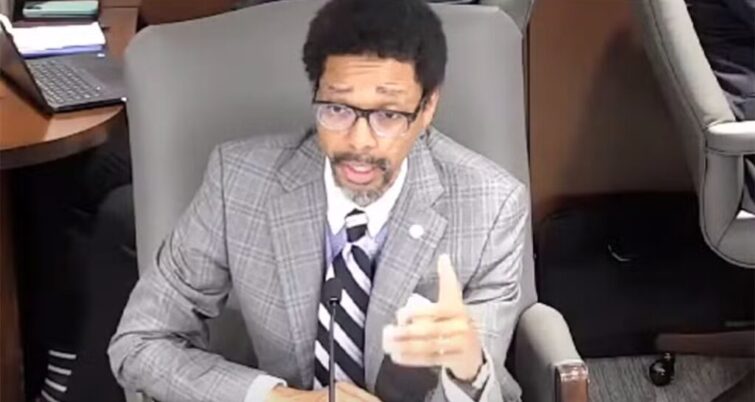
Robert E. Primus (screen grab from government hearing)
WASHINGTON, D.C. –– Surface Transportation Board (STB) member and Democrat Robert E. Primus, fired in August 2025 by POTUS 47, will not be returning to office following a June 29 Supreme Court ruling that Presidents have unfettered authority to terminate members of bipartisan independent (from the Executive Branch) federal agencies.
The decision—recognizing Unitary Executive Theory—upends a near century-old SCOTUS ruling protecting from POTUS termination independent agency officials who are Senate-confirmed for fixed terms—those agencies’ enabling statutes limiting terminations to inefficiency, neglect of duty or malfeasance. No reason was given for the Primus firing ahead of Primus’ fixed-term expiration of Dec. 31, 2027.
The now judicially supported firing leaves the five-member STB with but a single Democrat, Karen J. Hedlund, who is seeking Senate confirmation to a second term following renomination by POTUS 47. Whether he intends to nominate a second Democrat to fill the empty Primus seat is unknown. The other three STB members are Republicans—Chairperson Patrick J. Fuchs, Michelle A. Schultz and Richard J. Kloster.
Embraced by the Court in its June 29 decision is Unitary Executive Theory, which asserts the Constitution’s Article II provides for one Executive, the POTUS, who is assigned the same broad executive power over Senate-confirmed fixed-term members of independent regulatory agencies as the POTUS has over Executive Branch Cabinet and sub-Cabinet officers (such as the Secretary of Transportation and Federal Railroad Administrator) who serve at the POTUS’ pleasure.
Critics of Unitary Executive Theory assert that it invests with the POTUS free rein to intimidate or fire members of multi-member, bipartisan independent federal agencies not in lock-step with the Administration, and allows those agencies to be stocked with stooges in direct conflict with congressional intent in creating independent agencies.
Proponents of Unitary Executive Theory assert that such agencies are “a headless fourth branch” of government not provided for by the Constitution even though the Legislative Branch created them as expert guardians of legislative intent.
Upended by the June 29 SCOTUS ruling was a 1935 decision, Humphrey’s Executor, named for a by-then-deceased Federal Trade Commission (FTC) member and Republican William E. Humphrey. The SCOTUS ruled in 1935 that the firing—without cause—by Democratic President Franklin D. Roosevelt was unlawful.
Although Primus challenged his firing in federal court, the SCOTUS took up a separately filed case—Slaughter v. Trump—in which fired Federal Trade Commission (FTC) member and Democrat Rebecca Kelly Slaughter was fired by POTUS 47 without cause. Lower courts had sided with Slaughter.
The Slaughter-adverse decision similarly shuts the door on Primus whose lawsuit was pending in a lower federal court. Primus, who is Black, also has pending in federal court a lawsuit contending his firing was racially motivated.
In a dissent to the June 29 decision affecting Primus, Justice Sonia Sotomayor wrote that the ruling “promises to unleash only chaos [that it] distorts the structure of government to fit the majority’s theory of unitary, total executive control. The result is a President who emerges with far greater power than ever before. It is a power, however, that neither the People, nor Congress, nor the Constitution bestowed upon him.”
Chief Justice John G. Roberts Jr., voting with the majority, wrote that if anything remains of the 1935 Humphrey’s decision, “we overrule it.”
It is not clear how the June 29 SCOTUS decision affects National Mediation Board (NMB) member and Democrat Dierdre Hamilton, who was fired by POTUS 47 in October 2025 without a showing of cause. Although her first term expired in June 2025, the NMB enabling statute allows NMB members to remain in office until a successor is Senate confirmed. The NMB statute does not vest with the agency the same law enforcement executive functions authority granted the STB by Congress, which was at issue in Primus’ firing. Hamilton’s challenge to her firing remains pending in the federal courts. Still serving on the three-member NMB are Republican Loren Sweatt and Democrat Linda Puchalla.

Railway Age Capitol Hill Contributing Editor Frank N. Wilner examines STB political independence in his book, “Railroads & Economic Regulation,” available from Simmons-Boardman books, 800-228-9670, www.railwayeducationalbureau.com.
Media
RELATED ARTICLES