High-Accuracy, High-Speed Dynamic Railroading –– Commentary
Written by Alex Luna, Founder & CEO of AlphaRail


AlphaRail graphic
NASHVILLE –– There is only one correct path forward for a real rail growth future, and it is still not a Class I merger, or mergers of any kind.
Despite the opportunity to throw the switch and take the most meritorious track path I thought was obvious and had already laid out, the dogmatic commitment to the distortion of my growth North Star, now that the merger application has been filed for the second time, requires the correct answer, and the correct tactical name for rail growth, which is now championed by all railroads, to be provided and defined. There is only one correct path forward for a real rail growth future, and it is still not a Class I merger, or mergers of any kind.
For the historical record, the North Star of rail growth every railroad now champions did not originate inside railroads. Ironically, it was conceived following the conversations, reactions, buying behavior, and capital priorities I learned from my experience building and bringing frontier operations technology into the core of our two-century old industry’s oldest, hardest, and most change resistant domain: rail operations. In the years leading up to my national call for a growth focus, the experiences, initial reactions, and receptivity to our algorithmic platform built to make railroads better at delivering efficiently and on time made it clear that railroads actually did not want to try to grow, and had no interest in trying to add volume, trial technologies that could improve their operational execution, or allocate capital towards longer-term customer service experience upgrades that would hinder short term cost cutting efforts despite their long run benefit. PSR was not a sustainable, durable, fiscally responsible, or winnable strategy, yet in early 2024 Ancora wanted to force Norfolk Southern to do it again anyway. So, I intervened, forcefully, to recalibrate this industry’s directional priorities in a healthy, restorative, enduring, and winnable way to attempt to force railroads, through inevitable investor pressure, to start caring about and acting to fix their service problems so they could succeed and grow. I wanted to give this industry a better future to pursue to be able to move on from the PSR thinking destroying it. I did not expect at the time that strategy to work, much less my call for growth pursuit to be widely adopted, championed, and pursued by all railroads in the years to come. Our industry’s pursuit of growth is extremely positive.
When I started my career at Norfolk Southern, my job as a market manager was to make the railroad grow, and the experience of setting prices daily and negotiating large contracts with the rail customers who could enable that growth during the PSR era is what taught me why it couldn’t. Customers furious about service failures used that fury against me on price, and they were usually right: bad service is itself a barrier to growth, because bad service does not make rail customers want to pay you to move more of their freight. And even when they were willing to do so, operations often refused the business outright because it didn’t “fit” the capacity the PSR-designed operating plan allowed. Common sense would expect the obvious step for these opportunities to become new carload business to be quickly adding the capacity to handle it. But railroads did the opposite, chasing operating ratio for its own sake, which made growth a nuisance. That gap blinded them to the problem and its solution. So, in 2019 I started AlphaRail to build that solution: a rail operations platform capable of providing the computational capability to expand and contract operating capacity fast enough to say “yes” to new business and still move it efficiently.
To win a football game, a team must execute the right play calls: a quarterback sneak works when you are on the goal line a yard away from scoring, but makes no sense when on your own 1, even if the players execute perfectly. This core play calling problem caused the early symptoms that appeared as the rail industry news headlines that forced PSR to be eventually classified as a problem. “The plan is the plan and there is no backup”, a Class I chief operating officer at one point emphatically and confidently explained to his entire field operating workforce, an embodiment of the romanticized bravado and ethos surrounding Hunter Harrison’s PSR fervor, and intellectually blind to the most damaging operational sickness a railroad’s operations can have: delay propagation. PSR static scheduling was a strategy whose operational gains were initially real when the railroad as a team executed the plan’s play call better than it historically had but exposed itself as a losing operational strategy in the long run, especially on complex networks, when the play calls could not quickly change. Why?
Railroads have a physical fixed maximum operational capacity to their operations: train length, weight, speed, and operating safety rule constraints combined with hours-of-service rules create a real maximum volume capacity with repeating scheduling on a fixed track network. There is a fixed quantity of hours the entire crew base can legally work, a fixed number of locomotives the railroad owns to use for moving and creating trains, and within those hours a fixed total tonnage and length the trains can viably move. If the physical operating capacity only allows a railroad to deliver, for example, 1,000 railcars per day, and the network is continuously receiving 1,010 per day for delivery, the 10 cars per day that physically cannot be delivered begin to grow each day as backlog and congest the network and yards. Without adding trains and hiring more crews to operate more trains more frequently, the network physically cannot reduce this accumulating backlog without volume changing. The backlog, if for example we only operated for 2 days and had 20 railcars waiting to be delivered in the backlog, could only be cleared if on the third day we only received 980 railcars for delivery, allowing the 20 waiting to finally fit into the network’s physical operating capacity and move on trains for delivery. This simple example is the challenge for every single railroad regardless of size. It is the balance that must be struck, and the flaw in logic of relying on the metric that has become the most misinterpreted barometer for measuring, comparing, and judging a railroad’s success and operating performance: the Operating Ratio. Fundamentally, the cost of operating the number of trains we needed to deliver divided by the 1,000 railcars we were paid for delivering can be a low ratio, but it does not quantify or account for the delivery backlog. Accounting for and quantifying this backlog is a critical consideration for authentic judgement, for incomplete deliveries cannot yet accrue as revenue financially, and the quantity of railcars in the incomplete backlog is a core operational signal of the delivery performance and, when high, service deteriorating congestion that must also be considered. Notice the problem.
Real world rail demand is constantly changing, yet railroads can still have low operating ratios and still, like when the post-pandemic volume surge hit, caught unprepared and off guard operationally when traffic rises. PSR, with its operating ratio focus, created operational fragility which was not only blind to but ignored the maximum physical operating capacity problem: when volume declines, is intentionally demarketed, or lost, and operating capacity is shrunk to achieve a specific OR ratio, the network’s physical operating capacity ceiling is not a problem. But when volume returns and the fixed physical operating capacity of the network set for OR purposes becomes quickly maximized, like a car engine redlining at high rpms, a lateness backlog begins to build. When the operating plan at every layer cannot adapt and change fast enough to create the required capacity to process the backlog faster because it is designed to be repeated, and the railroad cannot quickly increase its T&E headcount to form more crews, like a car that cannot shift into the next higher gear, the backlog accumulates faster as the network over time congests, increasing dwell, and slowing the velocity of the resources of the operation, initiating a downward decline. Finally, when volumes begin to decline, letting the foot off the volume gas pedal so the engine can lower its RPMs before blowing, the network is physically able to begin processing and finally delivering its accumulated backlog: the network starts to “recover.” The quarterly OR target was achieved, but ignoring the backlog eventually blew the engine the next quarter and will blow again when volume grows if the railroad either continues its repeating operating plan or refuses to spend more to increase its operational capacity. Does this cycle sound familiar?
Yet if a railroad wants to grow, and add more railcar traffic to its network, it physically must find a way to add operational capacity to efficiently and profitably move more freight. This balance problem is the hardest and most important operational challenge in existence in a railroads business and outdoor operations. Mathematically complex, operationally complex, and the fundamental outcome promise that PSR claimed to be able to deliver yet was never truly achieved. It is an extremely hard problem.
The celebrity like “rail whisperer” ethos surrounding the late Mr. Harrison and his PSR protégés, caused by the short-term financial results created as traffic declined and prices went up, enabled a bravado and false confidence in their belief at the time that they did not need technology to help them design the plays of running their railroad because only they as tenured and experienced operating veterans, relying on instinct, knew how to do it best. They successfully pulled hard on the capacity lever they understood, train count and therefore crew headcount, and ignored the other, physical operating capacity, which the Operating Ratio is blind to. It did not matter because they were not trying to grow. The early financial results hid the inevitable and imminent operational backlog problem.
Calling the same play every time, because you cannot call an intelligent audible when the defense shows blitz, because you believe in the quarterback sneak you called as the right way to win, has been proven in football, and railroading, to not work. Why? Because railroads could not quickly expand and contract operational capacity to match demand every single day. But real growth requires more railcars moving on the network, meaning operational network capacity must also expand to grow. Thus, growth railroading’s most important operational challenge and priority: high speed capacity balance.
Union Pacific’s merger avoids this balance problem entirely, with fixed infrastructure expansion instead of improving the balance of intra or inter-carrier operational orchestration. Its solution is to literally upgrade an alternate route to route around the operating delay: the need to build the capacity to avoid Chicago. Building this expensive capacity requires significant capital-intensive upgrades, which they claim they don’t have the financial risk tolerance to make without acquiring NS: the capital risk of a commercial partnership agreement, despite both railroads being theoretically incentivized to stay committed to the partnership with the huge amount of new freight they will move, is too high to justify without eliminating the risk of Norfolk Southern terminating their operational agreement at some point in the future. Thus, per the merger’s logic, the acquisition is required to eliminate the risk of the required massive capital investment to eliminate the 24-48 hours of interchange dwell that prevents the interline service from attaining the speed required to compete with trucks and win the additive 2.1 million truckloads worth of rail freight they claim to be capable of securing. From UP and NS’s revised merger application: “These are the central interchange gateways between UP and NS, where freight today must change hands, where delays and costs accumulate, and where railroads lose freight to trucking because of those interchange delays and costs.”
But do rail customers choose to use trucking because it is faster than railroads, even though rail is cheaper and greener? The industry established at the 2024 STB hearing on “Growth in the Freight Rail Industry” that reliability, on-time performance, and a better shipping experience were what rail customers truly wanted, not speed. A quote from the transcript of testimony from Oliver Wyman’s Adriene Bailey, a reference also used for UP’s merger application, summarizing the three important factors Oliver Wyman identified based on their interviews with shippers causing shippers to shift more freight to trucks:
“The first is that railroads have failed to adapt as supply chain structures and shipper choice models have changed. Railroads must become more integrated with their customers to understand how they can best fulfill shippers more complex needs …The second factor is that rail service performance is simply not good enough. Shippers we surveyed expressed disappointment in rail’s poor on-time performance and lack of shipment visibility and ETAs. It’s important to note here that shippers are not expecting fast service nor even the same degree of reliability as trucking, but they do expect substantially more transit time consistency and a more responsive approach to problem resolution if they’re going to risk their freight to rail. Third, the railroads are not delivering an overall customer-centric experience. It is no secret that trucking is the gold standard for ease of doing business. Rail shippers we talk to are frustrated with slow response times, overly complex transaction processes and a general unwillingness by the railroads to be accountable for rail service-related failures.”
The bedrock of the belief argument of merging is that faster transit times are required by rail customers, which consist largely of industrial manufacturing operations or terminals which produce or operate on schedules of their own, to grow. But if this new 2.1 million truckloads is purely additive freight, and UP retains its current existing traffic base if the merger is approved, at least some of this existing freight traffic would theoretically still need to use Chicago as an interchange. If this interchange problem is the only reason rail customers choose trucks instead of the rails, the merger does not actually fix it.
Simply routing around the delay is not a scalable solution to nor a fix for the intra-carrier or inter-carrier coordination problems which cause delay, at any interchange or across the rail network in its entirety. If interchange delay between NS and UP prevents growth, is the implication not that interchange coordination between UP and CSX, BNSF, CN, CPKC and every single short line partner UP has is also a challenge stopping growth? Will UP have to buy every railroad it connects with to get all interchanges to be accelerated and improved to provide the faster service which it claims is operationally required for growth? Blaming the industry’s “structure”, building extensive new infrastructure, or buying each other does not actually fix the hardest, most challenging, and most important problem all railroads must fix to grow: operational balance. UP and NS do not become more reliable and transparent rail delivery service providers simply because they share ownership, and it should have been already clear from the national hearings on growth that speed is not primarily what rail customers want: they want a modern delivery service experience, even if it is a little slower. Railroads will not truly grow until they listen to their customers and first provide the service experience they continue to ask for: reliable, transparent, cost-effective, on-time performance. Reliability is a railroad’s most exploitable market advantage, not speed.
Even the regulator, who is not a rail customer, wants the same. The most important news story in rail in the past 46 years is the STB’s first permanent on-time-performance reporting mandate in the industry’s history for Class I railroads. They listened to my call for actual service quality transparency: You cannot improve what you are not measuring. This is extremely healthy and extremely good news for the future of the rail industry. For the first time, one of if not the most important metric rail customers care about will be quantified, tracked, and publicized. On July 8, when the first OETA and ISP reports are due, we will know how good railroads are at railroading. Railroads are now forced to care about their delivery performance, not their speed.
Luckily, balance delivers both. Modern delivery services enable and provide purchasable expedition: standard, premium, expedited, next day now speeds all purchasable based on the customer’s shipping or mailing preference. Railroads currently cannot provide such service choices to the entirety of their customer base. Not all rail customers share the same sensitivity to transit time, and some are, like intermodal customers, willing to pay a premium for faster rail service. A huge amount of the claimed 2.1 million truckloads targeted for winning are intermodal and do want faster transit. Some customers have a higher dwell tolerance than others. So how would we, using the existing track network, existing locomotive counts, existing crew base, and existing operational capacity, do so? How do we allocate priority, and capacity, at the same time? How do we achieve operational capacity balance?
Computational Railroading™: the real frontier of the future of railroading; the “meritorious track path” that I expected and intended railroads to begin to care about and take when I called for growth in 2024; the domain AlphaRail has been operating within for the past seven years and tried to aim the entire industry intentionally into this operational problem by quantifying a growth future; the method for achieving the operational balance that must be struck to enable efficient growth; the solving of the problem I defined in 2021 when I told this industry that innovation was the antidote.
Delay, and delay propagation, are scheduling, routing, assignment, and staffing problems. Scheduling problems require better schedules to be solved, which can be created at speed, to mitigate delay propagation. In practice for a railroad, this means defining and assigning railcars to blocks, blocks to trains, locomotives to trains, crews to trains, trains to routes, and routes to tracks, for yards to block, in an operationally feasible way that accounts for all regulatory, operational, safety, and behavioral constraints of the rail network, all while all continuously move and change. Each represents its own unique combinatorial optimization problem, but in real world rail operations their complexity compounds, for the solution to each impacts the feasibility and viability of the solutions to the others, making these already hard problems mathematically intractable. One locomotive breakdown, and the entire problem must be resolved. The failures of the PSR era proved what happens when not done properly, quickly, or accurately.
Computational Railroading™ is what can create growth, for not only one railroad, but for the system as one network: high-accuracy, high-speed dynamic railroading, provided by a non-rail owned, neutral operating platform for all railroads to coordinate within and use, and leverage state-of-the-art computational optimization tools that defines and solves the operational capacity balance, fast enough for use in the field, enabling actual carload, railroad and industry growth.
No railroad employee can list every possible operational solution to a rail network’s full delivery problem, and no railroad in this industry has any employee, or groups of employees, capable of outperforming a proper full-stack optimization engine in defining the correct operational plan solution to any demand and operating scenario better than the modern computational tools that exist in our world today, nor at a speed required to be useful. Striking real high speed capacity balance is out of reach without algorithmic tools: even defining one railcar’s journey across a railroad, where dozens of trains and crews could move it, through dozens of routes and yards, has hundreds of thousands of options. When deciding how to move them all, the possible schedule options outnumber the atoms in the universe, far beyond what any human can conceive, enumerate and define.
Utilizing modern algorithmic strategies and software tools to solve the multi-layered interconnected combinatorial optimization problems within the rail operating plan problem stack, with accuracy and speed, is the future of this industry, and the only actual technological capability that can remedy the operational symptoms, resolve operational execution friction, enable dwell reduction and more throughput capacity, to help not just one railroad, but railroads at scale as an industry, grow. Frontier computing like quantum computing, which continues to develop despite not currently capable of outperforming classical compute speeds for rail operational reliance and relevance, promises unique utility for our industry’s hardest problem if real advantage is ever achieved. Yet even as computing technology like quantum continues to mature, classical chip advances, like improvements in processing speeds, and research advancements in algorithmic techniques to derive higher quality solutions with more accuracy, make the realization of the future of Computational Railroading™ possible. And as computational power continues to increase, that future will change from possible to imminent, even at Class 1 scales. We built the AlphaRail platform to ensure that railroads have the necessary capability to realize this railroading future.
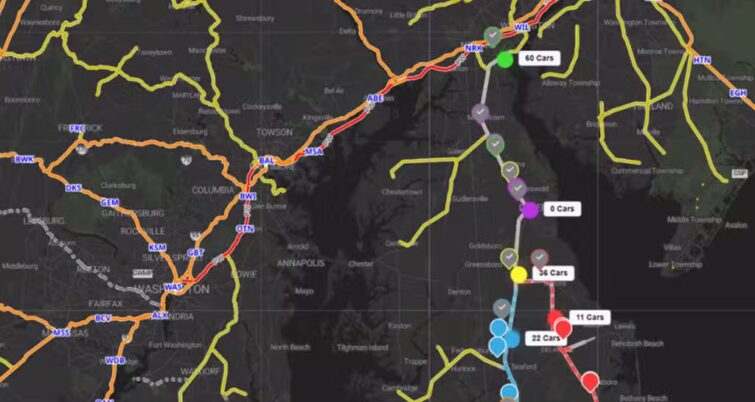
The AlphaRail platform once deployed makes it possible by using a state-of-the-art optimization engine that connects all the layers of operational planning, integrating all operational rules and constraints, and generating extremely accurate delivery execution instructions for every train, crew, and railcar on the network. It can generate comprehensive, accurate, and feasible daily rail delivery operation execution plans in minutes, and months of plans in hours, expanding and contracting operational capacity on a daily basis to match demand, while also enabling railroads to assign priority to not only individual railcars, but also any facility on the rail network that is willing to pay to have their traffic prioritized. Full depth analytics tracking yard dwell, inventory, on-time performance, train size, delivery completion, delivery backlog, operating revenue, operational cost, and operational performance provide a comprehensive metric view of how the network will perform with performance optimized asset allocation across the network’s territory, balancing crews and power to maximize delivery performance while reducing delivery backlog. All ready for operational execution and tracking in our detailed map view for full visibility into every railcar, train, customer, and yard’s operating state down to the track level. All changeable and resolvable to match the railroad’s asset base, resource rebalancing, or shipping behavior,while continuously learning and improving the optimization engine’s ability to accurately orchestrate the operation over time with targeted AI to maximize the accuracy and efficiency of the network in any demand scenario, continuously, every day, all the time.
Some rail operations employees do not like the idea of having their domains of responsibility tracked, some do not think they need to be tracked, even with chicken alfredo tracking widely available in the world, and some do not want their intuitive rail operational management and leadership acumen, in some cases built over decades, to be proven obsolete by algorithmic technology, despite the fact that it already is. This is the “disruption” we targeted: the blindness within the rail operating ideology that believes it does not have to provide customers with the best service experience possible to win customer business, actually compete like modern delivery services, and grow, because they don’t need to, and don’t have to use digital tools which are now the standard in the world. Some don’t think they need to “yet”, despite already being a decade behind this standard. That belief is indefensible for delivery service businesses, regardless of size, which are currently experientially obsolete yet claim they want to grow.
Every modern digitally enabled delivery service now does this continuously, daily, for chicken alfredo meals to orders for flowers. The delivery tracking, delivery execution, and delivery disruption management have been proven both possible and necessary in modern delivery industries with fierce competition, time sensitivity, and on-time performance. They must deliver on time, for the food will get cold. And no human or employee or operations leader is involved in those decisions for how to get your lunch to you when you are hungry. This capability, tracking and ordering lunch meals digitally on your phone, has been available and functional, for a decade. Now railroads have a more advanced, rail-focused, customer centric version, to strike the balance they have to strike, to add more traffic, outperform trucks, and accelerate real carload focused rail growth.
FedEx, a railroad customer, is now deploying autonomous trucks into their operations. Driverless vehicles from Waymo are operating on American roadways. Amazon now has aerial drones making grocery deliveries across the United States and the world. Walmart’s drone delivery service is now expanding. None have heavily staffed operating “command centers” where employees intervene in the routing and scheduling delivery execution directions telling the drone, autonomous truck, or autonomous vehicle, which route to take, when to leave, how to drive, or when to deliver: this is an automated process now in the delivery service world. Yet railroads, the first and most important delivery service backbone of the entire American industrial economy, think they should merge to grow, blaming the industry’s “structure”, instead of competing like modern delivery service businesses available in the world today. The industry structure is not the problem: the obsolete delivery service experience that railroads themselves provide is. Despite a recurring belief among many rail executives, operations leaders, and employees, that now is not “the right time”, the world outside this industry will not stop changing fast, and does not care if railroads can keep up, or if rail operations leaders continue to fight the real technological progress in transparency and operational execution required for railroads to be considered competitive and modern as delivery services. For growth to occur, rail operations leaders must listen to the marketing teams that experience these customer interactions daily, and rail operations must prioritize serving the customers, communities, and industries railroads are responsible for serving. With the AlphaRail platform, they now can in a completely new, modern way.
I did not wait for rail operating veteran or leadership permission, approval, acceptance or praise to make sure the rail industry stayed on the modern competitive edge and in the game. Rail growth came from us at AlphaRail. Computational Railroading™ is the meritorious track path for this industry’s growth future, even if the merger is approved. The AlphaRail platform does the math that calls the right play, striking the right balance railroads must strike to empower the most important players on the field for a railroad’s operating team, its crews, to do what they do best, and deliver well. Any railroad is welcome to reach out and give it a try.

Alex Luna is the Founder and CEO of AlphaRail, a 2020 Creative Destruction Lab Quantum Computing Stream graduate and the only rail-focused founding member of the Quantum Economic Development Consortium (QED-C). Alex started his rail career as an intern on Norfolk Southern’s Ag Marketing team. After modeling and renewing $1.6 billion in rail customer contracts as the Market Manager for Norfolk Southern’s sweeteners commodity franchise, the railroad’s most profitable agriculture franchise, Alex left to start AlphaRail to bring high-performance algorithmic and computing technology into the rail industry to improve the quality of rail service that rail customers experience.
Alex holds a BS in Supply Chain Management and Business Analytics from The University of Tennessee, Knoxville, an MBA from Vanderbilt University, and Venture Capital Executive Education from The University of California Berkeley. He also served on the Use Case Technology Advisory Committee for the US QED-C for 5.5 years.
Media
RELATED ARTICLES