Transportation Secretary Sean Duffy Questions Maryland Governor Wes Moore on Francis Scott Key Bridge Rebuild Costs And Other Issues
Written by David C. Lester, Editor-in-Chief


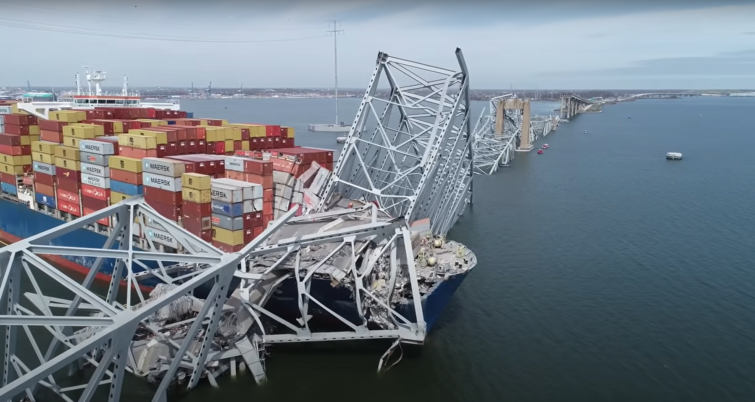
Francis Scott Key Bridge after being struck by a container ship. Photo courtesy of NTSB.
WASHINGTON, D.C. –– Readers will remember the collapse of the Francis Scott Key (FSK) Bridge last year after it was struck by an ocean vessel. The debris from the bridge collapse blocked container ships from accessing the Port of Baltimore's busiest terminals.
Now, the site is being prepared for a new bridge, which has recently been discussed by Transportation Secretary Sean Duffy and Maryland Governor Wes Moore.
The Secretary and the Governor met in March of this year to discuss the rebuild of the bridge, and last week, the Secretary wrote a follow-up letter to the Governor. Secretary Duffy wrote:
“The U.S. Department of Transportation (DOT) remains committed to continuing collaborative
work with the Maryland Department of Transportation (MDOT) to ensure all concerns related to
the replacement of the FSK Bridge are fully addressed.”
Sec. Duffy adds that “Since this project will be fully funded by the Emergency Relief Program, DOT will provide oversight to ensure the funds are used appropriately.”
Duffy continues –– “It is with this oversight role in mind that I would like to continue our discussion on how DOT can support MDOT in its delivery of critical infrastructure on time, on budget, and in compliancewith the law. I am particularly interested in how the State of Maryland plans to achieve key
delivery metrics for the FSK Bridge replacement project, including MDOT’s estimates of a $1.8
billion project cost and the 2028 expected completion date.”
The midpoint of the letter reads as follows: One additional area of specific concern relates to whether Maryland intends to award contracts for the FSK Bridge project in a manner that relies on the race or sex of contractors. Any reliance on race- or sex-conscious factors in contracting decisions could introduce significant legal vulnerabilities and inefficiencies in the management of the project. As outlined in my “Follow the Law” letter of April 25, 2025, addressed to all recipients of DOT funding, the Equal
Protection principles of the U.S. Constitution prohibit State and Federal governmental entities
from discriminating on the basis of protected characteristics, including race and sex.
Discrimination based on race is, has been, and will continue to be unlawful, except in rare
circumstances. See Students.for Fair Admissions, Inc. v. Harvard (SFFA), 600 U.S. 181, 220-21
(2023); see also Mid-America Milling Co. v. United States Department of Transportation, Case
No. 3:23-cv-00072. Similarly, sex-based classifications violate the Equal Protection Clause
absent “exceedingly persuasive” justification. Sec United States v. Virginia, 518 U.S. 515, 533
( 1996). These constitutional principles arc reinforced by Titles VI and VIl of the Civil Rights
Act of 1964, (42 U.S.C. §§ 2000d,et seq., & 2000e-2) and by the non-discrimination provisions
ofthe Federal Aid Highway Act of 1973 (23 U.S.C. §§ 140,324, et seq.), and Title IX of the
Education Amendments of 1972, as amended (20 U.S.C. § 1681, et seq.).”
You can download and read the Secretary’s entire letter here:
Maryland Governor Wes Moore responded to Secretary Duffy’s letter with a prepared statement:
“On the early morning of March 26, 2024, the Francis Scott Key Bridge crumbled into the Patapsco River after an unseaworthy ship—the size of three football fields—crashed into it. The tragedy resulted in the death of six Marylanders and threatened not only to cripple our state’s economy, but deeply impact the lives and livelihoods of the millions of Americans across the country whose prosperity depends on a fully functional bridge.
“We moved with speed and efficiency to secure expedited permitting to begin the rebuild immediately, clearing the channel to the Port of Baltimore in 11 weeks when some experts said it would take 11 months. Since then, we have worked expeditiously to promote full restoration of the bridge as a critical asset to our nation’s economy. Today, the project continues in the design phase, with demolition and pre-construction underway in parallel.
“We must keep in perspective that 13% of our state’s economy hangs in the balance and that the goods that flow through the Port don’t just touch Marylanders—they reach the farmer in Kentucky, the auto worker in Michigan, and the restaurant owner in Tennessee. The Port of Baltimore handles more cars and more farm equipment than any other port in the country. The Port is also ranked second for salt and exported coal and is among the top ten ports nationally for total cargo.
“We will continue to work with the Trump Administration to find ways to reduce costs and rebuild faster. We anticipate the price estimation process to be finalized in the coming months and we will provide regular updates from the Maryland Department of Transportation about the project’s status. In the meantime, we will continue to pursue litigation and make substantial financial contributions by way of advance construction costs and insurance settlement dollars to keep the project moving.
“The safety of the bridge and the sound stewardship of taxpayer dollars remain our top priority as we work to fully restore economic vitality—not only to the Port of Baltimore and the State of Maryland, but for the people across the country.”