NS progresses on environmental efforts
Norfolk Southern Corp. issued its fifth annual corporate sustainability report, documenting progress on the railroad’s efforts to reduce its business impacts on the environment.
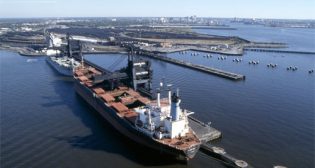
Arc Terminals LP and Canadian National are working together to build a rail tank car unloading terminal in Mobile, Ala., to handle Western Canadian heavy and Bakken light crude oils destined to Gulf Coast refineries.
The CN-served facility, which will have a maximum crude-oil handling capacity of 75,000 barrels or up to 120 tank cars per day, is scheduled to start operation by June 2013. Initial volume is expected to be 40 tank cars of crude oil daily, increasing according to demand.
John Blanchard, president of Arc Terminals, said, “The Mobile facility, the first rail tank car crude-oil unloading terminal in Alabama, will provide good access to Gulf Coast refineries and allow quick turnaround of tank cars, increasing product delivery and fleet velocity and reducing costs for car owners.
“The rail transload terminal will handle heavy crude oil from Western Canada and light crude oil from the Bakken basin via CN, which will provide Canadian producers single-haul service to our Mobile destination. A single-line haul is more efficient and less expensive than those involving two or more rail carriers and multiple terminal switching.”
The Mobile terminal will also load condensate into tank cars for backhaul by CN to Western Canadian oil producers.
In addition, it will be able to accommodate both general purpose and insulated and coiled cars, compared with other facilities capable of handling only general-purpose tank cars.
Jean-Jacques Ruest, CN executive vice president and chief marketing officer, said, “We are pleased to be an important supply chain partner for Arc Terminals. CN is focused on making its crude-oil customers more competitive and giving them access to markets with good net-backs. Crude oil by rail is one of CN’s fastest growing businesses. We expect to move in excess of 30,000 carloads in 2012 and we believe we have the scope to double this business next year.”
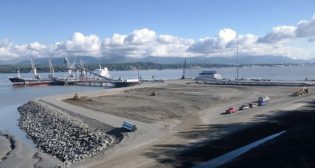
The Blakeley terminal has a storage capacity of 700,000 barrels for crude, fuel oil and asphalt. Terminal capacity could be expanded to more than one million barrels to meet potential future demand.
Chicago Mayor Rahm Emanuel and Chicago Transit Authority President Forrest Claypool say a tentative agreement with multiple CTA trade unions has been made and will provide the agency more flexibility for CTA construction and maintenance work and realize more than $6.5 million in cost savings.
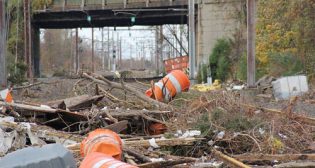
Nearly a week after Hurricane Sandy slapped the Northeast, transportation providers are still scrambling to repair infrastructure and restore service.
Southeastern Pennsylvania Transportation Authority crews worked around the clock to fix damage caused by Hurricane Sandy, which moved through the Philadelphia, Pa., area on Monday, Oct. 29 and Tuesday, Oct. 30.
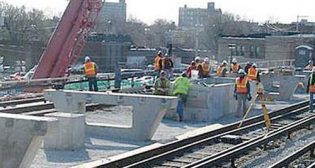
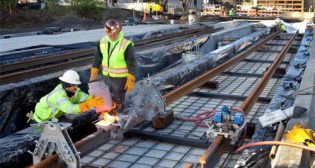
Construction of a $336-million, concrete-walled railroad trench reaching 30 feet deep, 65 feet wide and 1.4 miles long through the city of San Gabriel, Calif., began on Nov. 1.
New York and New Jersey rail transit remains in a state of emergency while crews work at a non-stop pace to repair damage and restore service.
Repairs continue to be made on Amtrak’s system in order to resume service to and from New York City from points south and north on the Northeast Corridor.
The recovery effort from Hurricane Sandy will be a monumental affair that will last weeks, if not months.
The Columbus and Greenville Railway (CAGY), was recently named Shortline of the Year at BNSF ‘s annual Shortline Conference held last month in Irving, Texas.
San Francisco Bay Area Rapid Transit’s (BART) all-time ridership record was broken Oct. 31, with 568,061 exits reported.
BNSF named Steve Bobb executive vice president and chief marketing officer, with responsibility for BNSF’s sales, marketing, customer service, economic development and business unit activities. He succeeds John Lanigan, who has decided to retire effective Jan. 15, 2013.
Stella-Jones Inc. has signed a non-binding letter of intent to acquire the shares of McFarland Cascade Holdings, Inc., a provider of treated wood products based in the state of Washington.
Due to New York City power outages, Railway Age and RT&S email addresses are temporarily unavailable.
During this emergency, please use the following address: [email protected]
Please include “Editorial” or “Sales” in the subject line, as well as if your email pertains to Railway Age or RT&S.
This is a temporary address and only to be used during this emergency. It will not be checked except in this situation.
Please note that Chicago office phone numbers are still in operation.
New York area commuters now have free access to limited service on Metropolitan Transportation Authority’s Long Island Rail Road, Metro-North and New York City Transit lines.
New Jersey Transit resumed operation along its River Line light-rail route at 3 p.m., Oct. 31, with trips occurring every 30 minutes between the Walter Rand Transportation Center in Camden and Trenton Transit Center.
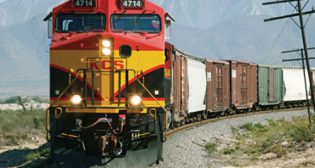
Northeast freight operations are slowly returning to normal along routes left in Hurricane Sandy’s path of destruction.
Union Pacific plans to enhance Illinois’ transportation infrastructure by investing $5.4 million in the rail line that runs between North Lake and Northbrook.
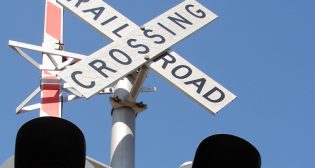
The Public Utilities Commission of Ohio (PUCO) approved construction authorization from the Ohio Rail Development Commission directing Norfolk Southern to install mast-mounted flashing lights and roadway gates in Summit County.
The California High-Speed Rail Authority (CHSRA) hired Frank Vacca, chief engineer of Amtrak, as its chief program manager. Vacca has more than 35 years of experience in commuter, intercity and high-speed passenger rail systems.