Remembering Don Phillips
Written by David C. Lester, Editor-in-Chief


From the Dome
ATLANTA –– From the October 2025 Issue of Railway Track and Structures.
An interesting and fun aspect of moving into a new career later in life after many years of following and admiring it from afar is to meet and work with people who you’ve followed and read for decades. Such was the case when, after 35 years of following railroading while in an information technology career, I entered the industry “professionally” as a railroad journalist in 2012. One of the individuals I had followed and made a point of reading his columns and articles was Don Phillips. For many years, as most people know, he was a columnist for Trains magazine under the name “Potomac Pundit,” later moving to simply “Don Phillips.” Those who are familiar with Don’s work know that he was a transportation reporter with the Washington Post for nearly twenty years and spent time afterward at the International Herald Tribune. Don began his career at UPI in the Atlanta bureau, later moving to the Washington, D.C. bureau.
The first of Don’s work that I came across was his piece in the October 1974 Trains, entitled “The Railroad That Stayed Out of Amtrak,” which profiled Southern Railway’s flagship passenger train, the Southern Crescent, which passed twice a day near my home in Atlanta. As a young rail enthusiast still learning about the many fascinating aspects of the industry, I could not have asked for a more relevant or interesting article. Moreover, the man who wrote it was an expert in the subject and a wonderful writer. For example, after lamenting the upcoming discontinuance of a couple of other SR passenger trains that were good but he referred to as “marginal,” he wrote the following.
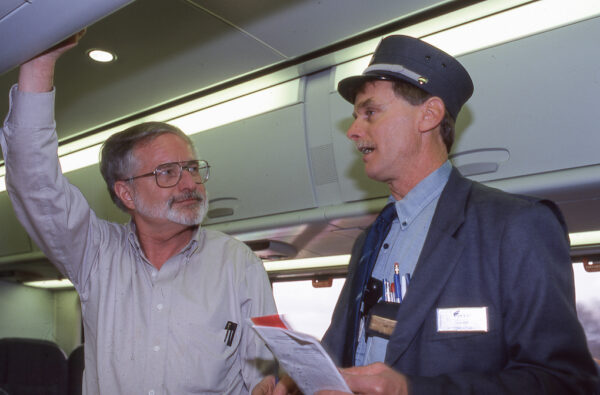
Don Phillips, left, chats with an Amtrak Acela Express conductor on the train’s first public run in December 2000. Brian Solomon, courtesy of Trains magazine.
“That’s the bad news. The good news is that every evening after 7:20 p.m. (depending on when a chronically late Amtrak connection arrives from New York), a stainless-steel streamliner pulled by three or four green-and-white E8s glides into another tunnel and emerges to roll past the U.S. Capitol, the Transportation Department Building, Amtrak headquarters, the Washington Monument, and the Jefferson Memorial before the engineer notches out to accelerate across the Potomac River. Ahead is an overnight ride to Atlanta, a morning of twisting and turning over the grades of the Alabama Division to Birmingham, and (three days a week) a fast flat ride to New Orleans with a through sleeper to Los Angeles if you wish.”
Don continued the discussion with “Inside is a full dining car with tablecloths and fresh flowers; sleeping cars with private rooms, including a master room with shower; and reclining-seat coaches that still look like coaches (none of these psychedelic colors or wall carpeting). None of the cars –– except perhaps some of the Amtrak run-through cars –– is more than three years from its last major overhaul.”
In addition to forthrightly and admiringly describing a fine passenger train, Don’s writing could also be entertaining. For example, in his November 1981 Trains column, Don wrote: “This is my second month in a row to eat crow. Last month, I had to admit understanding Amtrak’s survival chances. This month, in one case, I was wrong about something and I want to admit my mistake. In another case, I feel as I have eaten crow literally ––on Amtrak dining cars––and I want to complain.” After an astute discussion of the politics around the creation of and future for Conrail, Don got to his complaint. “Now about that other crow I had to eat. On the menu it was called steak, or fish, or chicken, but it was difficult to tell from the taste. Amtrak’s effort to cut dining-car losses by going to the fast-food concept is a disaster. I’m sure Amtrak will be able to improve the food over time, but that will be something like inventing a better Big Mac. Fast food is still fast food. And I simply can’t believe the use of plastic forks and trays was even considered. The last time I had plastic forks on a transportation conveyance was on Air Ghana in 1977.” [My how times have changed! DCL]
In his June 1997 column, his writing style combined with his informed perspective as he commented on the division of Conrail between CSX and Norfolk Southern. “Never in railroad history has a merger involved breaking up a huge railroad like Conrail. This will truly be the unscrambling of an egg . . . The division of Conrail involves the undoing of the 1968 Penn Central merger, an abdominal combination of the Pennsylvania Railroad and the New York Central that should have never happened.”
I finally had the opportunity to meet Don at a meeting of the Lexington Group for Transportation History many years ago. While we were acquainted, we were not close. Nevertheless, the opportunity to spend time talking with Don and getting some inside perspectives that would not see print was tremendous, and we communicated from time to time over the years. Don seemed like the kind of person who never met a stranger and was a genuine person. Don’s passing has been a tremendous loss to the rail and transportation journalism communities and, as I said in a note accompanying the obituary for Don in our news website, Don was one of the best, if not the best, transportation journalist(s) of our time. He will be missed.