RTD Breaks Down its Track Maintenance
Written by Jennifer McLawhorn, Managing Editor


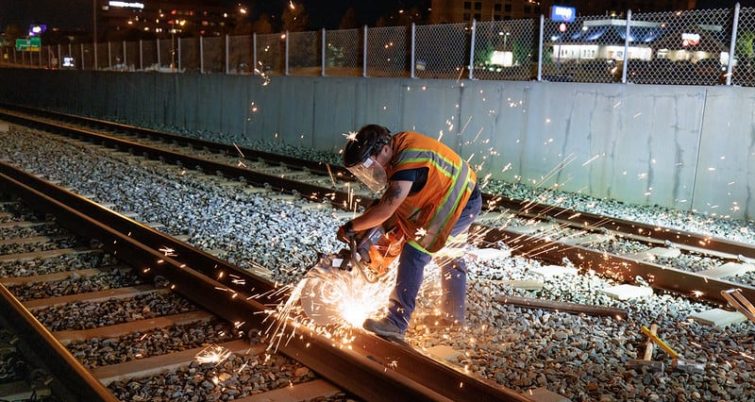
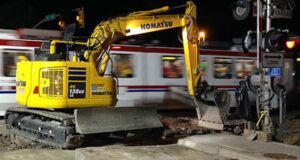
RTD crews work overnight.
Courtesy of RTD
DENVER - RTD crews are working overnight to make repairs along its Southeast Corridor.
After the project started on June 4th, RTD says that earlier this month, its crews had already replaced over 2,500 feet of rail in the area after inspections had identified rail defects in need of repair. RTD Light Rail Maintenance of Way Manager Dennis Hanson said, “That’s significant in that RTD rail workers typically replace 40-80 feet at a time.” MoW crews can replace 300-400 feet of 40-80-foot pieces of rail in a single area.
The project will reportedly continue to other sections of rail in the Corridor and in other areas. The MoW teams are working overnight on the D, E, H, and R lines. Because of the size of the project, RTD says normally, this type of work would be outsourced to a third-party contract, but its team had jumped in to perform these inspections and repairs instead. General Superintendent of Infrastructure Brian Farris explained that “It was quicker to procure everything ourselves.” Farris went on to add that they “had enough rail in stock that we didn’t need to purchase more rail when we started the project.” Since that time, RTD says it has added 10,000 feet of rail to its inventory.
Light Rail MoW Manager Hanson added, “They’ve really risen to the occasion. They’ve been able to leverage their knowledge, skills, and abilities. What’s impressed me is how they’re able to problem solve and come to a collective agreement on how to mitigate hazards and do the work safely. Everyone is getting the work done and they’re getting home safe, and that’s the most important thing.”
For its crews, there was “a track team, signal traction/power maintainers, track maintainers, track maintainer equipment operators, rail laborers, and MoW supervisors” with roughly 75 people. For those working overnight, that totaled around 22 people. MoW Supervisor Raymond Ferreris said, “there’s a lot we do in the background to set up one nights’ worth of work. . . We unload all the trucks of rail that come in and we need to be strategic – it’s a skill to unload rail. . . We do small areas of rail replacement normally – this is the most we’ve ever done.” This included moving 80-foot rails. Light Rail MoW Manager Hanson said its crews have to power down five or six substations before safely transporting rail to the needed sites. Crews power down these substations because “boom trucks and things” may touch the overhead catenary wire. Hanson said, “We have to lock-out, tag-out, and ground it.”
The process for getting equipment to the site involves setting rail on carts to travel on hi-rail vehicles. These crews need to be sure “it doesn’t make contact with any other infrastructure in the guideway,” said Hanson. He explained that “there are a lot of safety protocols involved that we follow to protect our workers, and they take time. It’s a very long process to get the materials out to where they’re needed.” Indeed, Maintenance Supervisor Evan Martinez added that the rail installation “is not the hard part. . . .It’s the logistics of getting what we need to the spot where we can install it. If we could magically drop it where we need, we would be done.”
When the workday is done, crews have to remove that heavy equipment and transport them to the subsequent holding areas before starting the same process again the next day. RTD reports its team is proud of the work they’ve done. Track maintainer Andrew Conley said, “It’s a satisfying job at night because we can do a lot of the heavy work, replacing rail, welding and operating equipment. It’s more gratifying being able to do the kind of work we do.”
As of reporting, the work is 85% complete, and its MoW crews are continuing to make repairs on the system before the winter season comes. With cooler temperatures comes contracting rail, and the cooler seasons are “less conducive for installing new rail.” With this seasonal timeline in place, Hanson said the team does “rail work year-round but not at this type of scale. . . [we’re] racing against the clock with this weather.”
When the cooler weather does settle in, its crews will perform rail grinding as a way to perform said maintenance. Hanson says its crews use a handheld machine for profile grinding, but with the summer work, they’re “looking to dramatically increase our grinding efforts.” Planning and preparation appear to be the best strategy in addressing rail defects and preventing future issues. Martinez said, “All of us have stepped up. This team is really crushing it. . . I’m a track person by trade. I’ve done this forever, and these guys make me better. It’s a team effort.”