National Transportation Safety Board Issues Preliminary Report on Union Pacific Railroad Derailment and Hazardous Materials Release
Written by David C. Lester, Editor-in-Chief


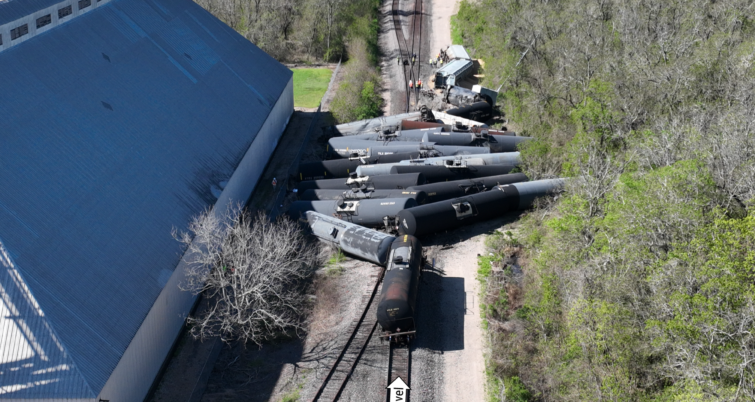
Site of derailment (Courtesy of Union Pacific via NTSB Report)
WASHINGTON, D.C. –– The National Transportation Board this week released a preliminary report on the March 2026 derailment of a Union Pacific train that included the release of hazardous materials.
What Happened
Westbound Union Pacific (UP) train MEWEG-18 derailed on March 18, 2026 at about 4:50 a.m. local time on the Glidden Subdivision near Richmond, Texas. (See map below, green circle.) Richmond is on UP’s Glidden Subdivision. Two empty railcars, 4 loaded railcars carrying non-hazardous materials, and 18 tank cars carrying hazardous materials were derailed in the accident. Ten of the 24 derailed cars released materials, including seven breached (punctured or torn) tank cars that collectively released about 120,000 gallons of ethanol, a hazardous material.[1] The released materials were contained on site and did not impact waterways or the public.[2] Union Pacific estimated damages to be about $3.6 million.[3] No injuries were reported. Visibility conditions at the time of the derailment were clear; the weather was 45°F with no precipitation.
“The train was westbound from Houston, Texas, to Eagle Pass, Texas, and consisted of 4 locomotives (3 head end and 1 mid-train distributed power unit), 97 loaded railcars, and 50 empty railcars, weighing about 14,470 tons and measuring about 10,295 feet long. The train crew was comprised of an engineer, a conductor, and a conductor pilot.[4] UP dispatch in Spring, Texas, coordinated the train movements. The train was equipped with a positive train control system and an energy management system, which were engaged at the time of the accident.[5] Shortly before the derailment, the train was traveling about 35 mph on main track 1 when it experienced an undesired emergency braking application, meaning the crew did not initiate the emergency brake application.[6]”
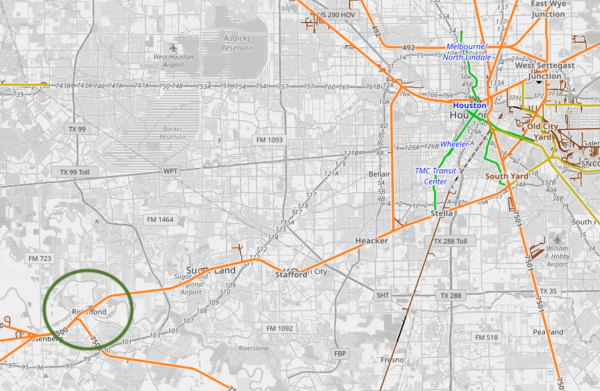
Approximate accident location within green circle (courtesy openrailwaymap.org)
“All aspects of the derailment remain under investigation while the National Transportation Safety Board determines the probable cause with the intent to issue safety recommendations to prevent similar events.
“Parties to the investigation include:
- the Federal Railroad Administration;
- the Pipeline and Hazardous Materials Safety Administration;
- the Texas Department of Transportation;
- UP;
- the Brotherhood of Locomotive Engineers and Trainmen;
- the Brotherhood of Maintenance of Way Employes; and
- the International Association of Sheet Metal, Air, Rail and Transportation Workers.[7]”
Notes
“[1] (a) Railcars 3 through 26, located behind the lead locomotives, derailed. (b) The derailed nonhazardous-materials railcars included 1 railcar carrying syrup, which breached and released materials, and 3 railcars carrying malt, 2 of which breached and released materials. The derailed hazardous materials railcars included 2 tank cars carrying liquified petroleum gas, which did not breach or release materials, and 16 tank cars carrying ethanol, 7 of which breached and released materials. (c) As of this report, authorities have recovered (physically collected and removed from the environment) about 95,000 gallons of ethanol; the remaining ethanol is expected to be recovered or dissipated into the atmosphere. (d) The breached tank cars included two DOT-117J tank cars and five DOT-117R tank cars. (e) The train also included tank cars carrying phosphoric acid and hexane, both hazardous materials; these tank cars did not derail, breach, or release hazardous materials.
[2] UP provided this assessment.
[3] UP did not have a complete damage estimate at the time of this report.
[4] A conductor pilot guides another conductor over a section of track that the conductor may not be familiar with or qualified on.
[5] (a) According to the Federal Railroad Administration, positive train control is a family of systems designed to prevent train-to-train collisions, over-speed derailments, incursions into established work zone limits, and the movement of a train through a switch left in the wrong position (Title 49 Code of Federal Regulations 236.1005).(b) According to UP, an energy management system is a software-driven, onboard technology that acts as intelligent cruise control to optimize train handling, fuel consumption, and greenhouse gas emissions. It analyzes terrain, train weight, and speed to determine the most efficient throttle and braking strategies.
[6] (a) The maximum authorized speed in the area of the derailment was 60 mph. (b) An emergency braking application uses the maximum braking force available and is designed to stop a train as quickly as possible.
[7] The Brotherhood of Maintenance of Way Employes spells “employees” with one ‘e.'”
Media
RELATED ARTICLES