Cleaning up rail grinding
Written by Mark Simmons, International Railway Journal


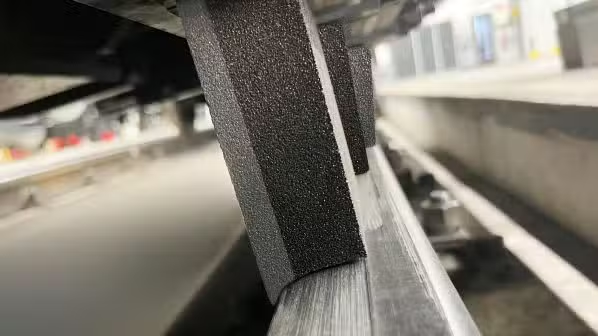
The solution RailTechnology developed for rail grinding in urban environments was simple, but effective.
Photo Credit: RailTechnology
STADTHAGEN, Lower Saxony, Germany –– Traditional rail grinding can be messy and require large volumes of water. Maurice Verheijen, CEO of RailTechnology, explains to Mark Simmons how his company developed a new type of grinding machine that is particularly suited to track maintenance in confined spaces such as tunnels.
TRADITIONAL rail grinding uses rotating grinding wheels to reprofile rail, improving ride quality, removing corrugations and reinstating transverse profiles in order to extend the life of the rail. This method works well but requires multiple passes, while the sparks produced by the grinding process can be problematic in confined spaces such as tunnels, where they can ignite built-up dust and cause fires.
When Maurice Verheijen, CEO of German rail vehicle manufacturer RailTechnology, decided to develop a new mobile rail treatment technology for use in urban rail environments that would help reduce noise and vibration, he was clear what he wanted to achieve: spark-free operation resulting in a smooth finish with full rail coverage in a single pass.
“We wanted to be able to efficiently remove rail corrugations and roughness without producing any sparks and at the same time leave a surface finish which is smoother than a finish typically achieved by other rail treatment technologies,” Verheijen says. The solution he came up with was simple, but effective.
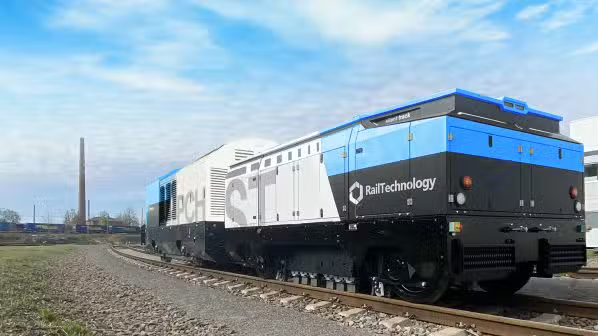
The Silent Track (ST) grinding unit coupled to a power car also developed by RailTechnology. Photo: RailTechnology
In order to achieve high metal removal without producing any sparks and dust, significant amounts of water are normally required. But by dripping water through a centrally-drilled hole in individually oscillating grinding stones he was able to substantially reduce the amount of water required, remove significantly more metal than conventional machines, and achieve a cleaner finish on the rail surface while ensuring spark-free operation.
“Unlike conventional machines which employ diesel engines and hydraulic systems, our machine uses only electric power and compressed air.” Maurice Verheijen, CEO of RailTechnology
“Getting the right abrasive blocks, and in particular getting the correct hardness, was a lengthy process,” Verheijen says. Construction of a prototype vehicle, building the necessary equipment onto a flat wagon, started in 2022 and took around a year to complete, followed by extensive testing. The vehicle was designed to hold up to two grinding modules on each side, with each holding three abrasive stones, allowing for up to six stones on each side.
The 150mm-long stones oscillate longitudinally in the direction of the rail at different angles rather than in a single plane, targeting different areas on the rail head and producing a very smooth finish on the rail surface. They are also able to deal more effectively with dipped welds than conventional grinding machines.
The test vehicle was paired with RailTechnology’s RGE1 self-propelled bi-mode treatment train. This is fitted with the company’s patented track and tunnel cleaning technology enabling the train to be used for both rail treatment as well as track cleaning activities using the onboard high performance dry vacuum system.
“Unlike conventional machines which employ diesel engines and hydraulic systems, our machine uses only electric power and compressed air, so is safer, cleaner and more cost-effective to maintain,” Verheijen says.
After two years of testing, including with London Underground and on the Copenhagen metro, the first production machine was outshopped at the end of last year. Verheijen is very pleased with the result, which has been branded and patented as Silent Track (ST) technology.
How Silent Track Rail Grinding Works
UNLIKE conventional machines which typically use grinding wheels, the angle of each grinding stone on the ST vehicle can be adjusted, allowing metal to be removed from any area of the rail. “Positioning the stones at different angles prevents the rail from being flattened during the grinding process and also allows for minor rail profile changes,” Verheijen says. Grinding machines can operate in multiple if required to ensure all grinding is completed in a single pass.
The swarf suction system ensures that no debris is left behind on the track. The orientation of the grinding stones also means that there is no need to remove trackside equipment such as axle-counters and flange lubricators before grinding begins. Treatment can be performed on both plain line track and switches with any rail type, including Vignoles or flat-bottomed rail and grooved/embedded rail.
Verheijen says that ST is extremely effective in removing rail corrugation, near surface defects and dealing with poor rail weld geometry, and misaligned welds in particular. Wheels bouncing over misaligned welds not only cause rapid track deterioration, reducing the life of track and vehicle components, but can lead to corrugation and generate significant noise and vibration.
“Our system smooths the rail surface to leave it without any residual roughness or peaks in the roughness spectrum.” Maurice Verheijen
Conventional rail grinding is not only ineffective in removing dips and peaks in welded rails, but can also make the situation slightly worse, as the rotating grinding wheels tend to follow the vertical alignment of the rail and so can make the dips deeper.
Similarly, the ST system is targeted at controlling rail roughness and corrugation. According to RailTechnology, corrugated rail can be up to 20dB noisier than smooth rail and can also cause significant vibration, affecting both passengers and nearby residents. “Our system smooths the rail surface to leave it without any residual roughness or peaks in the roughness spectrum and ensure that it complies with the requirements of ISO3095:2013,” Verheijen says.
In areas in which corrugation is likely to recur, rail life can be significantly extended, and as a result noise and vibration kept to a minimum, by removing only the minimum amount of material to achieve a perfectly smooth rail.

Media
RELATED ARTICLES