Choppy Air for Brightline
Written by David C. Lester, Editor-in-Chief


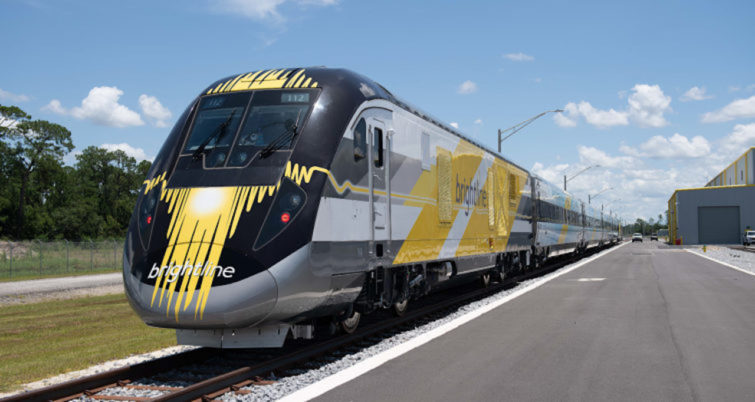
Brightline Florida, photo by David C. Lester
MIAMI –– Despite the popularity of Brightline's Florida service and eager anticipation of the opening of Brightline West, the carrier is dealing with some choppy air.
Despite booking three million trips in 2024, demonstrating the popularity of the private-sector Florida passenger railroad, Brightline Florida (BLF) lost $550 million in 2024. While the long-term impact of this loss cannot be accurately forecasted, financially, at least, last year was not a good one for the railroad. However, it’s always difficult to evaluate the true meaning of isolated financial numbers. For example, Railway Age Contributing Editor and passenger expert David Peter Alan, quoted the Palm Beach Post reporting on BLF finances, which said “According to the privately run passenger train company, [BLF] lost about $549 million in 2024, even though its revenue more than doubled compared to 2023.” The paper also said “A big chunk of that, more than $214 million, happened in May 2024, when [BLF] refinanced its debt of about $4.6 billion. [BLF] also paid $178 million in interest on its debt, [according to] its financial statement for 2024. But even without counting debt-related payments, the South Florida-Orlando train still spent more money than it made last year.”

Photograph courtesy of Brightline
In addition to this, Florida East Coast Railway (FECR) is suing BLF with claims that the passenger railroad is overselling its capacity to pursue local operations. Remember that BLF’s original operation was confined to operating on FECR tracks from Miami to Fort Lauderdale. Since the extension of the line to Orlando, the carrier operates 16 round trips between Miami and Orlando and would like to offer additional commuter service between Miami and Broward and Palm Beach Counties, which is referred to as the Coastal Link project.
Added to these challenges comes a report from Newsweek that the estimated costs of Brightline West (BLW), the line under construction between Las Vegas to Los Angeles, have risen from $16 billion to $21.5 billion. Increased material and labor costs were cited as the reason for the overall rise. This 30% increase in cost was reported in U.S. Department of Transportation documents associated with a request from BLW for a federal loan of $6 billion. Of course, it’s possible that build costs could rise even more in the future.
Brightline is the first privately operated rail passenger service to operate in the United States in decades. Observers believe that a financially and otherwise successful Brightline, both in Florida and Nevada-California, would finally demonstrate that quality passenger rail service can be operated at a profit.