It’s About More Than Counting Votes –– Commentary
Written by James Clements, Executive Vice President, Strategic Planning & Corporate Services, CPKC.


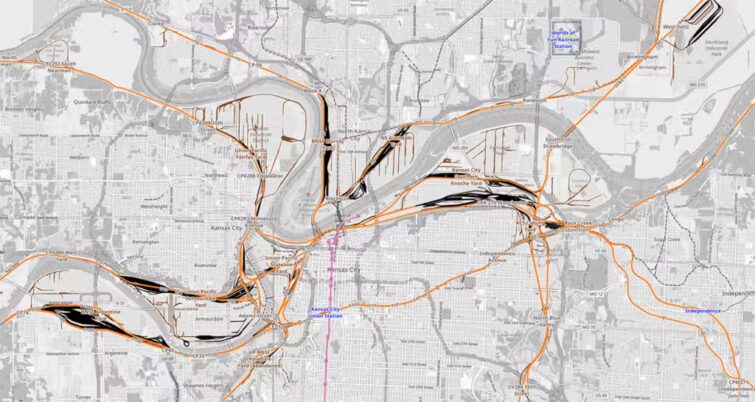
Detail of Kansas City region railroads, including KCT. Openrailwaymap.org
CALGARY –– On this, we [CPKC] agree with Union Pacific.
This may surprise many following the saga of the potential Norfolk Southern-Union Pacific merger, but CPKC whole heartily agrees that jointly owned and utilized terminal railroad facilities such as the Terminal Railroad Association of St. Louis (TRRA) and equipment pools such as TTX are absolutely vital to a well-functioning interconnected North American railroad network and must continue to operate fairly.
Giving one railroad undue control or sway over any one of these truly would be harmful to rail customers and a recipe for anticompetitive behavior. Union Pacific recognizes this and so has recently attempted to comfort the public by authoring an assurance that the neutrality and fairness of these shared rail facilities will be maintained by the resulting Union Pacific transcontinental railroad.
But like so many of the “sounds good” themes dripping out of Union Pacific over the past year trying to pump up their unnecessary and risky merger, there is more to the story.
Concerns about shared rail facilities operating with neutrality and fairness is a topic as old as railroading itself. Indeed, TRRA was a target of antitrust enforcement (and a famous Supreme Court case) in the early 1900s because it had been organized by Jay Gould, the Gilded Age Chairman of the Board at Union Pacific, to disadvantage independent railroads seeking to cross the Mississippi River.
Today, we find ourselves having this same debate, not just about one important rail gateway or equipment pool, but on a national and unprecedented scale. We are talking about a future Union Pacific with a degree of control and influence never before seen or contemplated in railroad supply chains.
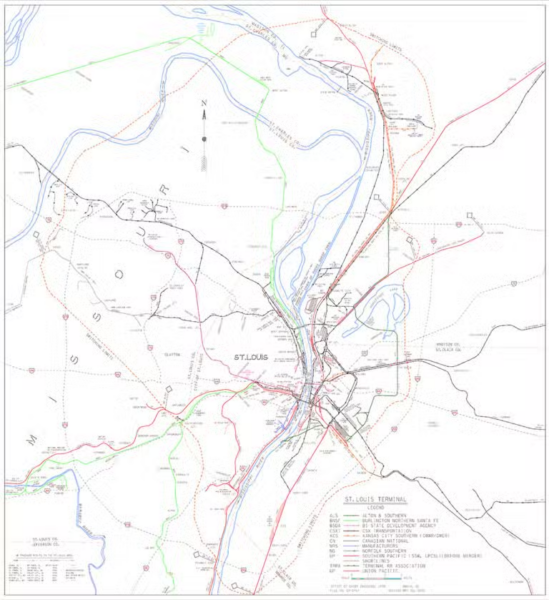
TRRA track map. Source: Office of the Chief Engineer, Union Pacific, May 2, 2002, as posted on the TRRA website
Rules about neutral and nondiscriminatory treatment —like those at TRRA, Kansas City Terminal Railway and elsewhere—are important. But those rules don’t keep owners with oversized influence from steering these railroad joint ventures to their own advantage and the disadvantage of others. The boards of these ventures make critical decisions about investments in jointly owned assets and how to deploy shared resources. The individual companies represented on those boards do not set aside their own competitive interests when participating in those decisions.
“We will give up our majorities and governance rights” in some places, at least—and there will be nothing to worry about, Union Pacific says. But boardrooms are rarely governed by simple arithmetic. Effective control can still be exerted even when an ownership stake is less than 50%. Influence comes from scale. It comes from market position. It comes from being, by far, the largest player in the room.
This isn’t crying wolf. We’ve already seen it from the existing Union Pacific time and time again.
Before the country rushes to make a bully bigger, consider what experience shows:
- At the vital Kansas City Terminal Railway (KCT), Union Pacific used its influence on the KCT board (with 5 of 12 votes) to delay an infrastructure project sought by CPKC for six months by withholding its approval and delaying KCT board action while attempting to force CPKC to transfer control of a critical bridge used by CPKC to UP.
- Across the parts of CPKC’s network where it shares facilities with Union Pacific, UP has used its control of capacity investments to hold up work needed to support CPKC’s traffic growth, while UP took advantage of other routes bypassing the track used by CPKC.
Looking ahead, consider this: The Union Pacific takeover of Norfolk Southern will give UP new influence over the Indiana Harbor Belt (IHB), a key joint facility in the vital Chicago gateway. Through NS’s ownership of Conrail, NS has an effective veto over investment decisions by IHB. Under UP control, NS would have new incentives to use that veto to hold back efforts by CPKC and other railroads to improve their own routes across Chicago while UP worked to develop its separate through route connecting the UP and NS networks.
Like every railroad, Union Pacific has a duty to act in the best interests of its shareholders. No one should fault UP for that. But as we have said since the beginning of this, what’s good for UP isn’t the only thing at stake.
After waves of consolidation, the 21st century has brought the North American railroad industry to a place of balance. A combined UP-NS destroys that balance and places future railroad competition under the thumb of a dominant transcontinental system.
CPKC and others experience this competition-squeezing weight already. Regardless of voting rights at this terminal or that equipment pool, a Union Pacific transcontinental would place its full hand on the scale from South Texas to New Jersey, from Long Beach to Atlanta, from Seattle to North Carolina, and everywhere else across the nation.
Of course, no one is going to feel sad for other Class I railroads. But the games this behemoth of a railroad can play to stifle competition and control the market won’t stop with who controls this switching yard or gets to build that bridge. The question is whether any one railroad should become so large, so influential and so strategically positioned that the balance that has protected these shared assets for decades begins to disappear.
As they disappear, choices and competition for U.S. businesses disappear with them.
Union Pacific’s position in the industry is already so dominant that UP executives have a hard time understanding anyone’s perspective that conflicts with their own. UP Chief Marketing Officer Kenny Rocker recently wrote he couldn’t understand why UP’s customers weren’t lining up to support the merger proposal. He believed that they all went away “reassured” after meeting with him, so to him the only explanation was that they were intimidated by the fear of “backlash” from other railroads if they spoke their mind.
This is Union Pacific failing to comprehend how fearful its own customers are of the giant the proposed merger would create, and the repercussions from UP they would face if they truly did speak their mind.
All this is what makes this irreversible decision so critical.
Since UP and NS announced their merger proposal, we have encouraged rail customers and all stakeholders to get involved and make their voices heard. It’s up to all of us. It is every stakeholder’s individual choice. Don’t let this decision be made without your voice being heard.